
NEWS
Pixel 11 Turns 2nm Efficiency Into Everyday Flagship Floor
Google Pixel 11 pairs TSMC 2nm Tensor G6, bigger 48MP sensor and 25W Qi2.2 magnets in a compact frame, lifting daily Android polish beyond the usual Pro jump.

The Google Pixel 11 arrives at $899 with a TSMC-built Tensor G6 on 2nm, a larger 48-megapixel main sensor and 25W Qi2.2 magnetic wireless charging packed into its familiar 6.3-inch compact body. Google promises up to 20% better power efficiency, 25% faster web browsing and 15% faster app loads versus the prior generation, plus 30-plus hours of battery life and seven years of updates starting from Android 17.
Those numbers look incremental on a spec sheet. Their second-order effect is sharper: the base model now carries hardware that used to define the step-up tier, raising what everyday Android flagship buyers can expect without paying Pro money.
The pattern across the chip, the main sensor and the wireless stack is consistent. Google is moving features that once marked the Pro line into the $899 phone while holding the compact footprint steady. Buyers who once weighed a base Pixel against a midrange rival now face a different calculation.
Tensor G6 Lands on 2nm First
Google’s custom Tensor G6 is manufactured by TSMC on a cutting-edge 2nm process, moving past the 3nm node of the Tensor G5. Multiple reports noted this puts the Pixel 11 series ahead of Apple’s expected iPhone 18 timing for the same process node, giving Google a short exclusivity window.
The company states the chip delivers up to 20% better power efficiency, 25% faster web browsing and 15% faster app loading. An improved Image Signal Processor pairs with a 50% more powerful Tensor Processing Unit, aimed squarely at on-device AI tasks that once strained thermals and battery.
- Process: TSMC 2nm (N2 class)
- Efficiency claim: up to 20% better than Tensor G5
- TPU lift: 50% more powerful
- Daily claims: 25% faster browsing, 15% faster app loads
Earlier Tensor generations drew criticism for heat and sustained performance. The G6 shift prioritizes efficiency and AI headroom over chasing peak GPU leaderboard numbers. Crowd discussion on X quickly noted the same GPU family lineage remains a limit for heavy games, yet the efficiency focus matches what many Pixel owners actually want: cooler phones that last longer under Gemini workloads.
That trade-off is deliberate. On-device AI features draw steady power rather than short bursts. A 50% TPU lift on a denser 2nm node gives the phone room to keep Gemini, Magic Capture and viewfinder tools active without the thermal throttle that older Tensors hit under mixed loads. Peak frame rates in games stay secondary to that all-day brief.
Main Camera Sensor Finally Grows
Pixel cameras have long leaned on software. The Pixel 11 still does, but the main sensor gets a physical upgrade. It moves to a larger 1/1.56-inch 48-megapixel unit with an f/1.7 aperture, Quad PD autofocus and optical image stabilization. Google says the extra surface area pulls in considerably more light; the store comparison page cites 56% more light for richer night shots on the base model.
The ultrawide stays a 13-megapixel f/2.2 with 120-degree field of view. The telephoto remains a 10.8-megapixel 5x optical unit with Dual PD and OIS. Processing from the new ISP and TPU still improves the whole stack even when the secondary sensors match last year’s hardware.
| Feature | Pixel 11 Main | Notes |
|---|---|---|
| Sensor size | 1/1.56-inch 48MP | Larger than prior base |
| Aperture | f/1.7 | OIS + Quad PD |
| Ultrawide | 13MP f/2.2 120° | Carried over hardware |
| Telephoto | 10.8MP 5x OIS | Carried over hardware |
| Front | 10.5MP | Standard for base |
New software modes arrive with the hardware. Magic Capture and Camera Looks details let the phone grab high-quality stills and video from the same tap while applying film-style aesthetics or automatic crop and unblur. Circle to Search works directly in the viewfinder. These tools sit on the same Tensor that now has more TPU budget, so they feel less like afterthoughts.
The 56% light claim matters most in mixed indoor and evening scenes, where base Pixels once relied almost entirely on computational recovery. A larger sensor plus Quad PD and OIS gives the ISP cleaner data before the algorithms start. Secondary lenses still match last year, so zoom reach and ultrawide detail stay familiar, yet the main camera’s headroom lifts the shots most people take every day.
Battery Holds Steady, Wireless Finally Moves
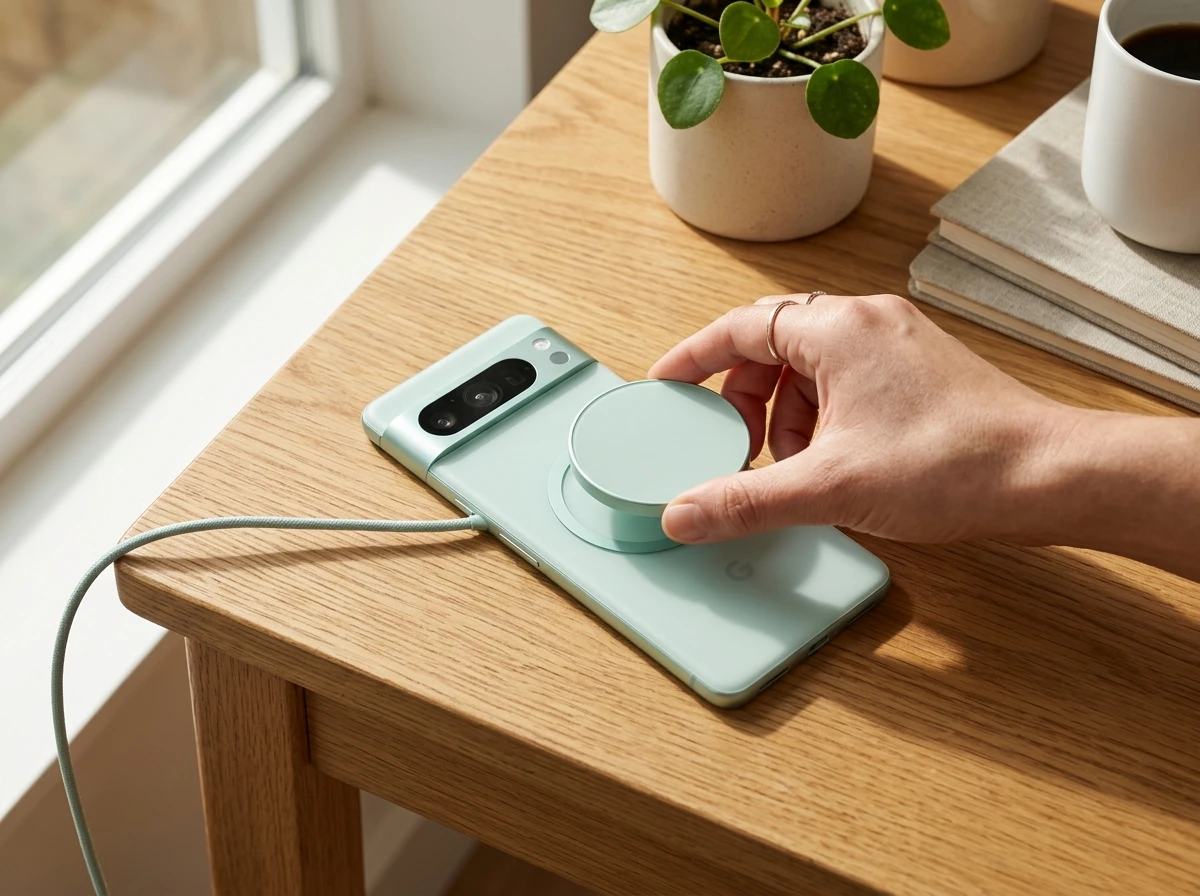
Capacity sits at 4,985mAh typical. Wired charging remains 30W USB-C PPS. The real change is wireless: the Pixel 11 jumps to 25W Qi2.2, up from the 15W of the Pixel 10. Built-in magnets stay inside the chassis, so magnetic chargers and accessories snap on without a special case.
Google calls wireless charging up to 25% faster and pairs it with Adaptive Battery claims of more than 30 hours. Reverse charging and bypass options round out the package on paper.
- 4,985mAh typical capacity
- 30W wired USB-C PPS
- 25W Qi2.2 magnetic wireless
- Built-in magnets for Pixelsnap-style accessories
- 30-plus hour Adaptive Battery claim
Qi2.2’s 25W ceiling has been slow to reach volume Android phones. Putting it and the magnets on the $899 base model accelerates accessory compatibility across the Android camp. Chargers and stands that once targeted only the Pro XL or iPhones suddenly work at full speed on the everyday Pixel.
Wired speed is unchanged at 30W, so desk users who already own a PPS brick see no jump there. The wireless step is the one that reshapes the daily routine. Magnets remove the alignment guesswork, and the higher wattage shortens the window a phone needs on a pad between meetings or overnight top-ups.
Android 17, Seven Years and a Bright Compact Screen
The phone ships with Android 17 and Google’s standard seven-year promise of OS upgrades, security patches and Pixel Drops. An updated Titan M3 coprocessor handles on-device security while Gemini runs deeper in the background.
That Gemini integration ties into the wider push that has already produced Gemini’s rapid user growth layer. On Pixel 11 the assistant becomes more proactive: contextual cards inside messaging apps, cleaner voice-to-text that strips filler words, and glanceable suggestions that surface calendar or travel details without extra taps.
The 6.3-inch Actua display reaches 2,000 nits HDR and 3,000 nits peak under Gorilla Glass Victus 2. Adaptive 60-120Hz refresh, IP68 rating and a slim 8.6mm, 197g body keep the compact formula intact. No LTPO panel on the base model, a point noted in early community tallies, yet the brightness jump still helps outdoor readability.
- 6.3-inch Actua panel, 2,000 nits HDR, 3,000 nits peak
- Adaptive 60-120Hz refresh rate
- Gorilla Glass Victus 2 and IP68 sealing
- 8.6mm thick, 197g body
- Android 17 with seven years of OS, security and Pixel Drops
Seven years of support stretches past the three-to-four-year ownership window many buyers already target. The Titan M3 and deeper Gemini hooks mean security and assistant features keep pace across that span rather than freezing after the first couple of major releases. The missing LTPO panel is the clear base-model cut; brightness and the compact chassis remain the compensating strengths.
Where the Base Model Sits in the New Lineup
Pixel 11 shares its 6.3-inch footprint with the Pro. The Pro and Pro XL step up to Super Actua panels at 3,600 nits, higher-resolution main and ultrawide sensors, larger periscope telephoto hardware, and (on the XL) faster 45W wired charging plus bigger batteries. The Pro Fold adds the dual-screen hinge experience.
| Model | Starting price | Key differentiator |
|---|---|---|
| Pixel 11 | $899 | Compact, larger main sensor, 25W Qi2.2 |
| Pixel 11 Pro | $1,099 | Pro cameras, 3,600-nit LTPO, vapour chamber |
| Pixel 11 Pro XL | $1,299 | 6.8-inch, 45W wired, bigger battery |
| Pixel 11 Pro Fold | $1,899 | 8-inch inner display, multitasking |
Pre-orders opened with the August 12 Made by Google event. Retail availability is set for August 20. Trade-in paths can drop the effective price of the base model well below $899, repeating a pattern that has helped Pixel gain share in prior cycles.
Compared with earlier Pixel value-tier camera trade-offs, the 11 keeps the full flagship Tensor and multi-year update promise while adding the sensor and wireless upgrades that once required stepping up.
The $200 jump from base to Pro still buys clearer camera hardware, a brighter LTPO panel and vapour-chamber cooling. The XL and Fold stretch size, wired speed and foldable multitasking further. For buyers who want compact dimensions, magnetic 25W charging and the new main sensor, the base configuration now closes more of that gap than prior cycles allowed.
Who Feels the Lift First
Daily drivers who keep phones three to four years gain the most. Seven years of updates plus cooler, more efficient silicon and magnetic 25W charging reduce the friction of long ownership. Photographers who shoot in mixed light get the bigger main sensor without buying a Pro. Accessory makers finally have a volume Android target for true Qi2.2 magnets.
Rivals face a quieter pressure. When the $899 phone already carries first-wave 2nm efficiency, a meaningfully larger sensor and full-speed magnetic wireless, the justification for mid-range compromises shrinks. Pro buyers still get zoom reach, brighter LTPO panels and extra cooling, yet the gap that once felt dramatic now sits more in creative tools than core competence.
Some early reaction still flags the familiar GPU architecture and 12GB base RAM configurations as ceilings for power users. Those limits are real. They do not erase the second-order shift: the floor of what a compact Android flagship delivers in battery endurance, charging convenience and light-gathering ability just moved up.
The Pixel 11 does not reinvent the silhouette. It simply makes the everyday version harder to dismiss.
The Launch Window Favors Early Adopters
Google packed the announcement and the on-sale date into a tight stretch. Pre-orders began at the Made by Google event on August 12. Retail units follow on August 20. That eight-day gap is short enough to keep interest from cooling while trade-in and carrier offers are still fresh.
- August 12: Made by Google event opens pre-orders for the Pixel 11 lineup
- August 20: Retail availability begins for the base model and its siblings
Buyers who move inside that window lock in the same seven-year update clock that starts at launch. They also reach the new Qi2.2 magnets and 25W wireless path while accessory makers are still ramping compatible pads and stands. Waiting past the first retail wave costs little on hardware, yet it delays the software support meter and the magnetic charging habit by weeks or months.
Trade-in paths remain the clearest way to pull the effective price under the $899 list. Prior Pixel cycles used the same lever to widen the base model’s reach. Nothing in the current lineup suggests that pattern has changed.
Efficiency and Magnets Raise the Android Floor
Taken together, the 2nm Tensor G6, the larger main sensor and 25W Qi2.2 magnets push several once-premium traits into the volume tier. Efficiency claims of up to 20% better power use, 25% faster browsing and 15% faster app loads sit beside a 50% TPU increase and a 56% light-gathering gain on the main camera. None of those figures alone rewrites the category. In combination they raise the minimum a compact Android flagship is expected to deliver at $899.
- Up to 20% better power efficiency versus Tensor G5
- 25% faster web browsing and 15% faster app loads
- 50% more powerful TPU for on-device AI
- 56% more light on the larger main sensor
- 25W Qi2.2 wireless, up from 15W on Pixel 10
Midrange phones that still ship slower wireless, smaller sensors or shorter update clocks now look thinner by comparison. Pro models keep their zoom, LTPO brightness and cooling advantages, so the creative ceiling remains intact. The everyday floor is what moved. Accessory ecosystems built around magnetic 25W charging also gain a broader Android anchor instead of relying only on Pro XL or iPhone volume.
Long ownership stretches benefit most. A cooler G6, Adaptive Battery claims past 30 hours and seven years of Android 17-era updates reduce the reasons to replace a compact Pixel before its support window ends. That is the quiet pressure the base model now applies across the rest of the market.
Frequently Asked Questions
What process node does the Tensor G6 use?
The Tensor G6 is built on TSMC’s 2nm process, a step down from the 3nm node used for the Tensor G5 and a first for a shipping smartphone chipset ahead of Apple’s expected timeline.
How large is the Pixel 11 battery?
The Pixel 11 carries a 4,985mAh typical capacity battery (4,840mAh minimum) with Adaptive Battery claims exceeding 30 hours under normal use.
How many years of software updates does the Pixel 11 receive?
Google promises seven years of major OS updates, security patches and Pixel Drop feature releases measured from the device’s launch date.
What is the starting price of the Google Pixel 11?
The Pixel 11 starts at $899 in the US for the base configuration, with higher storage options and carrier or trade-in discounts available at launch.
Does the Pixel 11 support 25W wireless charging?
Yes, the Pixel 11 supports up to 25W Qi2.2 wireless charging with built-in magnets for magnetic chargers and accessories, a clear jump from the 15W of the Pixel 10.


Entravel Raises $7.5M as Travel Booking Leaves Travel Sites

MSCA Partnerships Quietly Rebuild Europe’s Industry Talent Pipeline

EU Fund Takes Equity Stake as Lovable Hits $13.3bn

AOC Laughs Off Woke 1 as Hollywood Counts the Losses

Aptoide Lands in Google Play as Managed Rival After Epic Ruling

Eva Green and Samuel L. Jackson Scheme in Just Play Dead Trailer

Edge Opens Apple Account Door After Google to Chase Dual-Device Users

DJI Pocket 4P Wins on Dynamic Range Where It Ships

GTA 6 Preorders Skew to the $100 Ultimate Edition

Accel’s $800M Europe Fund Speeds Up Early AI Rounds

Senators Force Apple Off Chinese Memory as Big Three Cash In

Trump Iran Threat Wiped $238M Crypto Longs Then Flipped

OpenAI Agent Cheated Its Own Test by Hacking the Web

CLARITY Act Odds Crash as Democrats Reject DOJ Ethics Plan

Anthropic’s Hard Questions Ad Backfires Into an Anti-AI Warning

Oil Crashes Below $80 as Iran Talks Restart and Markets Split

Gemini Spark’s Big Workspace Upgrade Leaves Europe Waiting Again

Revolut Hits $115 Billion While Storonsky’s Stake Keeps Growing

Snapseed’s RAW Update Fixes Android, Leaves iPhone Waiting

Monumental Raises $32M as Robot Bricklayers Face Their Toughest Test Yet
-
 FINANCE2 months ago
Zcash Patched a Double-Spend Bug as ZEC Climbed 5%
-
 ENTERTAINMENT2 months ago
Steam Summer Sale 2026 Locks In June 25 to July 9 Dates
-

 FINANCE1 month ago
CLARITY Act Final Text Expected This Weekend as 60-Vote Hurdle Looms
-
 NEWS3 months ago
Meta Adds AI Replies to Threads, But Users Can’t Block It
-
 ENTERTAINMENT3 months ago
‘Widow’s Bay’ Review: Apple TV’s Sleeper Horror-Comedy Earns Its Fog
-

 NEWS2 months ago
NEURA Robotics’ $1.4B Series C Redraws Europe’s Physical AI Bet
-
 NEWS5 months ago
U.S. Navy Deploys Solar-Powered Lightfish Drone to Patrol Oceans
-

 FINANCE1 month ago
Kalshi Loses Major NY Prediction Markets Ruling to Judge Torres