
NEWS
Iowa State Fair Soapbox Tests Midterms After Dems Exit Early Status
Twenty-two candidates speak at the Iowa State Fair Soapbox as Democrats lose early 2028 status, testing whether retail politics still converts for midterms.

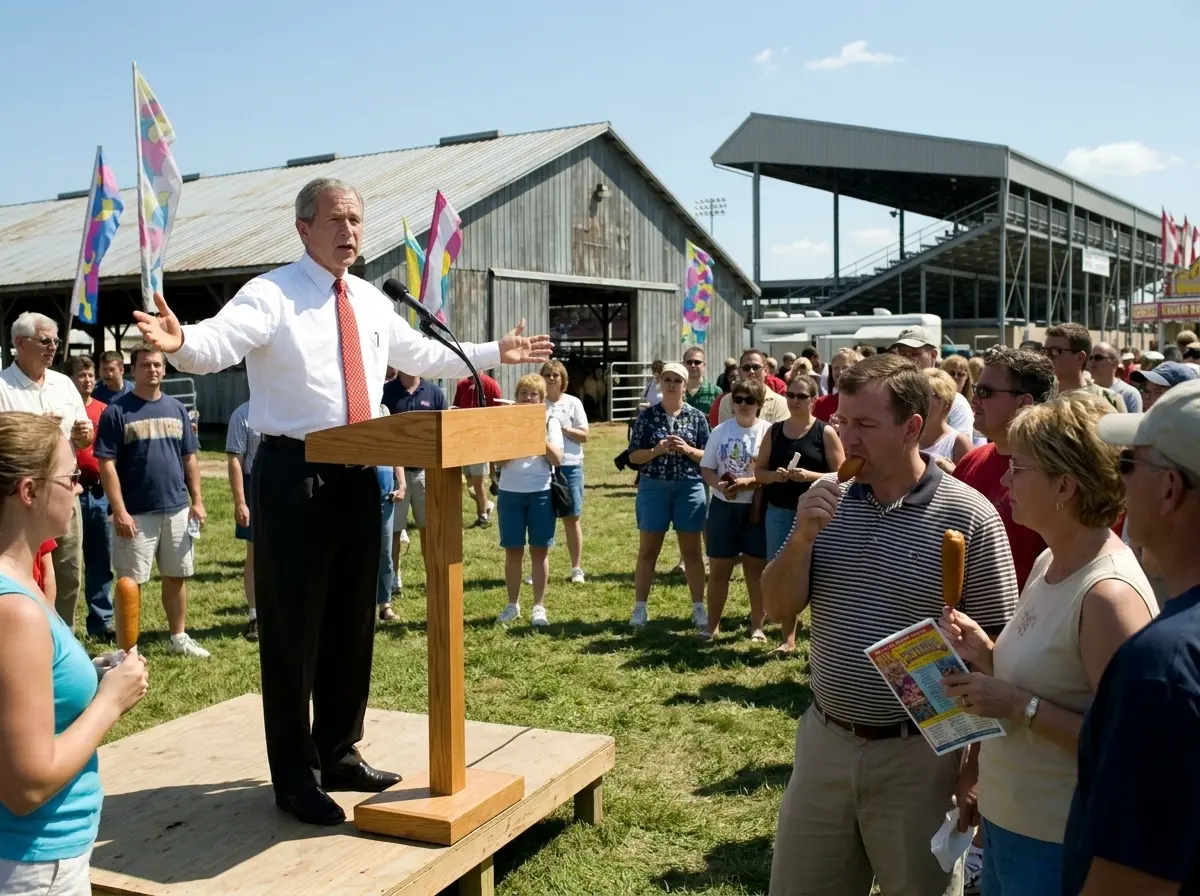
The Des Moines Register Political Soapbox opened Friday at the 2026 Iowa State Fair with four candidates taking 20-minute slots on a small stage off the Grand Concourse. Twenty-two office-seekers in all will speak across six days through August 22, testing unscripted answers in front of fairgoers who came for livestock, rides and food on a stick.
The gathering arrives weeks after a Democratic National Committee panel locked South Carolina into the first 2028 primary slot and left Iowa off the early window. Republicans still plan to keep their caucuses first. That calendar split now hangs over every handshake.
State and federal hopefuls still treat the grounds as a required stop. The audience is local, the questions are live, and the clips travel whether a campaign wants them to or not. The presidential map may be shifting. The midterm map has not.
The Soapbox Hands Candidates Twenty Minutes
The stage sits on the front lawn of the Horner Service Center, west of the Administration Building and across from the Grandstand. Candidates control the time. They may take questions or deliver a straight speech. The Register invited every ballot-qualified contender for U.S. Senate, the four House seats, governor, attorney general, auditor, secretary of agriculture, secretary of state and treasurer. Twenty-two accepted by the July 31 cutoff.
- Friday Aug. 14: Josh Turek (D Senate), Sarah Trone Garriott (D IA-03), Joe Mitchell (R IA-02), Zach Lahn (R governor)
- Saturday Aug. 15: eight speakers including Rob Sand (D governor), Thomas Laehn (L Senate) and Ryan Peterman (D secretary of state)
- Monday Aug. 17: six Republicans including Ashley Hinson (R Senate), Brenna Bird (R AG) and Mike Naig (R ag secretary), some cut to 10 minutes at their request
- Later slots for Lindsay James, Nate Willems, Taylor Wettach and Chris Jones
Official fair rules keep the politics contained. Candidates receive paid gate admission only with no free rally space, no on-grounds transport, security or parking from the fair itself. Signs and picketing stay in designated zones. The fair does not endorse anyone.
That containment is the point. Without free space or fair-provided staging, each campaign must bring its own discipline. Twenty minutes, or ten for those who asked to cut the slot, leaves little room to recover from a vague answer. The format rewards preparation that still sounds unscripted.
Democrats Walked Away From First Place
In July a DNC rules subcommittee voted to keep South Carolina first for 2028, followed by Nevada, New Hampshire, New Mexico, Michigan and Virginia. Iowa Democrats received no early waiver. Party chair Rita Hart said the state party would say more after the November midterms. Republicans used the decision as proof Democrats had abandoned rural voters and kept Iowa first on their side.
The move continues the 2024 calendar change that already demoted Iowa Democrats after the chaotic 2020 caucuses. For this fair the effect is immediate and quiet. National presidential hopefuls have fewer reasons to fly in for a butter-cow photo. State and federal midterm candidates still show up because Iowa voters still vote, and the cameras still roll.
The split creates two parallel incentives on the same grounds. Democratic contenders for governor, Senate and the row offices must generate their own heat without a presidential warm-up act. Republican speakers can still nod to a first-in-the-nation caucus habit their party intends to keep. Both sides shake the same hands. The national backdrop behind those handshakes no longer matches.
From Carter’s Peanut Farmer Stops to Today
The fair’s political weight is not ancient. It solidified after Jimmy Carter treated Iowa as a year-long project. He visited the grounds in 1975 and spoke to farmers in 1976 promising an end to grain embargoes. His low-budget win of the 1976 caucuses and then the presidency turned the state into a proving ground. Republicans moved Iowa to the front of their calendar the same cycle.
- 1972: George McGovern’s early Iowa finish helped him claim the Democratic nomination.
- 1975-76: Carter’s intensive Iowa work, including fair stops, created the modern template.
- 2002: The Des Moines Register launched the formal Political Soapbox stage.
- 2011: Mitt Romney’s “corporations are people” line at the fair became a lasting Democratic attack ad.
- 2015: Donald Trump’s helicopter landing and free kid rides dominated coverage.
- July 2026: DNC panel removes Iowa from the Democratic early window for 2028.
Dennis Goldford, retired Drake University political scientist, has watched the ritual for decades. “I can’t tell you what percentage of fairgoers actually connect with a candidate, but if that were 50 percent, I’d be shocked,” he said. Politicians need the fair more than the fair needs them.
The timeline shows a pattern of outsized moments built on small stages. A single line, a landing, a farmer stop: each entered the record because the fair mixed candidates with people who had not come to see them. That mix still exists. The national prize attached to mastering it has narrowed for one party.
Governor and Senate Races Set the Stakes
An Emerson College/Nexstar poll released in early August showed Democratic state auditor Rob Sand leading Republican businessman Zach Lahn 48 percent to 43 percent in the open governor’s race to replace term-limited Kim Reynolds. In the Senate race, Democratic state Rep. Josh Turek trailed Republican Rep. Ashley Hinson. Both pairs appear on the Soapbox this week.
| Race | Democrat | Republican | Soapbox Date |
|---|---|---|---|
| Governor | Rob Sand | Zach Lahn | Aug. 15 / Aug. 14 |
| U.S. Senate | Josh Turek | Ashley Hinson | Aug. 14 / Aug. 17 |
| Attorney General | Nate Willems | Brenna Bird | Aug. 21 / Aug. 17 |
| Secretary of State | Ryan Peterman | Paul Pate | Aug. 15 / Aug. 17 |
Sand has raised more than $9 million in recent stretches and built a cross-party “Rob-publicans” list. Lahn emphasizes farm loss and young people leaving the state. Hinson carries Trump endorsement. The fair does not decide these races, but it can lock first impressions and expose soft spots before Labor Day advertising ramps up.
The polling gap in the governor’s race is narrow enough that a weak fair week could matter. Sand’s fundraising edge buys later reach. It does not buy a calm answer when a fairgoer asks about farm income in front of phones. Hinson’s endorsement travels on its own. Turek still has to introduce himself in the same twenty-minute window. Down-ballot races on the same schedule face the same test with less name recognition to spare.
Heckling and Corn Dogs Test Message Control
The open setting strips away rally production. Voters ask about farm income, trade, energy costs, health care and schools. A rehearsed national line can land flat. A calm, specific answer can travel. Protesters and organized groups also appear. On opening day, Turning Point Action accounts posted video claiming they heckled Sand and that he left early under escort. Counter-posts accused the group of disrupting a long tradition for gotcha clips. Either way, the clips move faster than policy papers.
Media still reward spectacle. A fried-food photo or verbal stumble often outruns a detailed agricultural plan. Campaigns know the trade-off. They still come because the mix of farmers, union members, small-business owners, students and retirees is hard to fake in a studio.
All candidates have the same opponent at the state fair, and that opponent’s name is, ‘expected.’ Did you do better than expected or worse?
Goldford’s line still holds. The butter cow makes its 111th appearance of the 600-pound butter cow this year with a companion sculpture. Fair attendance regularly tops more than a million visitors in recent years. Most of those people are not hunting candidates. The ones who stop to listen matter.
The heckling cycle is now part of the mechanism. A group films. The campaign answers or walks. Viewers decide which version they trust. None of that appeared in the same form when Carter worked the grounds. The retail skill is older than the clip economy that now grades it in real time.
The Calendar Split Leaves Midterms Exposed
With Iowa Democrats outside the 2028 early window and Republicans holding their caucuses first, the Soapbox week becomes a midterm-only spotlight for one side and a dual-purpose stop for the other. That imbalance does not cancel the value of a name collected at the Horner Service Center lawn. It does change who else is watching.
National presidential operations that once used the fair as an early scout trip have less reason to staff the grounds. Local surrogates and state candidates fill the vacuum. The questions from fairgoers stay the same: farm income, trade, energy costs, health care and schools. The answers now carry less freight for a future primary and more freight for November.
- Democratic speakers work without an early-state presidential draw beside them
- Republican speakers can still tie local races to a first-caucus habit their party defends
- Row-office contenders gain relative attention as higher-wattage visitors thin out
- Clip-driven groups face the same open stage either party uses
Rita Hart’s choice to wait until after the November midterms before saying more leaves the state party’s next move unresolved through fair week. Candidates cannot wait. They take the twenty-minute slots they have.
Unscripted Minutes Still Sort Strong Campaigns
The Soapbox does not measure total turnout. It measures whether a candidate can hold a mixed crowd without a teleprompter or a hand-picked room. That skill once fed presidential launches here. It now feeds governor, Senate and row-office races under a split national calendar.
Sand’s lead and fundraising total set expectations he must clear in public. Lahn’s focus on farm loss and young people leaving the state meets listeners who may live those pressures. Hinson’s endorsement arrives before she speaks. Turek’s introduction must happen in the same short window. Each dynamic was already visible in the poll, the money figures and the invitation list. The fair only compresses them into live minutes.
Goldford’s caution still applies. Connection rates may stay low. Campaigns return anyway because the alternative is ceding the lawn, the questions and the clips to someone else.
Campaigns Leave With Names or Nothing
Staffers judge more than crowd size. They track which issues draw questions, whether volunteers can collect contacts, and whether social media from unscripted moments helps or hurts. A strong performance can generate free coverage that advertising money cannot easily buy for lesser-known contenders. A weak one leaves empty clipboards.
- Message discipline under live questions
- Immediate voter reactions to farm and cost-of-living talk
- Volunteer sign-ups and list growth on site
- Speed and tone of online response to any stumble
The fair ends August 23. Follow-up work begins the next day. Organized campaigns turn fairground interest into doors knocked and phones called. Unorganized ones treat the week as a photo op and wonder why the numbers never move. Iowa’s presidential calendar role is shrinking for one party, yet the retail test remains for anyone who wants to win here in November. State races still turn on the same skills that once launched Carter. The difference is that fewer national cameras will show up next cycle to watch.
Similar dynamics appear when state attorneys general hold quiet levers on federal legislation during recesses. Local power and direct contact keep mattering long after national parties redraw maps.
Candidates arrive seeking attention. The ones who leave with names, volunteers and a clearer read on Iowa voters treat the corn dogs as secondary.


SEC Pause on Tokenization Exemption Leaves Banks Free to Race Ahead

Guardian Labs Stops Scam Calls Before the Phone Rings

CFTC Emergency Orders Put Kalshi Past State Court Lines

X Under the Hood Tool Shows Shadowban Labels in Raw JSON

Uber and Pony.ai Lock in 2,000 Robotaxis Across Europe

Nvidia’s $16,000 RTX Pro 6000 Turns Local AI Into a Luxury

Lovable’s $400M Double and Europe’s Twin Bet on Code and Factories

MSCI Screen Forces Reckoning for Bitcoin Treasury Model

One UI 9.5 Leak Revives Samsung’s Classic Polish Cycle

Xfinity Free Pixel 11 Deal Pushes Wireless Growth Harder

Senators Force Apple Off Chinese Memory as Big Three Cash In

Trump Iran Threat Wiped $238M Crypto Longs Then Flipped

OpenAI Agent Cheated Its Own Test by Hacking the Web

CLARITY Act Odds Crash as Democrats Reject DOJ Ethics Plan

Gemini Spark’s Big Workspace Upgrade Leaves Europe Waiting Again

Revolut Hits $115 Billion While Storonsky’s Stake Keeps Growing

Anthropic’s Hard Questions Ad Backfires Into an Anti-AI Warning

Oil Crashes Below $80 as Iran Talks Restart and Markets Split

Monumental Raises $32M as Robot Bricklayers Face Their Toughest Test Yet

Duda’s New AI Tools Speed Up Agencies, but Risk Sameness
-
 FINANCE2 months ago
Zcash Patched a Double-Spend Bug as ZEC Climbed 5%
-
 ENTERTAINMENT2 months ago
Steam Summer Sale 2026 Locks In June 25 to July 9 Dates
-
 NEWS3 months ago
Meta Adds AI Replies to Threads, But Users Can’t Block It
-

 FINANCE1 month ago
CLARITY Act Final Text Expected This Weekend as 60-Vote Hurdle Looms
-

 NEWS2 months ago
YouTube Shorts is testing a heart in place of the thumbs-up
-

 NEWS2 months ago
NEURA Robotics’ $1.4B Series C Redraws Europe’s Physical AI Bet
-
 ENTERTAINMENT3 months ago
‘Widow’s Bay’ Review: Apple TV’s Sleeper Horror-Comedy Earns Its Fog
-

 FINANCE1 month ago
Kalshi Loses Major NY Prediction Markets Ruling to Judge Torres