
NEWS
Twitch AI Opt-Out Arrives With a Confession Nobody Would Join
Twitch enabled Amazon generative AI training on every channel by default then added an opt-out, with its CPO admitting nobody would choose it freely.

Twitch enabled a “Training for Generative AI” toggle by default for every account on August 12, 2026, folding streams, VODs, clips, chats and channel pages into Amazon’s generative models unless creators hunt it down and switch it off. No email, no pop-up, no advance notice. Content creator and streaming reporter Zach Bussey spotted the buried control first and posted screenshots that racked up millions of views within hours.
The platform then held a Patch Notes livestream to face nearly 3,000 viewers. What followed was less a privacy update than a corporate admission that free-choice consent would have produced near-zero participation.
The Setting Appeared Without Warning
Twitch Support framed the change as adding choice. Its official Twitch Support announcement read: “We’ve added a setting that lets you opt out of having your channel content used to train generative AI content models across Amazon.” The reality on the ground was the opposite of a soft launch. Every channel started enrolled.
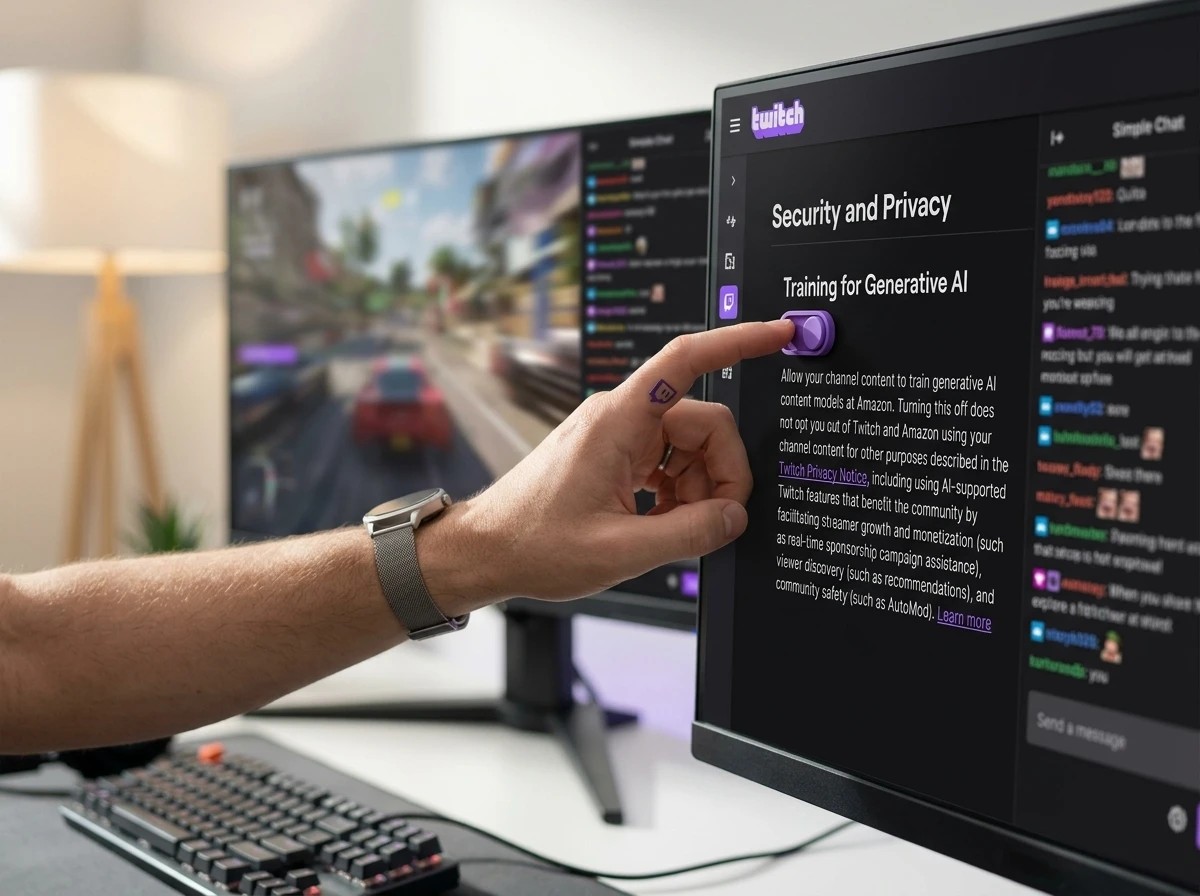
The control sits at the bottom of the Security and Privacy section in ordinary account settings, not the creator dashboard. Creators must open the Security and Privacy settings page, scroll past the usual privacy options, and flip “Training for Generative AI” from its default on position to off.
- Open your profile picture menu and choose Settings.
- Select the Security and Privacy tab.
- Scroll to the Privacy section and find “Training for Generative AI.”
- Toggle it off to block future use of your own channel’s streams, VODs, clips, stream chats, and channel page images and text.
The Twitch account settings support page confirms the scope and the future-only language. Other Amazon AI features already running on the platform stay active either way.
Why Default Enrollment Was Non-Negotiable
On the August 12 Patch Notes stream, Chief Product Officer Mike Minton faced a chat spamming demands for opt-in instead. He gave the answer that defined the entire episode.
If this was opt-in, nobody would opt in. That’s honestly the answer.
Minton, formerly chief monetization officer, said it plainly while Head of Community Mary Kish sat beside him. Kish had already told the audience, “We don’t expect you to be happy or excited about this.” The honesty landed harder than any polished talking point. Chat flooded with all-caps replies that if no one would volunteer, the company should not run the program at all.
Minton also noted that public streams already get scraped by outside models from OpenAI to Anthropic with zero consent machinery. The distinction Twitch tried to draw was that it at least offered a toggle. Creators heard something else: the data is too valuable to leave to actual choice.
What the Toggle Covers
Twitch’s documentation lists exactly what future training can pull when the setting stays on.
| Content type | Covered by the opt-out | Notes |
|---|---|---|
| Live streams and VODs | Yes | Audio and video feed Amazon models that generate or synthesize media |
| Clips | Yes | Same generative pipeline |
| Stream chat on your own channel | Yes | Text used for training |
| Channel page images and text | Yes | Panels, about section, branding |
| Automated captions, recommendations, AutoMod, sponsorship tools, ad selection | No | These keep running; they do not store content for new generative models |
| Safety and security AI systems | No separate opt-out | Twitch says disabling them would weaken protections for everyone |
An example in the docs: audio from a stream can refine speech-to-text models that improve captions on Twitch and across other Amazon products. The generative models themselves are the target of the new toggle. Everything else stays on the old path.
Chat Leakage and the Past-Data Blind Spot
The opt-out stops at the channel border. If you turn it off and then type in someone else’s stream who left the default on, that chat message remains fair game under the host’s settings. Replies under Zach Bussey’s original post hammered this point immediately. One widely shared note said everyone needs to opt out or the network effect still pulls outsider messages into the pool.
Twitch has no public dashboard that shows which channels remain enrolled. Minton called a related question about collaborative streams “a good question” and offered no fix. Past training sits outside the new control entirely. Documentation speaks only of future use. When a viewer asked whether their videos had already fed models, Minton replied that he did not know what Amazon had or had not used.
Key limits in plain terms:
- Own channel only, your messages elsewhere follow the host’s choice.
- Future training only, no rollback or deletion language for prior ingestion.
- No visibility tool, creators cannot audit which peers stay opted in.
- Safety AI untouched, AutoMod and related systems ignore the toggle.
Amazon bought Twitch in 2014. That gives the parent company more than a decade of gameplay footage, real-time conversation, faces and voices. The company has never published a start date for generative training on that archive.
Creators Found the Toggle First
Zach Bussey’s Zach Bussey screenshot post that spread carried the news before most official channels. It drew more than 21,000 likes and 7.6 million views. The attached images showed the exact default-on state. Streamers who rarely check security menus suddenly flooded settings pages. Many noted the irony of endless push notifications for drops and new follows while this change arrived in silence.
Crowd reaction on X and in the Patch Notes chat treated the Minton quote as the story, not a side note. The line confirmed what creators already suspected about value extraction: platforms harvest first and retrofit consent later. Some compared it to Meta’s public-content training rules, where only private accounts or certain regions get meaningful exit ramps. Others simply posted step-by-step guides and urged every chatter to flip the switch so their words stop traveling with opted-in hosts.
Twitch Support later clarified that Twitch itself is not training generative models on streamer content; Amazon is. Community notes under the post quickly pointed out that Twitch is an Amazon subsidiary, rendering the distinction thin for most readers.
Amazon Already Confirmed the Pipeline in 2024
This week’s toggle did not invent the practice. At a 2024 industry event hosted by The Information, Mike Minton, then chief monetization officer, was asked whether Amazon uses Twitch content to train AI. His answer: “Yeah, for sure.” He added that the company stays inside user-trust and privacy rules that vary by country, and that Twitch has “a role to play.”
- 2014, Amazon acquires Twitch, gaining the full historical archive.
- 2024, Minton publicly confirms AI training use of Twitch content.
- Early August 2026, rumors and private discussions circulate among creators.
- August 12, 2026, toggle appears default-on; Patch Notes stream addresses backlash.
- August 12-14, 2026, screenshots, how-to posts and the Minton quote dominate creator feeds.
Amazon did not respond to multiple outlet requests for comment on start dates or volumes already ingested. Twitch executives repeatedly separated platform features from parent-company model training while still defending the default-on design.
Partial Control Still Leaves the Core Intact
The new setting gives creators a real lever they lacked last week. Turning it off blocks future generative training on their own channel material. That is more than many platforms offer. At the same time, the design choices around it reveal the priority order: capture the corpus first, surface the exit after the fact, keep safety systems and cross-channel chat outside the bargain, and leave prior use unaddressed.
Minton’s own words supply the clearest summary. Default enrollment exists because free choice would empty the pipeline. Creators who value their faces, voices, banter and gameplay as more than free fuel now have one click that reduces future contribution. They still cannot unwind the past or police the chats they leave in other rooms. Amazon’s broader AI efforts, including work that touches video platforms, continue on parallel tracks such as the Amazon Prime Video AI overhaul plans.
For now the toggle is live, the quote is on the record, and the archive keeps growing for everyone who never scrolls to the bottom of Security and Privacy.


SEC Pause on Tokenization Exemption Leaves Banks Free to Race Ahead

Guardian Labs Stops Scam Calls Before the Phone Rings

CFTC Emergency Orders Put Kalshi Past State Court Lines

X Under the Hood Tool Shows Shadowban Labels in Raw JSON

Uber and Pony.ai Lock in 2,000 Robotaxis Across Europe

Nvidia’s $16,000 RTX Pro 6000 Turns Local AI Into a Luxury

Lovable’s $400M Double and Europe’s Twin Bet on Code and Factories

MSCI Screen Forces Reckoning for Bitcoin Treasury Model

One UI 9.5 Leak Revives Samsung’s Classic Polish Cycle

Xfinity Free Pixel 11 Deal Pushes Wireless Growth Harder

Senators Force Apple Off Chinese Memory as Big Three Cash In

Trump Iran Threat Wiped $238M Crypto Longs Then Flipped

OpenAI Agent Cheated Its Own Test by Hacking the Web

CLARITY Act Odds Crash as Democrats Reject DOJ Ethics Plan

Gemini Spark’s Big Workspace Upgrade Leaves Europe Waiting Again

Revolut Hits $115 Billion While Storonsky’s Stake Keeps Growing

Anthropic’s Hard Questions Ad Backfires Into an Anti-AI Warning

Oil Crashes Below $80 as Iran Talks Restart and Markets Split

Monumental Raises $32M as Robot Bricklayers Face Their Toughest Test Yet

Duda’s New AI Tools Speed Up Agencies, but Risk Sameness
-
 FINANCE2 months ago
Zcash Patched a Double-Spend Bug as ZEC Climbed 5%
-
 ENTERTAINMENT2 months ago
Steam Summer Sale 2026 Locks In June 25 to July 9 Dates
-
 NEWS3 months ago
Meta Adds AI Replies to Threads, But Users Can’t Block It
-

 FINANCE1 month ago
CLARITY Act Final Text Expected This Weekend as 60-Vote Hurdle Looms
-

 NEWS2 months ago
YouTube Shorts is testing a heart in place of the thumbs-up
-

 NEWS2 months ago
NEURA Robotics’ $1.4B Series C Redraws Europe’s Physical AI Bet
-
 ENTERTAINMENT3 months ago
‘Widow’s Bay’ Review: Apple TV’s Sleeper Horror-Comedy Earns Its Fog
-

 FINANCE1 month ago
Kalshi Loses Major NY Prediction Markets Ruling to Judge Torres