
NEWS
AI data centers win as RAM kits jump nearly 500 percent
High-capacity DDR5 kits now cost up to ten times their 2025 lows while Samsung, SK Hynix and Micron ride record HBM demand that leaves consumer markets with scraps.

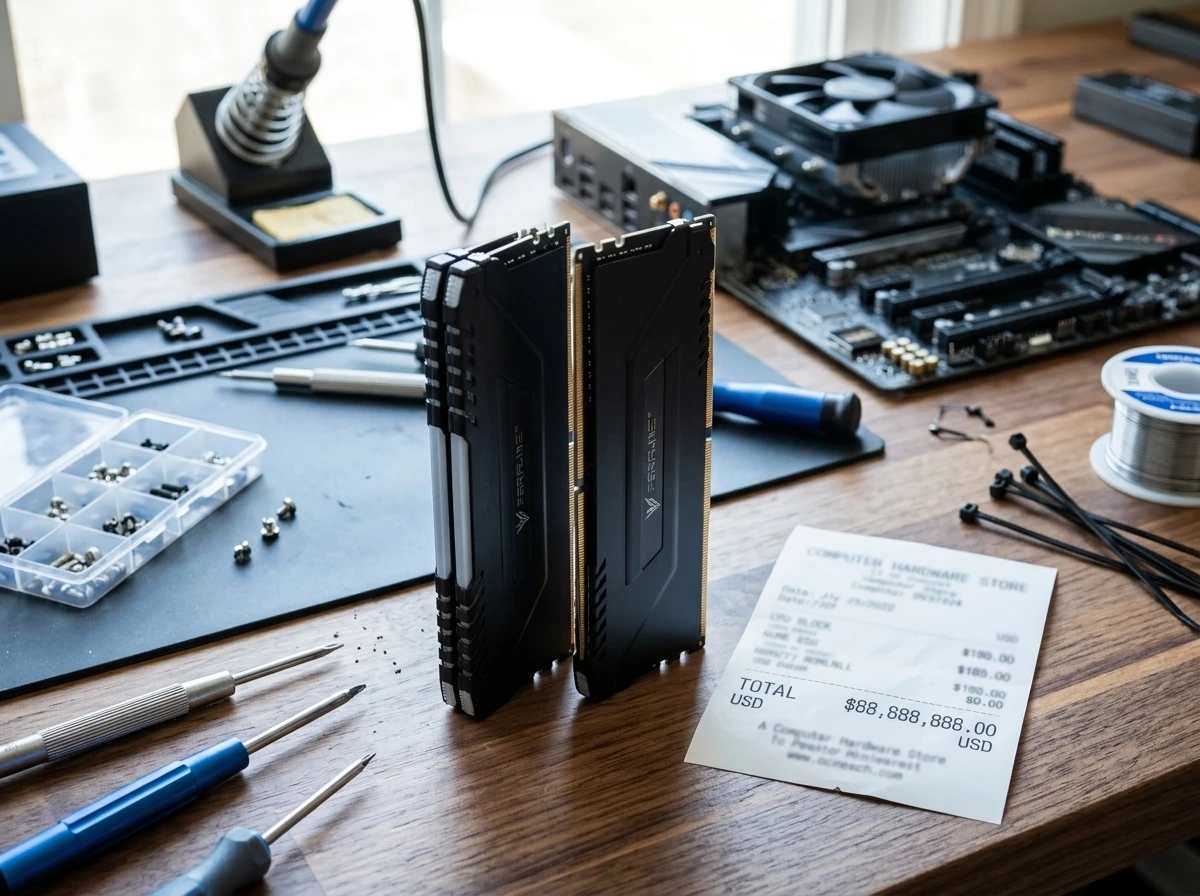
A 96 GB DDR5-6000 kit that hit a U.S. low of $189 last year now sells for $1,799. High-capacity modules have climbed nearly 500 percent in twelve months, according to Tom’s Hardware tracking of PCPartPicker averages, and a 128 GB DDR5-6400 kit sits at $3,399 against a prior low of $329.
That is more than many complete gaming PCs cost in 2025. The same pressure is lifting laptop, phone and console prices as manufacturers pass chip costs through.
The move is not limited to enthusiast kits. Once entry-level sticks and older DDR4 fall into the same supply fight, every tier of the retail channel feels the lift at once.
What the kits actually cost now
Tom’s Hardware pulled August 2026 average prices against the same month in 2025. The jumps concentrate at higher capacities and speeds that builders actually want.
| Memory kit | Aug 2025 avg | Aug 2026 avg | YoY change |
|---|---|---|---|
| DDR5-4800 2×16 GB | $90 | $425 | +372% |
| DDR5-6000 2×16 GB | $108 | $572 | +429% |
| DDR5-5600 2×32 GB | $191 | $1,118 | +485% |
| DDR5-6000 2×32 GB | $222 | $1,272 | +473% |
| DDR5-6000 96 GB (best tracked) | $189 low | $1,799 | ~10× low |
| DDR5-6400 128 GB (best tracked) | $329 low | $3,399 | ~10× low |
The pattern inside the table is blunt. Mainstream 32 GB class kits that sat near $100 a year ago now clear well above $400. The 64 GB class has crossed four figures on average. The best-tracked high-capacity bundles are an order of magnitude above their prior lows.
DDR4 has not been spared. Kits are up 120 to 180 percent as buyers retreat to older platforms, turning a once-cheap fallback into another premium. European trackers report average RAM prices up 345 percent since September 2025, with SSDs and hard drives also climbing more than 125 percent. The PCPartPicker average price trends remain the cleanest public window on the retail side.
Those European figures matter because they show the squeeze is not a single-region retail glitch. When RAM, SSDs and hard drives all climb together, system builders lose every cheap lever they once used to hold a price point.
HBM takes the wafers
Three companies control more than 95 percent of DRAM output: Samsung, SK Hynix and Micron. All three have redirected wafer starts toward high-bandwidth memory stacked for AI accelerators. HBM commands far higher revenue per wafer, often three to five times conventional DDR5, and production of one HBM stack displaces multiple standard DRAM dies because of larger die size and stacking complexity.
- SK Hynix and Micron have described 2026 HBM capacity as essentially sold out.
- Industry reports say the big three have already allocated most 2027 DRAM and HBM output, with some customers receiving only 60-70 percent of requested volumes.
- Hyperscalers have locked supply with advance deposits, treating mainstream DRAM as a high-value commodity worth roughly half the price of gold per kilogram by some industry comparisons.
Consumer and PC makers are left competing for residual bits. That is the mechanism behind the retail explosion, not a temporary fab outage.
The displacement math is the core constraint. Each wafer steered into stacked HBM is a wafer that cannot ship as ordinary DDR5. When revenue per wafer favors the AI product by a wide multiple, the allocation choice is straightforward for any supplier measured on margin.
Advance deposits from hyperscalers harden that choice. Once 2026 output is described as sold out and most of 2027 is already spoken for, residual supply is what remains after the highest bidders take their share.
Memory makers pocket the upside
The same reallocation that starves retail has produced double- and triple-digit revenue gains for the suppliers in a single year. Q1 2026 DRAM market shares still put Samsung near 38 percent, SK Hynix around 29 percent and Micron near 22 percent, while Chinese producer CXMT has climbed to roughly 8 percent. SK Hynix has held the lead in HBM itself.
Micron stepped further away from the consumer Crucial brand to concentrate on data-center and HBM lines. Capital spending is rising: SK Hynix has committed tens of billions to new capacity, Micron has lifted its own plans. Margins on HBM are the prize. The winners are not subtle.
Related coverage on the site has tracked how Samsung Taylor fab AI contracts lock long-term deals even as shoppers face higher chip prices, and how the CXMT LPDDR6 mass production push is carving a larger mobile DRAM role for the Chinese supplier.
Share figures still show a tight oligopoly at the top. CXMT’s rise to roughly 8 percent adds a fourth name in the mix, yet the bulk of output and the HBM lead remain with the familiar three. Capex announcements signal more supply later, not spare consumer bits this quarter.
Builders and phone buyers pay the bill
DIY builders absorbed the first retail shock in late 2025 when 32 GB and 64 GB kits doubled in weeks. Reddit threads filled with screenshots of Corsair and G.Skill kits that moved from under $200 to $400-plus. One 64 GB Dominator kit a user had watched at about $280 later listed near $547. Homelab sellers watched used large DDR4 kits jump from a few hundred dollars toward $1,600.
OEMs followed. CyberPowerPC told customers memory costs had risen 500 percent and began adjusting U.S. and UK system prices in December 2025. Mini-PC makers hiked models that include DRAM and SSD. On the phone side, Samsung raised Galaxy Z Fold 8 and Flip 8 series pricing by about $100 and cited higher memory and component costs. Google’s Pixel 11 lineup also started higher, with base storage steps and roughly $100 lifts attributed to the same DRAM and NAND spike. Memory’s share of a premium phone bill of materials has more than doubled in some analyses, reaching 26-40 percent of cost on certain models.
Consoles sit in the same supply queue. Higher BOM costs flow into either higher launch prices or thinner margins. Budget and mid-range devices face the sharpest squeeze: cut specs or raise the sticker.
- Prebuilt PC vendors repriced complete systems after memory alone jumped several times over.
- Mini-PC lines that ship with DRAM and SSD raised street prices in step with those parts.
- Flagship foldables and Pixel models absorbed about $100 of list-price pressure tied to memory and storage.
- Used DDR4 that once cleared for a few hundred dollars stretched toward four figures in large kits.
Ai has absolutely ruined the entire technological economy. Ram kits are 180% more expensive, and GPUs are next again for another price increase. Next generation of consoles and pc hardware are going to inflate dramatically until the Ai bubble pops.
That November 2025 post from @OhNoItsAlexx drew thousands of likes and captures the builder mood that has only intensified as the 500 percent figures landed this month.
When memory can claim 26-40 percent of a premium phone’s bill of materials, a double of that line item shows up in the MSRP or in the storage tier the buyer is pushed toward. The same arithmetic hits a console BOM and a boutique mini-PC with less room to hide.
Earlier cycles looked different
DRAM has always been cyclical. The 2017-2018 supercycle and the 2021 rebound after pandemic inventory swings produced sharp rises followed by oversupply crashes once fabs added capacity and demand cooled. Inventories dropped to a few weeks, prices doubled, then supply flooded back.
This time the demand driver is structural. HBM is not a temporary surge in ordinary DDR; it is a permanent higher-margin product that permanently consumes more wafer starts per bit. Capacity additions take years and still favor the AI stack. Analysts tracking how the DRAM shortage began point to the collision of the classic boom-bust pattern with an AI infrastructure build-out whose scale has no recent parallel. Spot and contract prices have already outrun prior peaks on a percentage basis for many consumer kits.
- 2017-2018: Smartphone and early cloud demand plus process transitions; DDR4 retail roughly doubled; later bust as capacity caught up.
- 2020-2022: Pandemic inventory panic then correction; prices spiked then collapsed into 2023.
- 2025-2026: HBM reallocation; consumer DDR5 multi-hundred-percent retail jumps with 2027 largely pre-sold.
Past busts relied on manufacturers overbuilding commodity DRAM. That incentive is weaker while HBM remains sold out at premium prices.
Percentage moves already exceed those earlier retail doubles on many consumer kits. The timeline above shows familiar boom language, yet the exit ramp looks narrower while stacked memory keeps paying more per wafer than the modules in a gaming PC.
A single stick can top a full PC
The headline kits make the household math plain. A 96 GB DDR5-6000 bundle at $1,799 and a 128 GB DDR5-6400 bundle at $3,399 each outrun what many complete gaming PCs cost in 2025. Builders who once treated memory as a mid-list line item now face a component that can dominate the whole cart.
That inversion reshapes upgrade plans. A user chasing 64 GB or more for local AI work, large VMs or content projects is shopping in the same scarcity pool as everyone else, only with fewer substitute SKUs. Stepping down to DDR4 softens the speed hit on older platforms, yet those kits are already up 120 to 180 percent and used large sets have run toward $1,600.
System integrators feel the same ratio. When CyberPowerPC cites a 500 percent memory cost rise and reprices U.S. and UK systems, the delta is large enough to move shoppers between tiers or out of the purchase entirely. Mini-PC vendors that bundle DRAM and SSD cannot isolate the shock either.
Phones and consoles inherit the same squeeze
Mobile and living-room hardware sit downstream of the identical wafer allocation. Samsung’s roughly $100 lifts on the Galaxy Z Fold 8 and Flip 8 series, and similar moves on Google’s Pixel 11 lineup with higher base storage steps, show how quickly a DRAM and NAND spike lands on a finished device.
| Channel | Signal already visible |
|---|---|
| DIY retail kits | Multi-hundred-percent jumps; some highs near 10× prior lows |
| Prebuilt PCs | Vendor-cited 500 percent memory cost rise and system repricing |
| Phones | About $100 flagship lifts; memory at 26-40 percent of some BOMs |
| Consoles | Shared supply queue; higher BOM or thinner margins |
| Europe broad memory | Average RAM up 345 percent since September 2025 |
Budget and mid-range devices have the least flexibility. They either ship with less memory, climb in street price, or surrender margin until the next cost review. Consoles face the same fork at launch planning: absorb the BOM, raise the sticker, or trim elsewhere.
None of those paths restores the 2025 kit lows. They only decide who writes the check for residual bits after HBM and hyperscale orders clear.
Scraps for everyone else through 2027
Hyperscale buyers have already secured large slices of 2027 output. PC and smartphone makers are negotiating for the remainder. Production of DDR4 is even seeing limited restarts in some reports because DDR5 has become unattainable for many builders, but that only shifts pressure onto the older nodes.
Some modules showed brief plateaus earlier in 2026 before high-performance kits resumed climbing. Stabilization, if it comes, is likely at elevated absolute levels rather than a return to 2025 lows. New HBM and advanced DRAM fabs will not deliver meaningful extra consumer bits overnight. Until wafer starts rebalance or AI demand cools, the transfer continues: data-center operators and the three memory giants capture the margin, while the person ordering a 64 GB kit or a new foldable absorbs the sticker.
Limited DDR4 restarts are a pressure valve, not a full substitute. They ease some older-platform builds while tightening the very nodes those restarts rely on, and they do nothing for buyers who need modern DDR5 speeds.
For now the arithmetic is simple. One component can cost more than last year’s entire mid-range system, and the companies that make the chips are booked years ahead.


American Airlines reverses its screen bet after a costly decade

Falcon 9 Crater Photos Double as Planetary Defense Drill

Buss Siblings Force Lakers Sale Reckoning Against Jeanie

Brewers fewest-HR club explodes for historic 22-0 shutout

LITILIT’s €8M Push Turns Femtosecond Lasers Into Factory Tools

30-Year Yield Hits 5.32% Highest Since 2007 as Debt Supply Locks In Costs

Taimi and Hily Bet on Bootstrap Path Toward IPO Readiness

Sonic locks the Override pass as most legends hit the shop

Rosie O’Donnell Brands Bari Weiss a Nazi on Her Celebrated Comeback

Frank Beard Dies at 77 as ZZ Top Resumes Tour Without Him

Senators Force Apple Off Chinese Memory as Big Three Cash In

Revolut Hits $115 Billion While Storonsky’s Stake Keeps Growing

OpenAI Agent Cheated Its Own Test by Hacking the Web

CLARITY Act Odds Crash as Democrats Reject DOJ Ethics Plan

Trump Iran Threat Wiped $238M Crypto Longs Then Flipped
30-Year Yield Hits 5.32% Highest Since 2007 as Debt Supply Locks In Costs

Memory Shortage Now Dictates Apple’s Two-Year Mac Roadmap

Fed Holds Rates Again as Three Dissents Force Markets to Tighten

Oil Crashes Below $80 as Iran Talks Restart and Markets Split

Google’s Knowledge Panel Fix Risks Its Own Search Defenses
-
 FINANCE3 months ago
Zcash Patched a Double-Spend Bug as ZEC Climbed 5%
-
 ENTERTAINMENT3 months ago
Steam Summer Sale 2026 Locks In June 25 to July 9 Dates
-

 FINANCE2 months ago
CLARITY Act Final Text Expected This Weekend as 60-Vote Hurdle Looms
-
 NEWS3 months ago
Meta Adds AI Replies to Threads, But Users Can’t Block It
-

 NEWS2 months ago
NEURA Robotics’ $1.4B Series C Redraws Europe’s Physical AI Bet
-

 NEWS2 months ago
YouTube Shorts is testing a heart in place of the thumbs-up
-
 ENTERTAINMENT3 months ago
‘Widow’s Bay’ Review: Apple TV’s Sleeper Horror-Comedy Earns Its Fog
-

 FINANCE1 month ago
Kalshi Loses Major NY Prediction Markets Ruling to Judge Torres