
NEWS
Qualcomm Dragonwing Q-2390 Chips Chase Volume Over TOPS
Qualcomm’s Dragonwing Q-2390 and IQ-2390 put 1.1 TOPS, TSN Ethernet and optional LTE on one cheap die for kiosks and factory panels, not flagship models.

Qualcomm on Tuesday unveiled the Dragonwing Q-2390 and IQ-2390, a pair of 1.1 TOPS chips aimed at cheap gadgets and factory boxes. The parts sit at the bottom of the Dragonwing stack Qualcomm already sells to robots and industrial PCs, and they exist to cut the number of chips on a kiosk, vacuum, or control panel.
Jeff Arnold, vice president and general manager for auto telematics and industrial and embedded IoT at Qualcomm Technologies, tied the launch to cost and integration, not peak model size. System-on-modules show this week at IFA in Berlin. Test kits are due in early 2027.
The Chips Sit at 1.1 TOPS
Qualcomm’s own IoT catalog rates the new Q2 and IQ2 parts at 1.1 TOPS, with a 4-core CPU. That is the same AI number as the older Q4 and IQ6 rungs, and it is a long way from the halo SKUs the company uses when it talks about factory vision or humanoid robots.
The IQ8 series is listed at 40 TOPS with 8 CPU cores. The IQ9 series is listed at 100 TOPS. The IQ10 series, introduced for advanced robotics, is listed at 350 TOPS with an 18-core CPU. The Q-2390 and IQ-2390 do not join that fight. They fill the empty cheap slot so a door panel or a retail terminal can still say Dragonwing on the schematic.
DRAGONWING TOPS BY SERIES
| Platform | NPU rating | CPU cores | Role |
|---|---|---|---|
| Q-2390 (Q2) | 1.1 TOPS | 4 | Consumer and commercial |
| IQ-2390 (IQ2) | 1.1 TOPS | 4 | Industrial, first IQ2 part |
| IQ8 series | 40 TOPS | 8 | Factory and robot boxes |
| IQ9 series | 100 TOPS | 8 | Heavy industrial AI |
| IQ10 series | 350 TOPS | 18 | Advanced robotics |
That spread is the point of the announcement, and it fits Qualcomm’s bet on AI devices beyond phones without pretending a kiosk needs a 100 TOPS die. Small vision models, keyword spotting, and local control loops fit 1.1 TOPS. A 7 billion parameter assistant does not.
Compute, Vision and Radio Share One Die
Arnold’s brief is that too many connected products still stall on cost, complexity, and the mess of stitching several chips together. Qualcomm’s answer is a single platform that takes jobs that used to sit on a CPU, a vision chip, a modem, and a network PHY, then sells that bundle into devices that cannot carry a flagship bill of materials.
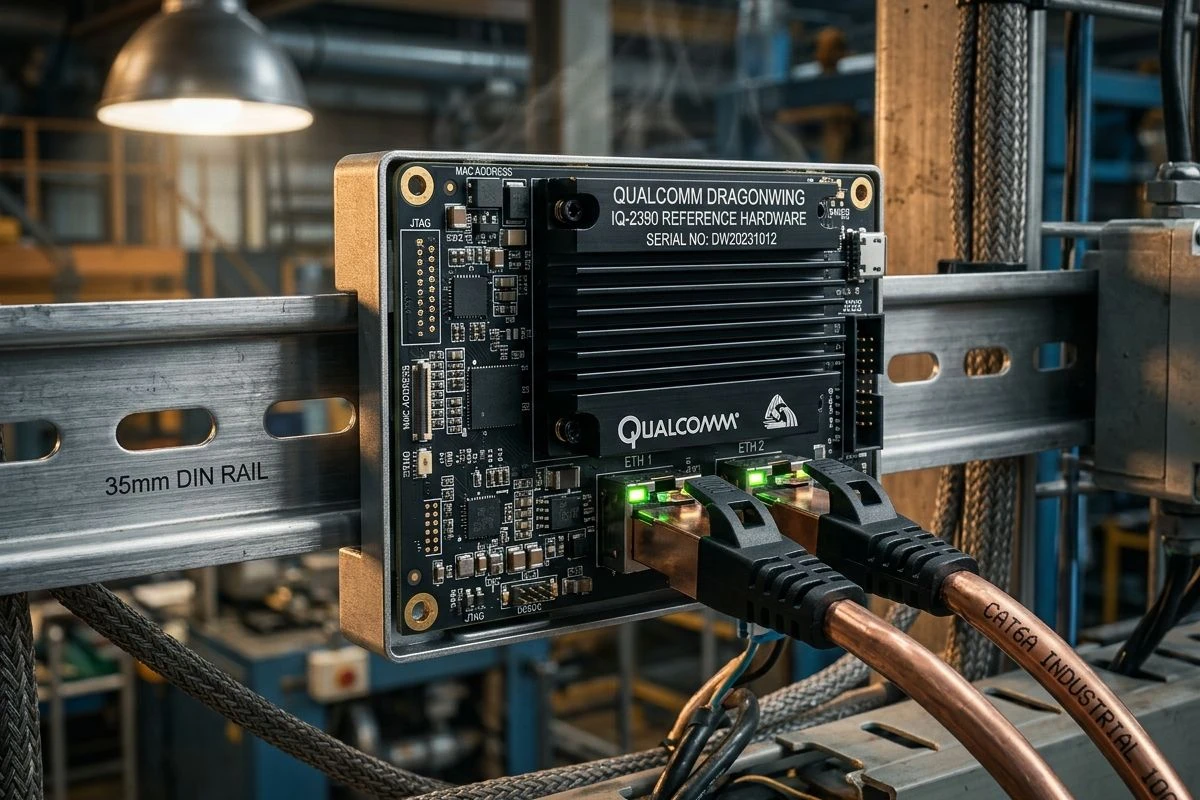
The cost-optimized Q-2390 IoT processor puts application compute, on-device AI, camera and display support, optional LTE Cat 4, GPS, wired and wireless links, and hardware security on one design. The industrial twin adds deterministic Ethernet and a wider temperature rating. Device makers get a smaller board and a shorter parts list. Qualcomm gets the socket.
WHAT LANDS ON ONE DIE
- Application CPU: One Cortex-A78 core plus three Cortex-A55 cores, branded Kryo, clocked up to 1.9 GHz.
- Graphics and AI: An Adreno 704 GPU at 1.1 GHz and a Hexagon NPU rated at 1.1 TOPS.
- Real-time core: An optional RISC-V microcontroller for low-latency control, with Zephyr on the SKUs that include it.
- Wired net: Dual Gigabit Ethernet with Time-Sensitive Networking, so machines can keep a shared clock.
- Optional radio: LTE Cat 4 and GNSS on Q-2390M parts, plus Wi-Fi 5 and Bluetooth through companion chips.
Wi-Fi 5 and LTE Cat 4 are old radios by phone standards. They are cheap, widely certified, and good enough for a kiosk that needs a fallback link when the store access point dies. The integration is the product. The radio generation is the compromise.
What the Q-2390 Puts in a Kiosk
The consumer and commercial chip is aimed at products that are tight on space, heat, and unit cost: smart home gear, retail terminals, appliances, access control, fitness equipment, and home robots. Qualcomm also lists hybrid media stations and enterprise terminals. Local inference is the pitch for a camera-equipped vacuum that still has to decide what it is looking at if the home Wi-Fi drops.
A short Q-2390 product walkthrough from Qualcomm frames the part for retail, home robots, and enterprise edge, not for phones. That is the same non-phone push that showed up when Samsung moved the Galaxy Watch 9 onto Qualcomm silicon, except this time the target is a board inside a kiosk rather than a wrist.
Memory is dual-channel 16-bit LPDDR4x at 1.8 GHz. Graphics run on the Adreno 704. A Hexagon V66 DSP at 1.1 GHz handles audio on the SKUs that include it. The application cores can run Android, Yocto Linux, or Ubuntu, which lets a vendor ship a familiar UI on a retail panel without inventing an operating system.
The useful split-second trick is local vision, not generative chat. A door reader that matches a face, a gym machine that tracks a pose, or a cleaner that avoids a chair can run on this class of NPU. Teams that want on-device large language models are already being pointed at IQ8-class parts, including Arduino’s VENTUNO Q board on the IQ-8275, which Qualcomm rates at 40 TOPS.
The IQ-2390 Takes Heat, Shock and Tight Clocks
The IQ-2390 is the first chip in a new IQ2 series, sitting under IQ6, IQ8, IQ9, IQ-X, and IQ10. Qualcomm wrote it for compact industrial systems that need compute, vision, AI, and real-time networking with a long supply life: operator panels, machine vision, gateways, PLCs and CNC, scanners, fire panels, HVAC, elevator panels, EV chargers, energy storage, and meters.
Qualcomm lists hardware-backed security, ECC memory protection, industrial packaging, and a 10-year longevity claim on the product page. The public longevity catalogue has not yet added the Q-2390 or IQ-2390 by name, so the promise lives on the product pages and in the IQ2 pitch, not yet on the dated catalogue table.
IQ-2390 HARDWARE LIMITS
- Temperature: Rated from -30°C to +115°C, with packaging meant to take vibration and shock.
- Networking: Two 1 GbE ports with Time-Sensitive Networking for time-aware automation.
- Package: High 0.8 mm ball pitch, which is easier to route and inspect on industrial boards than a fine phone BGA.
- I/O: USB, PCIe, storage, 10 QUP serial engines, and 155 GPIO pins for sensors and actuators.
The industrial hook is the pair of Gigabit ports. Dual Gigabit Ethernet with TSN lets a control panel and a camera box share a network that can reserve time slots for motion commands, so a vision event and a motor update do not fight for the same millisecond. That is how Qualcomm is trying to walk into cabinets that used to start with an NXP or TI part plus a separate PHY.
AI is creating a fundamental shift in how connected devices are designed and deployed, but many product categories still face barriers around cost, complexity and integration. With the Dragonwing Q-2390 and IQ-2390 processors, we’re enabling intelligence to scale across a much broader range of devices, from retail systems, smart appliances and consumer robots to industrial controllers, machine vision systems and critical infrastructure.
Jeff Arnold, VP and GM, Auto Telematics and Industrial and Embedded IoT, Qualcomm Technologies
His list is wide on purpose. A chip that can sit in a vacuum and a pump controller is a volume chip. Volume is how Qualcomm turns Dragonwing into something that looks like Snapdragon’s attach rate, only on boards that never see a smartphone case.
The NPU and LTE Arrive as Options
Launch spec tables split the family harder than the marketing names do. The Q-2390 comes in S and M radio cuts, and in AA and AB feature cuts. M parts add 4G LTE and GNSS. AB parts add the NPU, the RISC-V core, and the Hexagon V66 audio DSP. The industrial SKU is listed as IQ2390-AB, with no LTE modem and no GNSS, which matches Qualcomm’s IQ-2390 page.
Q-2390 AND IQ-2390 SKUS
| Part | LTE and GNSS | NPU and RISC-V | Notes |
|---|---|---|---|
| CQ2390S-0-AA | No | No | Lowest consumer cut |
| CQ2390S-0-AB | No | Yes | Local AI, no cellular |
| CQ2390M-0-AA | Yes | No | Q-2390M radio, no NPU |
| CQ2390M-0-AB | Yes | Yes | Full consumer bundle |
| IQ2390-AB | No | Yes | Industrial, -30°C to +115°C |
An appliance maker can buy a Q-2390 that is basically a display-and-radio chip, then skip the NPU fee. A vision kiosk buys the AB cut. A factory HMI buys IQ2390-AB and uses Ethernet instead of LTE. Qualcomm still needs a second PMIC, PMT0102, on SKUs that enable the real-time MCU, so the “one chip” story is one SoC plus the power and radio companions the design actually ships.
Software follows the same split. Cortex-A cores run Android, Yocto Linux, or Ubuntu. The RISC-V core, when present, runs Zephyr for tasks that cannot wait on a Linux scheduler, such as a motor interlock or a packet deadline on the TSN ports.
Industrial Boards Still Start With NXP and TI
Qualcomm is walking into a socket that already has owners. NXP’s i.MX 93 is a common Linux-plus-control pick, with a Cortex-M33 that can stay up while the A55 cluster sleeps, CAN-FD, dual Gigabit Ethernet, and an Ethos-U65 NPU that NXP rates around 0.5 TOPS. Texas Instruments’ AM62x family still shows up on operator panels that care about fast boot and a cheap Qt UI. MediaTek’s Genio 420 lists 7.2 TOPS, which is several times the Hexagon rating on these Dragonwing parts.
Qualcomm’s counter is not a higher TOPS number. It is LTE on the M SKU, a GPU that can drive a real UI, a camera ISP, TSN on both Gigabit ports, and a temperature rating that reaches +115°C on the industrial cut. NXP still has a deeper fieldbus and functional-safety story on parts such as i.MX 94, with TSN switching and protocol stacks factories already certified. Qualcomm is selling a cleaner BOM to teams that want Android or Ubuntu and can live without a decade of EtherCAT middleware.
That is a slow siege, and the calendar shows it. Evaluation hardware is not due until early 2027, so most PLC and HMI redesigns that lock a chip this winter will still tape out on last year’s NXP or TI die. Qualcomm’s win, if it comes, is the next refresh cycle on high-count, cost-sensitive boards: elevator panels, chargers, retail terminals, and the home robots that need a camera and a UI more than they need SIL-rated motion control.
Modules Show at IFA, Kits in 2027
Qualcomm is showing Q-2390 and IQ-2390 system-on-modules in Berlin this week, and it says early-access work is already underway with SECO on Compact Vision 5, plus Fibocom, Engicam, and Eight Development. That module-first path is how IoT silicon actually gets designed in. Most appliance and HMI teams will not layout a 0.4 mm or 0.8 mm BGA themselves. They will buy a module, bring up Android or Yocto, then argue about camera lanes.
FROM ANNOUNCEMENT TO EVALUATION KITS
- September 1, 2026: Qualcomm announces the Dragonwing Q-2390 and IQ-2390 processors ahead of IFA.
- IFA 2026, Berlin: Partners show system-on-modules, including SECO’s Compact Vision 5.
- Early access: Fibocom, Engicam, Eight Development, and SECO work against pre-production silicon.
- Early 2027: Official developer evaluation kits are expected to ship.
SECO’s Compact Vision 5 is already in that early-access pile, which is the first physical board most buyers will touch. Evaluation kits follow in early 2027, and that is when appliance and HMI teams will start schematic work in volume. Until those kits land, the Q-2390 and IQ-2390 are a price list and a Berlin demo, not a factory default.
Frequently Asked Questions
How much RAM can the Dragonwing Q-2390 use?
Qualcomm’s Q-2390 spec list sets memory at dual-channel 16-bit LPDDR4x clocked at 1.8 GHz, with density up to 8 GB. That is enough for Android or Ubuntu on a kiosk or home robot, and it is well below the 16 GB class used on IQ8 developer boards aimed at larger on-device models.
What camera and video specs do the chips list?
Launch spec tables give the platform two 4-lane MIPI CSI inputs, a 13 MP dual-camera path at 30 fps with zero shutter lag, and a 25 MP single-camera path at 30 fps. Video decode is listed at 1080p30 for H.264, H.265, and VP9, with encode at 1080p30 for H.264 and H.265, so these are 1080p parts, not 4K media chips.
Which companion chips sit beside the Q-2390?
Qualcomm names PMT0101 as the main PMIC and PMT0102 as a second power chip required on SKUs that enable the real-time MCU. Optional companions include the WTR2965 RF transceiver for cellular, WCN3950 or WCN398x for Wi-Fi 5 and Bluetooth 5.0/5.1, and the WSA8855 audio codec.
What does the optional RISC-V core actually run?
Spec tables describe an optional SiFive E61 real-time core, up to 600 MHz with 768 kB of memory, sitting beside 512 KB of shared L3 cache on the application cluster. Qualcomm points that core at Zephyr, so a motor interlock or TSN deadline can run while Android or Linux owns the A78 and A55 cores.
What display and storage interfaces do the chips expose?
The platform lists a 4-lane MIPI DSI output up to 1080p60, an Adreno 921 display block, eMMC 5.1 and SD 3.0 for storage, USB 3.1 on Type-C or Micro USB plus a USB 2.0 Type-C port, and PCIe 2.0 x1 for a modest expansion device such as extra Ethernet or storage.


Space Cargo Buys Into France’s Zero-G Flight Company

The $399 Omni Walks Away, Then Asks for a Dock

TECNO’s 0mm Bezelless Phone Still Needs a Rim

The Ryobi Tools That Unblocked a Garage Workbench

Ripple’s 700 Million XRP Re-Lock Repeats a Yearlong Pattern

The 2026 Kawasaki Ninja ZX-10R Matches Honda’s Price

Chainlink Puts Official US Inflation and GDP Onchain

Google Pushes Gemini Daily Brief off the Chat Screen

The Crosshair A16 HX Outruns Its Own Power Brick

Cloover Turns a $350 Million Installer Book Into a Utility

30-Year Yield Hits 5.32% Highest Since 2007 as Debt Supply Locks In Costs

Oil Crashes Below $80 as Iran Talks Restart and Markets Split

Walter’s TWG Insists No Fraud as Insurer Probes Force Cleanup

Astute’s $1.2M bet makes B2B creator deals feed AI discovery

Strategy Parks $1.59B Cash While Bitcoin Stack Stays Flat

BlackRock Turns Cash Empire Into Stablecoin Reserve Rails

The 20% Savings Ideal Meets a 2.7% Reality Check

SpaceX Stock Rebound Tests Real Demand Before Huge Unlock

Monzo chair Gary Hoffman exits after board revolt fallout

Amber’s €7M locks Mittelstand knowledge inside Europe
-
 FINANCE3 months ago
Zcash Patched a Double-Spend Bug as ZEC Climbed 5%
-
 ENTERTAINMENT3 months ago
Steam Summer Sale 2026 Locks In June 25 to July 9 Dates
-

 FINANCE2 months ago
CLARITY Act Final Text Expected This Weekend as 60-Vote Hurdle Looms
-
 NEWS4 months ago
Meta Adds AI Replies to Threads, But Users Can’t Block It
-

 NEWS3 months ago
YouTube Shorts is testing a heart in place of the thumbs-up
-

 NEWS1 month ago
Senators Force Apple Off Chinese Memory as Big Three Cash In
-

 NEWS3 months ago
NEURA Robotics’ $1.4B Series C Redraws Europe’s Physical AI Bet
-
 ENTERTAINMENT5 months ago
Extraction 3 Is Officially Coming to Netflix in 2027