
NEWS
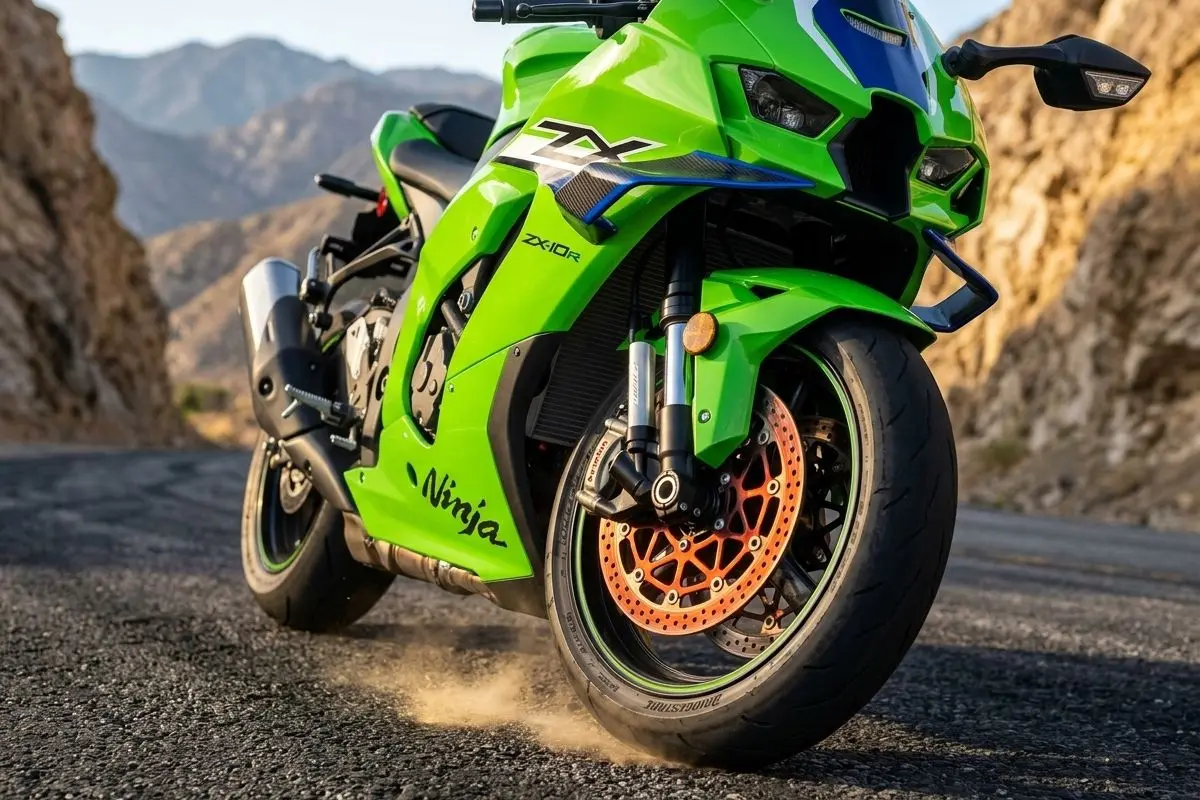
The 2026 Kawasaki Ninja ZX-10R Matches Honda’s Price
The 2026 Kawasaki Ninja ZX-10R lists 190.0 hp and the same $16,999 base as Honda’s CBR1000RR, while the homologation ZX-10RR jumps to $29,999.

The 2026 Kawasaki Ninja ZX-10R is on the US sheet at 190.0 hp and a $16,999 base, the same money as Honda’s CBR1000RR. Destination is $840, so the non-ABS bike lands at $17,839 and the ABS bike at $18,839, matching leftover 2025 ZX-10R totals still listed with that same $840 fee.
Kawasaki’s November 3, 2025 press note still talks about cleaner emissions and “raw performance.” The US number is 6 hp and 1.4 lb-ft below the prior 196 hp and 83.9 lb-ft. The second move is the sticker: the street 10R now sits on Honda money, while the homologation ZX-10RR opens at $29,999.
The US Claim Drops to 190 Horsepower
Kawasaki’s American product page lists 190.0 hp at 11,500 rpm and 82.5 lb-ft at 11,300 rpm from the carryover 998 cc inline-four, measured to ISO 4106. Bore, stroke, and the 13.0:1 compression ratio do not change. Peak torque still lives high, at 11,300 rpm, so the motor wants revs if you came from a twin.
Japan publishes a different sheet: 145 kW (197 PS) at 13,000 rpm, and 152 kW (207 PS) with ram air. The US peak is both lower and earlier. That gap is calibration, noise, and EPA paperwork sitting on top of the same Euro 5+ hardware, not a new crankshaft.
2025 VS 2026, ON THE US SHEET
| Item | Prior ZX-10R (US) | 2026 ZX-10R (US) |
|---|---|---|
| Claimed peak power | 196 hp | 190.0 hp at 11,500 rpm |
| Claimed peak torque | 83.9 lb-ft | 82.5 lb-ft at 11,300 rpm |
| Base MSRP plus $840 destination | $17,839 non-ABS / $18,839 ABS | $17,839 non-ABS / $18,839 ABS |
| Winglets | Integrated into the cowl | Outboard ABS wings, 25% more downforce |
| Street tires | Bridgestone Battlax RS11 | Bridgestone Battlax RS12 |
| Dash | Prior glossy TFT | 5-inch matte TFT |
Curb weight is 458.6 lb without ABS and 463.1 lb with it, on the 49-state bike, with a 4.5-gallon tank and a 57.1-inch wheelbase. Dry figures are 421.2 lb and 425.6 lb. You still get the Bosch IMU suite: S-KTRC, launch control, engine-brake control, cornering management, and a bidirectional quickshifter.
Euro 5+ Added a Second Oxygen Sensor
Euro 5+ did not tighten the gram-per-kilometer caps that arrived with Euro 5. It changed how long the aftertreatment has to hold those caps, and how the bike proves it in service. New type approvals needed the step from 2024; all new registrations had to meet it from 2025. Kawasaki’s hardware answer is small, and it is sitting in the exhaust, not in a new bore.
A second O2 sensor has been added downstream of the catalyzer, complementing the upstream sensor and enhancing overall emission control. Improvements to the catalyst itself, including a smaller, lighter design with higher quality materials, help maintain performance while minimizing weight gain.
Kawasaki Motors Corp. USA, 2026 Ninja ZX-10R press kit
That second O2 sensor downstream of the catalyzer is the Euro 5+ tell. Two lambda probes, one before the brick and one after, let the ECU watch oxygen storage and light a warning if the catalyst is fading. Dr. Frank Schwarz, who leads thermodynamics, function, and emissions at BMW Motorrad, said makers now design the diagnostics so riders should not see that lamp more often than they did on Euro 5 bikes.
WHAT EURO 5+ ACTUALLY CHANGED
- The limits: CO, HC, and NOx caps stay at Euro 5 levels; the fight is durability and monitoring, not a new number on the door sticker.
- The mileage: Fast bikes must now show aftertreatment that still works across a 35,000 km catalyst durability test, about 21,700 miles, instead of a 3,500 km shortcut plus a paper deterioration factor.
- The sensors: A second lambda probe after the catalyst feeds OBD stage II, which can light the engine lamp and, if the system fails far enough, cut power.
- The noise: UNECE R41.05, in force from January 1, 2025, keeps the old limit values but multiplies the test points; Schwarz described one homologation run that went from 5 measuring points to 20, covering country-road speeds that older tests skipped.
Kawasaki never leads with the 6 hp. The US page just prints 190.0 hp. The press kit talks about a smaller, lighter catalyst and a cleaner engine that still pulls. The quieter, mapped exhaust is why a street tester started shopping cans after the first ride, and why dyno shops already treat the 2026 motor as a baseline, not a finished tune.
Outboard Winglets Buy 25 Percent More Downforce
If the exhaust lost some bite, the fairing is where Kawasaki spent the model year. The wings move off the cowl and stick out. Kawasaki says the extra frontal area adds 25% more downforce and only 0.3% more drag, with the attack angle set so the blades stay calm in braking, drive, and lean. They are ABS resin, and the upper edges run into chin spoilers under new hybrid projector and reflector LED lights. The ram-air mouth sits higher to make room.
https://x.com/KawasakiUSA/status/1985799429060796563
Chassis changes exist to live with that extra front load. The aluminum twin-spar frame is the same path from head pipe to pivot, but the swingarm pivot rises 2 mm for rear traction and what Kawasaki calls secondary cornering force. Fork protrusion through the triple clamp drops so the front sits a little higher. Rake and trail on the US sheet stay 25.0 degrees and 4.1 inches. Showa’s 43 mm Balance Free fork still offers 4.7 inches of travel, the BFRC lite rear shock 4.2 inches, and an Öhlins mechanical damper remains standard.
Stock rubber is Bridgestone Battlax RS12, up from RS11. Dual 330 mm Brembo discs and radial-mount M50 four-piston calipers handle the front; a 220 mm disc and a single-piston caliper sit at the rear. On a canyon test the RS12s did not snap in, then held once the bike was leaned. Slow-speed steering felt heavy until the first real corners arrived. The wings will not do much at commuting speeds. They are there for the front to stay on the ground when the motor is still a missile past 8,000 rpm, on the way to that 11,500 rpm US peak.
What the 2026 ZX-10R Costs Against Honda
The Honda CBR1000RR starts at $16,999 before a $775 destination charge, $17,774 as a rolling total, with ABS at $17,299. Kawasaki’s non-ABS 10R matches that $16,999 base and then asks $65 more in freight. ABS is the split that shows up in the till: $17,999 against Honda’s $17,299, a $700 gap before anyone talks rubber or screens. Honda does not print a US horsepower figure. It does print 432 lb curb, 434 lb with ABS, so the Kawasaki ABS bike is 31.1 lb heavier than Honda’s ABS bike on the two published curb numbers (463.1 versus 434).
US STICKERS, LITER CLASS
| Bike | Claimed power | Base MSRP | Destination | Curb weight |
|---|---|---|---|---|
| 2026 Ninja ZX-10R | 190.0 hp at 11,500 rpm | $16,999 / $17,999 ABS | $840 | 458.6 lb / 463.1 lb ABS |
| 2026 CBR1000RR | Not published in the US | $16,999 / $17,299 ABS | $775 | 432 lb / 434 lb ABS |
| 2026 Ninja ZX-10RR | Homologation spec | $29,999 | Not listed with the R | Single-seat race kit |
Suzuki’s updated GSX-R1000R is in the same emissions bind. Overseas claims sit at 192.3 hp at 13,200 rpm and 81.1 lb-ft at 11,000 rpm, down from about 199 hp on the old bike, and Suzuki still does not print a US output. UK list money has been quoted at £17,599. In the showroom the 10R’s fight is Honda at the same $16,999 and Suzuki a few hundred to a couple of thousand higher depending on trim, not a $24,000 V4.
Kawasaki still lists 2025 ZX-10R stock at those same $17,839 and $18,839 destination-included totals. Buying the 2026 bike does not cost extra for the new face, the 5-inch screen, or the RS12s. That is the quiet inventory problem for dealers sitting on last year’s green, and the reason a 600 cc graduate can step up without paying a “new model” tax.
Homologation Hardware Moved to the ZX-10RR
The street 10R is the volume product. The RR is where Kawasaki parked the parts that still have to look like a World Superbike in the paddock. Kawasaki’s US family listing puts the RR at $29,999, $12,000 above the ABS 10R (29999 minus 17999) and $13,000 above the non-ABS bike. Japan split the launch dates too: the 10R went on sale August 1, 2026, at 2,486,000 yen; the RR follows September 12 at 3,476,000 yen.
WHAT THE RR ADDS FOR THAT MONEY
- The seat: A single seat cuts passenger hardware and some mass for track days.
- The brakes: Higher-spec calipers with steel lines, aimed at repeated stops that street pads and hoses do not see every weekend.
- The motor: Lightweight pistons on top of the shared 998 cc architecture.
- The tires: Pirelli Diablo Supercorsa rubber instead of the RS12 street tires.
Kawasaki’s press kit still leads with seven World Superbike titles. The street bike inherits the electronics and the Brembo M50 front, then asks you to pay almost double if you want the homologation twin. For a rider who will never cut a timing loop, the 10R is the whole product. For a club racer, the RR is the one that makes the 6 hp argument feel small, because the parts that matter on a Saturday are not the ones Euro 5+ took.
Two Hours Is the Street Limit
A week of commuting, canyon runs, and freeway miles is where the 190.0 hp figure stops mattering. Rain, Road, and Sport modes bundle traction and power; four Rider maps let you split those systems. Sport felt too sharp around town, so Road did the daily work and still did not feel dull. The quickshifter stayed light up and down. Cruise control, the unglamorous piece, took load off the right wrist until Sport at a 70 mph indicated cruise in sixth, where the bike lurched and wandered 1-3 mph on grades. Road and Rain calmed that down.
Seat height is 32.5 inches, so a tester in boots could flat-foot it; anyone under a 30-inch inseam will dab. Pegs sit high and the bars sit low, which is correct for a liter bike and wrong for a gas-tank run. Unbroken saddle time landed around two hours before a stretch stop. Independently adjustable compression and rebound helped everywhere except a nasty stretch of the 405, where the front still bounced. The 5-inch screen is the cabin upgrade people will notice: a slightly matte face that dumps glare, with enough menus that the first week included undoing settings. After that it receded.
None of that makes the 10R a tourer, and Kawasaki already sells that job in other clothes, including the daily-plus-weekend Kawasaki Versys 650. The point of the street test is narrower. This liter bike can do a commute and a grocery run without feeling like a paddock refugee, then still go stupid from 8,000 rpm. That is the product Euro 5+ accidentally helped: a mapped, censored, cruise-equipped superbike you can live with, as long as you accept the stretch stops and the Sport-mode cruise bobble.
Exhaust Shops Already Know the Workaround
Riders taking 2026 10Rs home in Japan in late August talked about coming back to Kawasaki and riding at an easy pace. The delivery photos are street bikes in Lime Green/Blue 24, not pit boards. The argument on the dyno bench is the other half of the same bike. Stock, the US motor is held down by the catalyst, the second sensor, and the noise map. Tuner videos already walk a 2026 10R from a baseline pull through a can, a filter, and stacks; one shop’s race-gas pull was advertised at 205 rear-wheel horsepower. Treat that as a shop claim, not a factory figure. It tells you where owners think the 6 hp went.
Kawasaki will not sell you that map. It will sell you Rideology connectivity, voice command as a licensed extra, and a 12-month limited warranty, plus optional Protection Plus in 12-month steps out to 48. Colors are Lime Green/Blue 24 or Metallic Matte Graphenesteel Gray with Metallic Spark Black and Pearl Storm Gray. If the green is too loud, the gray bike is the same motor. If even 190.0 hp with a quiet can feels like the wrong kind of Kawasaki, the company still builds the supercharged Kawasaki Z H2 naked for people who want forced induction and no race fairing.
The 2026 ZX-10R is already in customer hands in Japan, and US crates carry the same $16,999 opening number as Honda. Six horsepower left the US sheet. The wings, the screen, and the frozen sticker stayed, and the $29,999 RR is waiting if you want the rest of the kit.
Frequently Asked Questions
Does the 2026 ZX-10R Make the Same Power in Japan and the US?
No. Kawasaki’s Japanese sheet lists 145 kW (197 PS) at 13,000 rpm and 152 kW (207 PS) with ram air, while the US page lists 190.0 hp at 11,500 rpm under ISO 4106, so the American peak is both lower and earlier even though displacement, bore, and compression match.
What Warranty Does Kawasaki Put on the 2026 ZX-10R?
The US bike carries a 12-month limited warranty, with optional Kawasaki Protection Plus sold in 12, 24, 36, or 48-month add-on terms, which is the factory coverage window you are actually buying with the $16,999 base, not a multi-year included plan.
At What RPM Does the ZX-10R Quickshifter Work?
Kawasaki’s dual-direction KQS is designed to work on the street once the engine is above 2500 rpm, so clutchless upshifts and downshifts are a mid-rpm street feature as well as a track tool, not something that only wakes up near peak power.
How Is the 190.0 hp Figure Measured?
Kawasaki footnotes the US horsepower as an ISO 4106 measurement, a standard that can read higher than the SAE method used for many cars, which is why that 190.0 hp should not be lined up, unadjusted, against an SAE car rating or a rear-wheel dyno print from a shop.


Space Cargo Buys Into France’s Zero-G Flight Company

The $399 Omni Walks Away, Then Asks for a Dock

TECNO’s 0mm Bezelless Phone Still Needs a Rim

The Ryobi Tools That Unblocked a Garage Workbench

Ripple’s 700 Million XRP Re-Lock Repeats a Yearlong Pattern

The 2026 Kawasaki Ninja ZX-10R Matches Honda’s Price

Chainlink Puts Official US Inflation and GDP Onchain

Google Pushes Gemini Daily Brief off the Chat Screen

The Crosshair A16 HX Outruns Its Own Power Brick

Cloover Turns a $350 Million Installer Book Into a Utility

30-Year Yield Hits 5.32% Highest Since 2007 as Debt Supply Locks In Costs

Oil Crashes Below $80 as Iran Talks Restart and Markets Split

Walter’s TWG Insists No Fraud as Insurer Probes Force Cleanup

Astute’s $1.2M bet makes B2B creator deals feed AI discovery

Strategy Parks $1.59B Cash While Bitcoin Stack Stays Flat

BlackRock Turns Cash Empire Into Stablecoin Reserve Rails

The 20% Savings Ideal Meets a 2.7% Reality Check

SpaceX Stock Rebound Tests Real Demand Before Huge Unlock

Monzo chair Gary Hoffman exits after board revolt fallout

Amber’s €7M locks Mittelstand knowledge inside Europe
-
 FINANCE3 months ago
Zcash Patched a Double-Spend Bug as ZEC Climbed 5%
-
 ENTERTAINMENT3 months ago
Steam Summer Sale 2026 Locks In June 25 to July 9 Dates
-

 FINANCE2 months ago
CLARITY Act Final Text Expected This Weekend as 60-Vote Hurdle Looms
-
 NEWS4 months ago
Meta Adds AI Replies to Threads, But Users Can’t Block It
-

 NEWS3 months ago
YouTube Shorts is testing a heart in place of the thumbs-up
-

 NEWS1 month ago
Senators Force Apple Off Chinese Memory as Big Three Cash In
-

 NEWS3 months ago
NEURA Robotics’ $1.4B Series C Redraws Europe’s Physical AI Bet
-
 ENTERTAINMENT5 months ago
Extraction 3 Is Officially Coming to Netflix in 2027