
NEWS
France’s Mega Tech Deals Mask a Thinning Early Pipeline
Eutelsat, AMI and Mistral led France’s H1 2026 tech raises with debt and giant seeds for sovereign AI and space, while seed deals hit multi-year lows.

France’s tech companies pulled in billions in the first half of 2026, topped by Eutelsat’s €975 million satellite package, Advanced Machine Intelligence’s roughly $1 billion seed and Mistral AI’s $830 million GPU debt raise. The money clustered in AI infrastructure, space, health and defence.
That concentration built real sovereign capacity. It also left early-stage deal counts at multi-year lows. The half therefore reads as two stories at once: a handful of outsized cheques that moved national totals, and a thinned funnel underneath them.
The Ten Raises That Defined the Half
Tech.eu ranked the largest French tech raises of H1 2026. Debt and outsized seeds dominated the upper ranks. Here is the list with the amounts and focus of each company.
| Rank | Company | Amount | Focus |
|---|---|---|---|
| 1 | Eutelsat | €975M | LEO satellite fleet expansion |
| 2 | Advanced Machine Intelligence (AMI) | $1B | World-model AI systems |
| 3 | Mistral AI | $830M | Nvidia GPUs and French data centre |
| 4 | Alan | €580M | Digital health insurance platform |
| 5 | Aura Aero | €340M | Hybrid-electric regional aircraft |
| 6 | Harmattan AI | $200M | Defence autonomous systems |
| 7 | Pennylane | $200M | SME accounting and finance software |
| 8 | Morpho | $175M | Onchain credit infrastructure |
| 9 | Quobly | €115M | Silicon quantum processors |
| 10 | FineHeart | €83M | Implantable heart-failure device |
These ten transactions alone moved several billion euros and dollars. French Tech Journal put the wider H1 total at €4.83 billion across a thinned deal count. Tech.eu’s broader European tracker showed France at roughly €6.0 billion, still third behind the UK and Germany.
The ranking itself signals the shift. Export-credit debt, a giant seed and a GPU-linked bank package occupy the top three slots. Classic equity growth rounds fill much of the rest, but the ceiling was set by infrastructure and foundation-model bets rather than pure software scale-ups.
Why a Handful of Cheques Moved the Needle
Two deals did most of the heavy lifting on growth. AMI Labs’ large seed and Alan’s June growth round together accounted for the bulk of the year-on-year gain, according to French Tech Journal analysis. Strip them out and H1 2026 sits only a few percent above the prior year on the fewest first-half deals in six years.
Median round size hit a six-year high near €5 million. Growth-stage money stayed available. Series A cheques swelled because some “A” rounds now look like classic growth cheques. Seed and pre-seed counts fell sharply, down 64 percent from the 2022 peak. Investors wrote larger tickets into fewer companies.
- Nine rounds crossed €100 million in six months, triple the H1 2025 count.
- Deal volume dropped while capital recovered, the classic concentration pattern also visible Europe-wide.
- Bpifrance appeared in roughly one in six Q2 deals, often plugging the early-stage gap private funds left open.
The same dynamic showed up in the 2026 unicorn list concentration pattern, where a tiny number of names absorbed outsized capital.
Concentration has a mechanical effect on headline totals. A market can post a higher aggregate on fewer closings when median size climbs and mega-rounds multiply. That is precisely the pattern the half produced: capital recovered, deal count did not, and public co-investment filled gaps private seed funds left open.
Sovereign Infrastructure Took the Biggest Cheques
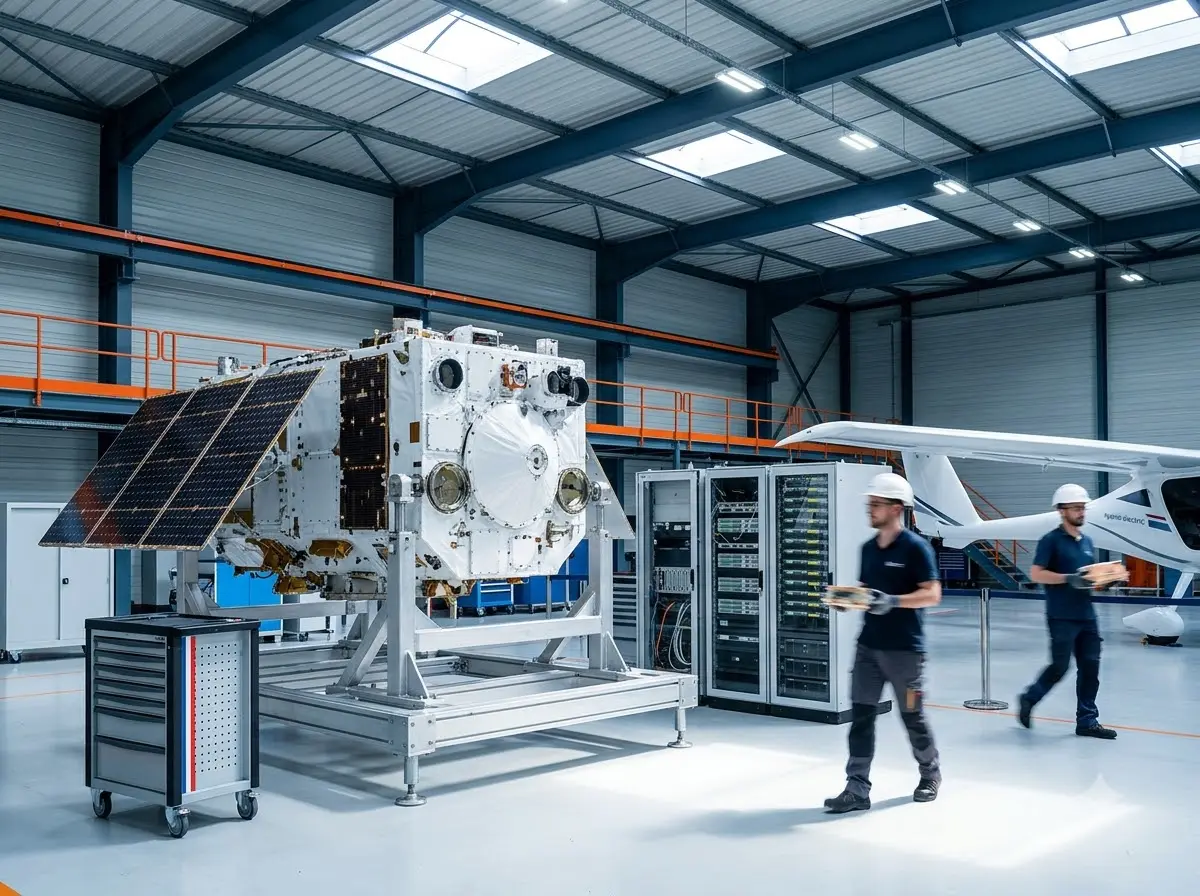
Eutelsat signed €975 million Export Credit Agency financing backed by a French state guarantee through Bpifrance Assurance Export. The package funds 340 new LEO satellites from Airbus Defence and Space in Toulouse, on top of 100 already ordered, to renew the OneWeb constellation that already exceeds 600 satellites. CEO Jean-Francois Fallacher said the funding “significantly strengthens our financial structure and gives us the means to support the deployment of our LEO activities.”
Mistral AI raised $830 million in debt from a bank consortium including BNP Paribas, Crédit Agricole, HSBC and MUFG. The money buys 13,800 Nvidia GPUs for its first French data centre near Paris, expected online in the second quarter of 2026. The company is pushing a full-stack European offering built around customisation and data control.
AMI, founded by Yann LeCun after he left Meta and co-founded with Alexandre LeBrun, closed a $1.03 billion seed at a $3.5 billion pre-money valuation. Backers included Cathay Innovation, Greycroft, Bezos Expeditions, Nvidia, Temasek and Bpifrance. The lab is building world models that learn physical dynamics from sensors rather than next-token prediction, with hubs planned in Paris, New York, Montreal and Singapore. It ranks among the largest European seed rounds on record.
Taken together, the three largest raises buy physical and computational capacity rather than pure go-to-market spend. Satellites, GPUs and world-model research all lock in multi-year build programmes. That is why debt and export-credit structures could carry so much of the load beside equity.
We believe great health is a universal right, and that prevention should be too. For ten years we have shown that technology can turn healthcare from reactive to proactive.
Jean-Charles Samuelian-Werve, Co-founder and CEO of Alan, Prosus announcement
Health, Aircraft, Defence and Quantum Filled the Middle
Alan raised €580 million across two H1 rounds, the larger a €480 million round that valued Alan at €5.5 billion with Prosus leading a €400 million slice. The platform combines insurance, care navigation and prevention for more than 1.1 million members and over 37,000 businesses. ARR passed €800 million, up 53 percent year-on-year, and the French business is profitable.
Aura Aero, founded by former Airbus engineers in Toulouse, took €340 million to scale hybrid-electric training and 19-seat regional aircraft plus a military drone arm. Harmattan AI closed a $200 million Series B for AI-enabled autonomous defence systems covering drone interception, ISR, electronic warfare and command tools that keep humans in the loop. That defence AI momentum sits alongside the broader European pattern of defence AI winners across European mega-rounds.
Pennylane’s $200 million Series E funds R&D and German expansion of its all-in-one SME finance platform. Morpho’s $175 million deepens open onchain credit rails for institutions. Quobly’s €115 million Series A industrialises silicon-qubit processors meant to sit inside existing data centres and HPC sites. FineHeart’s €83 million advances its FlowMaker implantable pump for advanced heart failure.
The middle of the table therefore mixes scaled digital health, dual-use aerospace, defence autonomy, SME software, onchain credit, quantum hardware and medtech. None of those rounds matched the top three on size, yet together they show capital still reaching several strategic verticals once a company clears early-stage risk.
What the Numbers Leave Behind
AI still dominated French sector tallies. Deeptech and quantum grew without a single giant distorting the total; Grenoble’s Quobly helped push the city to second place behind Paris for the quarter. Health and biotech ex-Alan rose sharply. Software, cleantech and pure cybersecurity lagged.
The second-order effect is structural. Capital is flowing into the physical and computational backbone Europe says it needs: LEO connectivity independent of non-European constellations, domestic GPU clusters, silicon quantum that plugs into ordinary data centres, and tactical defence autonomy. Those assets take years and billions to build. Debt and export-credit tools proved usable at scale. Giant seeds can still clear when the founder carries LeCun-level credentials.
- LEO renewal through Eutelsat’s OneWeb expansion and Airbus production in Toulouse.
- Domestic GPU capacity via Mistral’s 13,800-chip French data centre plan.
- World-model research anchored by AMI’s Paris hub and multi-city network.
- Silicon quantum designed by Quobly to fit existing data centres and HPC sites.
- Defence autonomy with humans kept in the loop, as Harmattan’s stack frames it.
At the same time the funnel that should produce the next cohort of Series A and B companies narrowed. Seed counts collapsed. Private early-stage funds did fewer deals. Public money through Bpifrance became the floor under the earliest stages. A market can run on concentration for a stretch. It cannot run that way forever if the goal is a deep bench of independent European tech firms.
How France Sat Inside the Wider European Picture
Europe overall raised about €44 billion in H1 2026 on fewer deals than prior peaks, per Tech.eu. The UK led with €18.7 billion. Germany followed at €6.3 billion. France’s €6.0 billion put it in the top tier, with AI the largest European vertical at €5.9 billion. Readers can track the underlying deal flow through the free Tech.eu Funding Explorer data on European deals.
| Market | H1 2026 total |
|---|---|
| Europe overall | €44 billion |
| United Kingdom | €18.7 billion |
| Germany | €6.3 billion |
| France | €6.0 billion |
| AI (largest European vertical) | €5.9 billion |
Crowd conversation on X mixed French pride in Mistral’s sovereign positioning and LeCun’s world-model bet with sharp notes that European compute ambitions still trail the largest U.S. clusters. One recurring observation was that selling multi-year capacity commitments has become the practical way to finance data-centre scale in Europe, turning AI labs into infrastructure operators as much as model builders.
France’s near-parity with Germany on the Tech.eu measure, and its clear third-place rank behind the UK, keeps it inside Europe’s top tier even as deal counts thin continent-wide. The same concentration logic visible in Paris shows up in the wider European totals: large AI and infrastructure packages do most of the arithmetic.
Bank Debt and Export Credit Carried Scale
Two of the three largest French packages were not classic equity rounds. Eutelsat’s €975 million came as Export Credit Agency financing with a French state guarantee through Bpifrance Assurance Export. Mistral’s $830 million came as debt from a commercial bank consortium.
That mix matters for how sovereign capacity gets funded. Satellite fleets and GPU clusters require large upfront sums and multi-year deployment calendars. Export-credit and bank debt let those programmes proceed without matching equity dilution at every step. AMI’s $1.03 billion seed shows equity can still clear at extreme size when the technical thesis and founder profile line up, yet the half’s top ranks were not equity-only.
Bpifrance’s dual presence, as guarantee channel on Eutelsat and backer on AMI, plus its appearance in roughly one in six Q2 deals, underlines how public instruments now touch both the ceiling and the floor of the market.
Where the Next Cohort Has to Come From
Seed and pre-seed counts down 64 percent from the 2022 peak leave a thinner path into Series A. Median round size near a six-year high of €5 million helps companies that do raise, but it does not replace lost volume at the entry point.
Private early-stage funds did fewer deals. Bpifrance often plugged the gap. Growth-stage money remained available, and nine rounds above €100 million showed that scaled companies could still clear large cheques. The open question is whether enough new names will reach that tier if the seed layer stays compressed.
Alan’s profitable French business, Pennylane’s German expansion plans and Aura Aero’s Toulouse industrial base show what a deeper bench can look like once companies mature. Sustaining that pattern requires the funnel above them to widen again, not only more mega-rounds at the top.
Frequently Asked Questions
How much did French tech raise in total in H1 2026?
French Tech Journal tallied €4.83 billion. Tech.eu’s European methodology put France near €6.0 billion. Method differences usually turn on whether large debt packages and certain later-stage instruments are fully included. Both sources agree the total rose on a smaller number of larger cheques.
Why did Eutelsat raise €975 million?
The French-backed export credit package finances procurement of 340 new OneWeb LEO satellites from Airbus in Toulouse, plus earlier orders, so the constellation can replace ageing birds and maintain global low-latency coverage for government, mobile and fixed customers.
What makes AMI different from other AI labs?
AMI is building world models that learn how physical environments behave from sensor data, following Yann LeCun’s long-standing argument that pure large language models are insufficient for real-world reasoning and planning. The $1 billion-plus seed is one of the largest early-stage raises in European history.
Is Mistral’s raise equity or debt?
The $830 million package is debt financing arranged with commercial banks. It specifically funds purchase of 13,800 Nvidia GPUs and fit-out of Mistral’s first data centre in France rather than a classic equity dilution round.
Which French city outside Paris stood out?
Grenoble captured €238 million across five deals in one quarter, lifted by Quobly’s quantum Series A and other deeptech names, making it the clear second hub behind Paris for that period.
The half closed with France holding genuine scale in the assets that matter for European tech autonomy. Whether that scale compounds into a broader, healthier market depends on whether seed activity stabilises before the current generation of mega-funded companies becomes the only story left.


GTA 6 Fuel Meters Deliver the Immersion Fans Wanted and the Friction They Fear

Aisel’s €1.7M Builds Psychiatry OS Beyond Note Writing

Pixel 11 Pro Fold Makes Durability the Foldable Bet That Counts

Maher and Stewart Force Democrats Into a Hard Reckoning

Injective Secures SEC Transfer Agent Status and Shifts RWA Records Onchain

Amazon Drops Alexa+ Paywall on Fire TV for Free AI Access

Flip’s $25M Bet Puts AI on the Factory Floor at Last

Windows 11 Gives Win32 Apps Individual Camera and Mic Controls

Genesis GV90 Brings Coach Doors to Production Luxury EV

2026 Jeep Cherokee Hybrid Standard AWD Cracks Compact Rivals

Senators Force Apple Off Chinese Memory as Big Three Cash In

Revolut Hits $115 Billion While Storonsky’s Stake Keeps Growing

OpenAI Agent Cheated Its Own Test by Hacking the Web

Trump Iran Threat Wiped $238M Crypto Longs Then Flipped

CLARITY Act Odds Crash as Democrats Reject DOJ Ethics Plan

30-Year Yield Hits 5.32% Highest Since 2007 as Debt Supply Locks In Costs

Fed Holds Rates Again as Three Dissents Force Markets to Tighten

Memory Shortage Now Dictates Apple’s Two-Year Mac Roadmap

Oil Crashes Below $80 as Iran Talks Restart and Markets Split

Google’s Knowledge Panel Fix Risks Its Own Search Defenses
-
 FINANCE3 months ago
Zcash Patched a Double-Spend Bug as ZEC Climbed 5%
-
 ENTERTAINMENT3 months ago
Steam Summer Sale 2026 Locks In June 25 to July 9 Dates
-

 FINANCE2 months ago
CLARITY Act Final Text Expected This Weekend as 60-Vote Hurdle Looms
-
 NEWS3 months ago
Meta Adds AI Replies to Threads, But Users Can’t Block It
-

 NEWS2 months ago
NEURA Robotics’ $1.4B Series C Redraws Europe’s Physical AI Bet
-

 NEWS2 months ago
YouTube Shorts is testing a heart in place of the thumbs-up
-
 ENTERTAINMENT3 months ago
‘Widow’s Bay’ Review: Apple TV’s Sleeper Horror-Comedy Earns Its Fog
-

 FINANCE1 month ago
Kalshi Loses Major NY Prediction Markets Ruling to Judge Torres