
NEWS
Google’s AI Buildout Drives a 37% Power Surge, Its Largest Ever
Google’s 2025 Environmental Report shows a 37% electricity jump from AI data centers, with supply-chain emissions up 25% and water use at 10.9 billion gallons.

Google’s electricity consumption jumped 37% in 2025, the largest annual increase in the company’s history, according to its 11th annual Environmental Report, released this week. The surge, driven by AI data center buildout, Google Cloud growth, and YouTube streaming, brought total electricity use to more than 250% above 2019 levels. Google’s data centers alone consumed 42 million megawatt-hours in 2025, up from 30.6 million the year before.
The same report that documents the 37% jump also records a 2% drop in direct operational emissions, a 25% rise in supply-chain emissions, and a 34% increase in operational water use. The 100% renewable matching headline holds; the supply-chain and water figures sit further down the same document.
A 37% Surge, the Largest in Company History
Google’s 2025 Environmental Report puts the 37% electricity jump alongside a 27% increase in 2024. The acceleration lands on top of an already steep curve, with cumulative electricity use having grown more than 250% since 2019.
The report attributes the surge to the construction and operation of infrastructure supporting AI products, alongside continued growth in Google Cloud and YouTube video streaming. Google itself named the constraint plainly in the report’s climate section, the most direct admission yet from a hyperscaler that the buildout curve and the grid’s clean-power curve have separated. The gap is what the rest of the report tries to close.
The Load Now Rivals National Grids
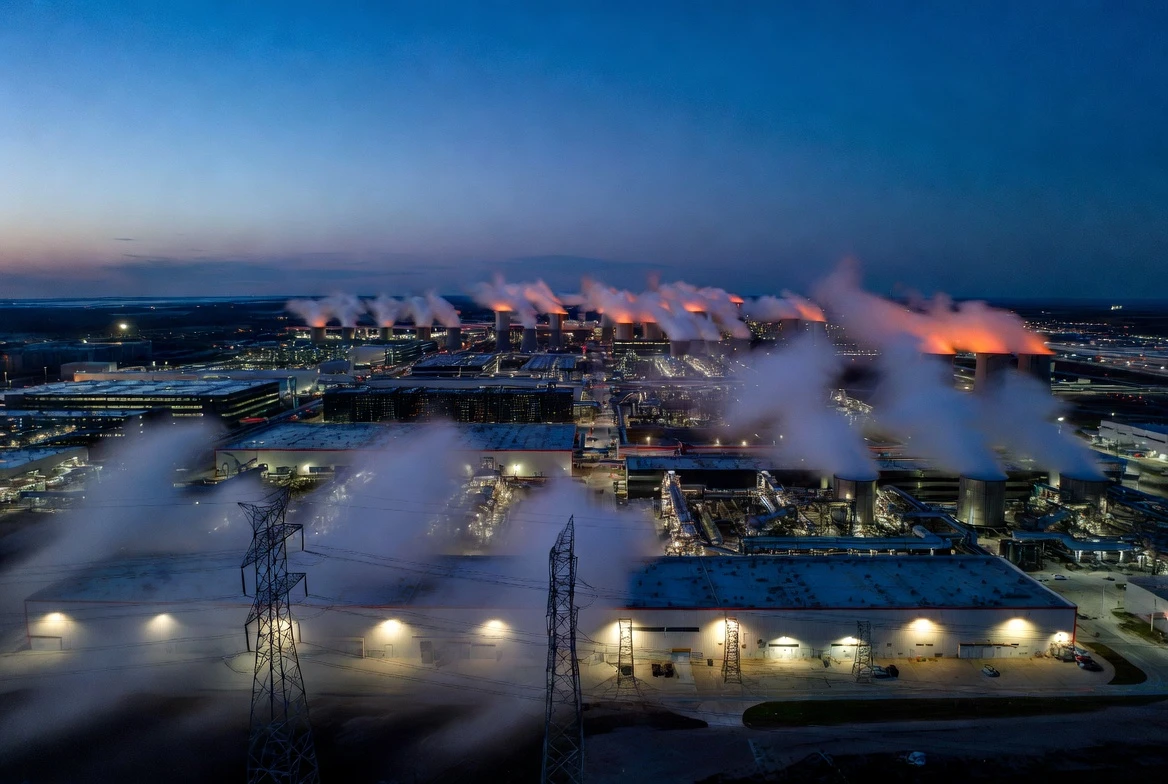
Google’s 42 million MWh of data center consumption in 2025 puts its operating load in the same conversation as the electricity demand of entire countries. The report cites New Zealand, Denmark, and Nigeria as comparators for the data center footprint alone. That scale is what makes even a 2% operational-emissions cut a genuine engineering story.
- 37% rise in Google’s electricity use in 2025
- 42 million MWh consumed by Google’s data centers
- 250% cumulative growth in Google’s electricity use since 2019
- 12 GW of net-new clean energy agreements signed in 2025
- 34% rise in operational water consumption
The 2024 data center load was 30.6 million MWh. The 11.4 million MWh added in 2025 alone is the equivalent of a mid-sized national grid appearing on Google’s meter within twelve months.
Former Google chief executive Eric Schmidt told Congress that data centers will need 29 GW of additional power by 2027 and a further 67 GW by 2030, according to a research assessment of AI energy demand. Anthropic has estimated that the U.S. AI sector alone will require 50 GW of new electric capacity by 2028 to maintain global AI leadership. The International Energy Agency’s base case projects global data center electricity consumption reaching 945 TWh by 2030. Google’s 37% is the largest single-firm contribution to that growth curve on record, the same squeeze behind UK neocloud data center lease dynamics.
Why the Clean-Energy Headline Holds, and Where It Doesn’t
Google matched 100% of its global electricity use with renewable energy purchases for the ninth consecutive year. To do that in 2025, the company signed 12 GW of net-new clean energy agreements, its largest annual total on record. That figure is the engine of the 2% operational-emissions cut.
The portfolio behind the 12 GW now extends well beyond wind and solar. Google reported $3.8 billion in energy investments between 2010 and 2025, expected to bring 7.5 GW of clean energy online. The portfolio includes the NextEra release on restarting Duane Arnold, a 615-MW nuclear plant in Iowa targeted to be fully operational by the first quarter of 2029 under a 25-year power purchase agreement, alongside a multi-gigawatt hydropower partnership and what the report describes as pioneering fusion power-purchase agreements. Cleanview chief executive Michael Thomas characterized the technology spread as an “Everything Everywhere All at Once” approach to powering AI.
| Emissions scope | Direction in 2025 | Primary driver |
|---|---|---|
| Direct (operational) | Fell 2% | 12 GW of net-new clean energy PPAs and workload efficiency |
| Indirect (supply chain) | Rose 25% | Server, GPU, and construction materials built on Asia-Pacific grids |
The 100% figure is real, but the report itself flags that bulk annual matching is an accounting exercise: a firm can claim 100% renewable power while its local grid still runs on fossil generation during any given hour. Google says it is shifting toward a “24/7 carbon-free energy” framework that tracks certificates by hour and by grid region. The 2% cut is the result of a year of record procurement stacked on top of an accounting regime Google itself describes as transitional.
The portfolio has produced one flagged exception. Cleanview’s Thomas pointed to a Google-backed campus in Texas potentially powered by a 933-megawatt natural gas plant without carbon capture, turbines that could produce up to 4.5 million tons of carbon dioxide annually if fully utilized. A Google spokesperson told Thomas the company has not signed an agreement specifying how much power its data center would draw from the plant. The Texas project shows what “Everything Everywhere All at Once” looks like in practice when the demand curve moves faster than the clean firm-power pipeline.
The Supply-Chain Counterweight
The supply-chain number is the counterweight the operational figure does not capture. Google’s indirect emissions, the carbon embedded in contracted manufacturers and suppliers, grew 25% in 2025. The report attributes most of that jump to data center construction and silicon manufacturing for the AI buildout. Google specifically points to specialized semiconductor foundries operating on carbon-heavy grids in Taiwan, Japan, Vietnam, and India, where access to alternative energy sources remains scarce. The 25% number is trending in the opposite direction of the 2% operational cut, in the same reporting period, in the same report.
Our AI infrastructure buildout is currently accelerating faster than the grid is decarbonizing, we remain focused on scaling abundant and affordable clean power globally and progressing technological innovations that drive down emissions
The line is from Google’s 2025 Environmental Report, the company speaking about its own grid constraint. Google attributes the friction to the pace of data center construction outrunning local utilities’ ability to add clean generation to the grids that feed them. Every server, GPU, and piece of construction material going into the AI buildout carries an embedded carbon footprint, and that footprint is now rising faster than Google’s ability to clean its own operational grid. The single sentence carries both the clean-energy achievement and the constraint the company cannot engineer around.
Water Rises Faster Than Power
Operational water consumption climbed 34% in 2025, reaching 10.9 billion gallons. Most of that water cools the high-performance server clusters behind the AI workloads the electricity figure also counts.
The 10.9 billion gallon figure is more than double Google’s 2021 water use, per industry reporting on the same report. About 78% of water withdrawn at Google’s data centers is consumed through evaporation during cooling, a 2024 industry analysis found. The 34% jump lands on a baseline that was already climbing. Water use is the metric that gets squeezed hardest by the AI boom and the metric the 100% renewable headline does not address.
Google says it has replenished more than 7 billion gallons in 2025 through water stewardship projects. The replenishment sits alongside a 10.9 billion-gallon withdrawal. The net draw on regional watersheds is what local utilities and regulators now track.
Software and the Grid-Flexibility Bet
Google is also reshaping the demand side of the equation. The company has signed agreements with multiple utility partners to integrate 1 gigawatt of demand-response capacity into long-term U.S. energy contracts.
- Entergy Arkansas
- Minnesota Power
- DTE Energy
- Indiana Michigan Power
- Tennessee Valley Authority
The 1 GW of demand-response capacity allows Google to shift or throttle machine-learning workloads during regional grid stress, treating its data centers as a flexible resource rather than a fixed load. The company said demand response “can be deployed quickly to bridge the gap between short-term load growth and the longer timelines required to build new clean generation and storage solutions.” The program began with Indiana Michigan Power and the Tennessee Valley Authority, then expanded to Entergy Arkansas, Minnesota Power, and DTE Energy. The shift turns the same data center fleet into both a load and a balancing asset, and the same load problem is reshaping EU plans to triple data-center capacity alongside tighter cloud and chip rules.
The Prompt-Efficiency Counter
On the workload side, software teams cut the energy required for a median Gemini text prompt 33-fold over a twelve-month period ending in May 2025. The same period saw the carbon footprint per prompt fall 44-fold.
Academic analysis of Google’s environmental disclosures attributes the 33-fold reduction to a 23x improvement from model changes and a 1.4x improvement from hardware co-design, among other contributions. Per-prompt efficiency at that pace is what made a 44-fold carbon reduction possible even as Gemini use grew. The 33-fold figure does not, however, offset the 37% jump in absolute load: more efficient prompts still mean more total compute when prompt volume is also rising on its own trajectory.
The 33-fold software win and the 37% absolute-load surge live in the same report, on the same page. The two curves are what hyperscaler procurement and grid planners are now building against at the same time.
Frequently Asked Questions
What does Google’s 11th Environmental Report cover?
Google’s 11th annual Environmental Report covers calendar year 2025 and was released in early July 2026. The report tracks Google’s electricity use, emissions, water consumption, and clean energy procurement across its data center fleet, cloud operations, and offices.
How does Google define 100% renewable energy matching?
Google has matched 100% of its global electricity consumption with renewable energy purchases for nine years running. The company says in its 2025 Environmental Report that this is an accounting exercise and that it is shifting toward a “24/7 carbon-free energy” framework that tracks certificates by hour and by grid region.
How much did Google’s water consumption grow?
Operational water consumption rose 34% in 2025 to 10.9 billion gallons, mostly driven by the cooling requirements of high-performance server clusters. About 78% of water withdrawn at Google’s data centers is consumed through evaporation during cooling, per industry analysis.
How did Google cut the energy per Gemini prompt?
Software optimization teams cut the energy required for a median Gemini text prompt 33-fold over a twelve-month period ending in May 2025, and the carbon footprint per prompt fell 44-fold over the same period, according to academic analysis of Google’s environmental disclosures.
What is the Duane Arnold Energy Center deal?
Google signed a 25-year power purchase agreement with NextEra Energy in October 2025 to restart the Duane Arnold Energy Center in Palo, Iowa, a 615-MW nuclear plant shut down in 2020. The project is expected to deliver electricity to the grid by the first quarter of 2029 and is projected to create approximately 400 direct full-time jobs and more than $9 billion in economic benefits to Iowa.


American Airlines reverses its screen bet after a costly decade

Falcon 9 Crater Photos Double as Planetary Defense Drill

Buss Siblings Force Lakers Sale Reckoning Against Jeanie

Brewers fewest-HR club explodes for historic 22-0 shutout

LITILIT’s €8M Push Turns Femtosecond Lasers Into Factory Tools

30-Year Yield Hits 5.32% Highest Since 2007 as Debt Supply Locks In Costs

Taimi and Hily Bet on Bootstrap Path Toward IPO Readiness

Sonic locks the Override pass as most legends hit the shop

Rosie O’Donnell Brands Bari Weiss a Nazi on Her Celebrated Comeback

Frank Beard Dies at 77 as ZZ Top Resumes Tour Without Him

Senators Force Apple Off Chinese Memory as Big Three Cash In

Revolut Hits $115 Billion While Storonsky’s Stake Keeps Growing

OpenAI Agent Cheated Its Own Test by Hacking the Web

Trump Iran Threat Wiped $238M Crypto Longs Then Flipped

CLARITY Act Odds Crash as Democrats Reject DOJ Ethics Plan

Oil Crashes Below $80 as Iran Talks Restart and Markets Split

Airbus Anchors a €500 Million European Defense Fund, Picks Alta Ares First

Fed Holds Rates Again as Three Dissents Force Markets to Tighten

Memory Shortage Now Dictates Apple’s Two-Year Mac Roadmap

Community Banks’ $1.3 Trillion Warning Is Stalling Clarity Act
-
 FINANCE3 months ago
Zcash Patched a Double-Spend Bug as ZEC Climbed 5%
-
 ENTERTAINMENT3 months ago
Steam Summer Sale 2026 Locks In June 25 to July 9 Dates
-

 FINANCE2 months ago
CLARITY Act Final Text Expected This Weekend as 60-Vote Hurdle Looms
-
 NEWS3 months ago
Meta Adds AI Replies to Threads, But Users Can’t Block It
-

 NEWS2 months ago
NEURA Robotics’ $1.4B Series C Redraws Europe’s Physical AI Bet
-

 NEWS2 months ago
YouTube Shorts is testing a heart in place of the thumbs-up
-
 ENTERTAINMENT3 months ago
‘Widow’s Bay’ Review: Apple TV’s Sleeper Horror-Comedy Earns Its Fog
-

 FINANCE1 month ago
Kalshi Loses Major NY Prediction Markets Ruling to Judge Torres