
NEWS
StretchSense Secures $2.3M to Transform Virtual Reality Training

Imagine trying to learn complex surgery or jet engine repair while holding a clumsy plastic controller in your hand. It disrupts the experience and breaks the immersion needed for deep learning.
StretchSense just secured $2.3 million in fresh funding to fix this exact problem by replacing controllers with high-tech gloves. This latest investment marks a major pivot for the company as it aims to bring realistic hand interactions to enterprise training worldwide.
Big Backing for a Hands-Free Future
The funding round was led by PXN Ventures and received significant support from Scottish Enterprise. This new injection of capital brings the total amount raised by the company to nearly $20 million over three rounds.
This financial boost is not just about keeping the lights on. It is a strategic move to fuel aggressive global expansion. The company plans to use these funds to scale its operations and refine its technology for broader markets.
Scottish Enterprise playing a key role highlights the company’s growing footprint in the United Kingdom.
While the company has roots in New Zealand, its focus on the European and American markets is intensifying. The investment will specifically support the development of their Centre of Excellence in Edinburgh.
Here is a quick breakdown of the funding landscape for StretchSense:
- Lead Investor: PXN Ventures
- Strategic Partner: Scottish Enterprise
- Total Raised to Date: Approximately $20 million
- Primary Goal: Global expansion of XR training solutions
The company is betting big that the future of virtual reality lies in enterprise solutions rather than just consumer gaming. They believe businesses are ready to invest in better training tools.
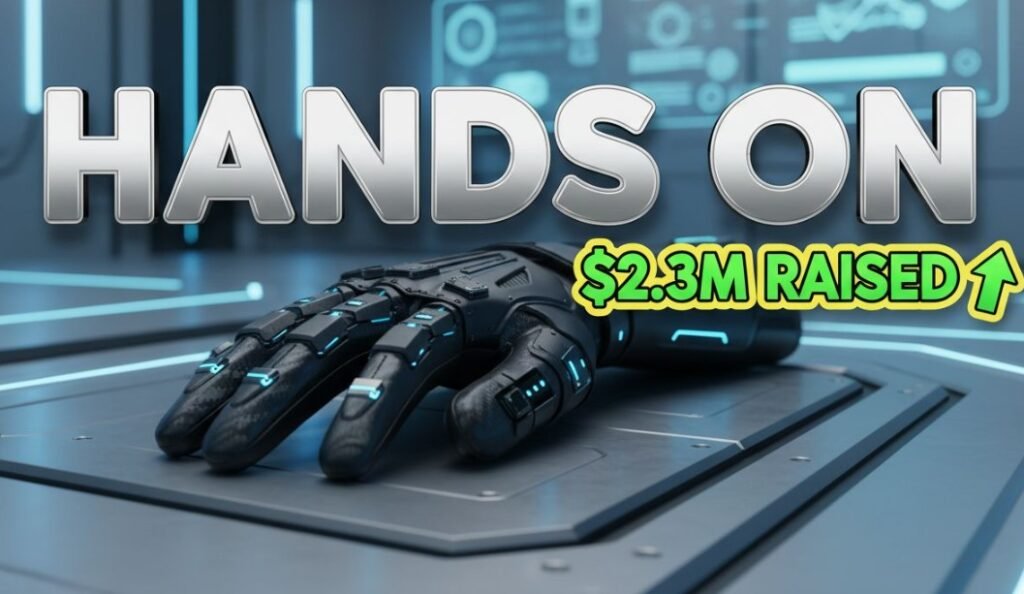
StretchSense XR training haptic gloves black background
The Problem with Plastic Controllers
Most virtual reality headsets today come with handheld controllers. These work fine for swinging a sword in a video game but fail miserably for professional training.
You cannot build muscle memory for delicate tasks if your hands are gripping a plastic stick.
StretchSense solves this by using proprietary stretch sensors woven directly into comfortable gloves. These sensors measure the precise movement of fingers and knuckles without any external cameras or bulky equipment.
The technology uses machine learning to interpret these movements in real time.
This allows a user to reach out and grab a virtual lever, turn a dial, or hold a medical instrument just like they would in the real world. The gloves also feature haptics which provide vibration feedback to simulate the feeling of touch.
“The XR Train glove powers scalable, truly immersive training, delivering intuitive interaction and measurable outcomes across enterprise and government environments.” — Chris Chapman, CEO of StretchSense.
The removal of controllers lowers the barrier to entry for new users. Trainees do not need to learn which button does what. They simply use their hands naturally.
From Hollywood Studios to Hospitals
StretchSense did not start in the boardroom. They actually built their reputation in the entertainment industry.
Their gloves have been a staple in Hollywood and the gaming industry for years. They are used by major studios for motion capture to animate characters in movies and video games.
Now they are taking that high-fidelity technology and applying it to serious industries.
The company has identified four key sectors where their technology can save lives and money:
- Healthcare: Surgeons can practice procedures without risk to patients.
- Aviation: Pilots can flip switches and manage cockpits realistically.
- Defence: Soldiers can train in hazardous scenarios safely.
- Education: Students can interact with complex machinery remotely.
The transition from entertainment to enterprise is a logical step for the company.
In the entertainment world, a slight glitch in finger tracking might just mean a retake. In aviation or healthcare training, precision is non-negotiable. The robust nature of their sensor technology makes them uniquely qualified to bridge this gap.
A New Leader with a Clear Vision
The company recently appointed Chris Chapman as the new CEO to steer this expansion. Chapman is no stranger to the business.
He previously served as an investor director and knows the company inside out. His appointment signals a shift from pure research and development towards aggressive commercial growth.
His strategy is clear. He wants to integrate physical interaction seamlessly into virtual environments.
The goal is to make the technology invisible so the user focuses entirely on the task.
Under his leadership, the company is looking ahead to 2026. The roadmap includes scaling the “XR Train” product line and establishing deeper partnerships with government and private entities.
The market for extended reality training is booming. Companies are realizing that VR training is safer and cheaper than real-world drills.
However, the hardware has lagged behind the software. StretchSense aims to be the missing link that makes VR training viable for mass adoption.
Their gloves are designed to be durable and even machine washable. This practical approach shows they understand the needs of daily business operations.
Why Muscle Memory Matters
The core value proposition of StretchSense goes beyond just looking cool. It is about the science of learning.
When you perform an action repeatedly with your hands, your brain creates neural pathways. This is called muscle memory.
Using a controller creates the wrong kind of muscle memory for professional tasks.
If a pilot learns to flip an emergency switch by pressing the ‘A’ button, that training does not translate well to a real emergency. They need to physically reach out and flip the switch.
StretchSense enables this direct transfer of skills.
By simulating the exact physical motions required in the real world, the training becomes significantly more effective. This reduces the time it takes to train staff and increases safety compliance.
Data capture is another massive advantage. The gloves do not just track movement for visual display.
They record data on how the trainee is moving. Instructors can analyze this data to see if a student is hesitating or using the wrong grip.
This level of insight was previously impossible to get without an instructor standing right next to the student. Now it can be done remotely and analyzed by algorithms.
With $2.3 million in the bank and a clear path forward, StretchSense is positioning itself as the standard for how we interact with the digital world. They are proving that the future of technology is not about more screens. It is about getting our hands back.


Entravel Raises $7.5M as Travel Booking Leaves Travel Sites

MSCA Partnerships Quietly Rebuild Europe’s Industry Talent Pipeline

EU Fund Takes Equity Stake as Lovable Hits $13.3bn

AOC Laughs Off Woke 1 as Hollywood Counts the Losses

Aptoide Lands in Google Play as Managed Rival After Epic Ruling

Eva Green and Samuel L. Jackson Scheme in Just Play Dead Trailer

Edge Opens Apple Account Door After Google to Chase Dual-Device Users

DJI Pocket 4P Wins on Dynamic Range Where It Ships

GTA 6 Preorders Skew to the $100 Ultimate Edition

Accel’s $800M Europe Fund Speeds Up Early AI Rounds

Senators Force Apple Off Chinese Memory as Big Three Cash In

Trump Iran Threat Wiped $238M Crypto Longs Then Flipped

OpenAI Agent Cheated Its Own Test by Hacking the Web

CLARITY Act Odds Crash as Democrats Reject DOJ Ethics Plan

Anthropic’s Hard Questions Ad Backfires Into an Anti-AI Warning

Revolut Hits $115 Billion While Storonsky’s Stake Keeps Growing

Gemini Spark’s Big Workspace Upgrade Leaves Europe Waiting Again

Oil Crashes Below $80 as Iran Talks Restart and Markets Split

Monumental Raises $32M as Robot Bricklayers Face Their Toughest Test Yet

Community Banks’ $1.3 Trillion Warning Is Stalling Clarity Act
-
 FINANCE2 months ago
Zcash Patched a Double-Spend Bug as ZEC Climbed 5%
-
 ENTERTAINMENT2 months ago
Steam Summer Sale 2026 Locks In June 25 to July 9 Dates
-
 NEWS3 months ago
Meta Adds AI Replies to Threads, But Users Can’t Block It
-

 FINANCE1 month ago
CLARITY Act Final Text Expected This Weekend as 60-Vote Hurdle Looms
-

 NEWS2 months ago
NEURA Robotics’ $1.4B Series C Redraws Europe’s Physical AI Bet
-

 NEWS2 months ago
YouTube Shorts is testing a heart in place of the thumbs-up
-
 ENTERTAINMENT3 months ago
‘Widow’s Bay’ Review: Apple TV’s Sleeper Horror-Comedy Earns Its Fog
-

 FINANCE1 month ago
Kalshi Loses Major NY Prediction Markets Ruling to Judge Torres