
NEWS
The 2027 BMW X5 Lands With First iX5 and Neue Klasse Tech
The fifth-generation 2027 BMW X5 launches in October with its first-ever all-electric iX5 variant, 435 miles of EPA range, 460 kW charging, and styling that is already dividing the brand.

The 2027 BMW X5 debuted on Tuesday at BMW’s Spartanburg, South Carolina assembly plant. It brings the broadest powertrain lineup in the model’s history, including the first-ever all-electric iX5 that adopts the technology stack from the Neue Klasse EVs. The launch caps a refresh cycle for the German mid-size luxury SUV trio that began earlier this year with the redesigned Audi Q7 and Mercedes-Benz GLE-Class. Production continues at the same Spartanburg plant that built the original X5 in 1999.
The iX5 60 xDrive, the launch electric variant, is rated at an estimated 435 miles of EPA range from a 144 kWh battery. It supports up to 460 kW of DC fast charging, enough to refill the pack from 10 to 80 percent in 22 minutes. The gas-powered X5 40 xDrive arrives first this fall at $71,250, with the plug-in X5 50e xDrive and the iX5 60 xDrive following early in 2027. A V8-powered M Performance variant is scheduled to arrive later in 2027, and the BMW iX5 Hydrogen will pair all-electric driving with quick refueling stops further ahead. The reveal gives BMW’s most important SUV its broadest reset since the model’s 1999 launch.
The Styling Reckoning
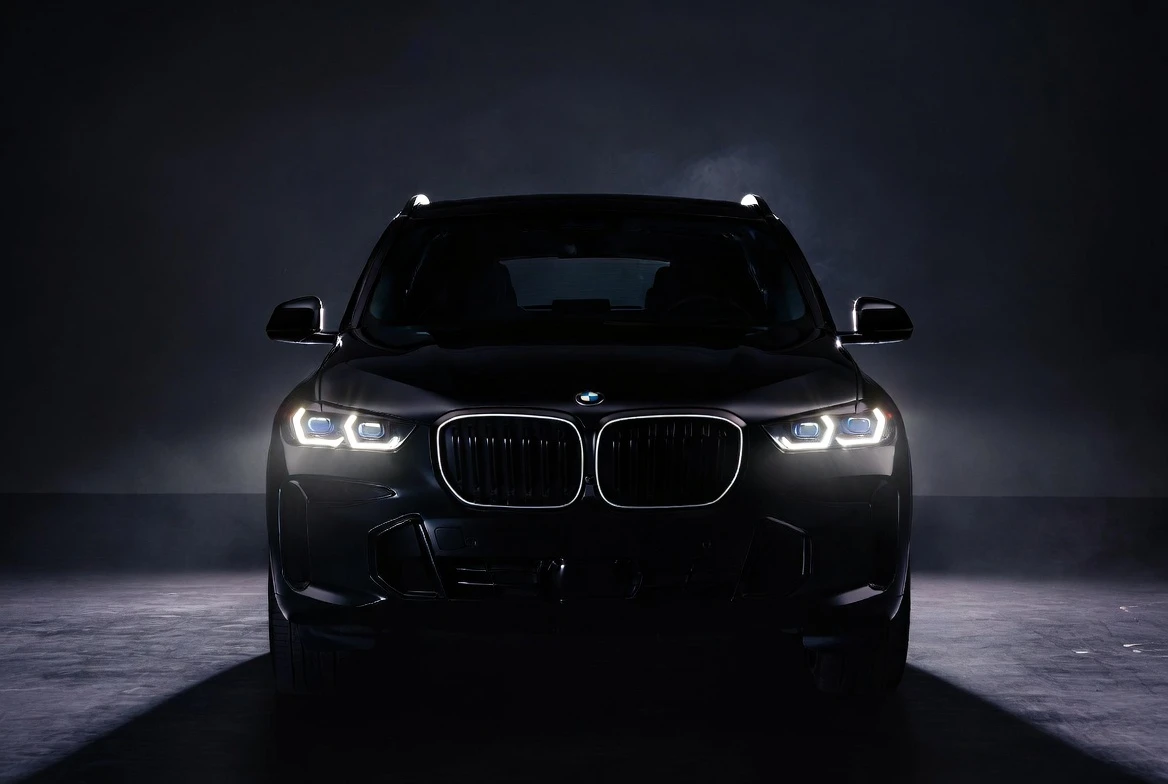
When the 2027 X5 was first shown to journalists in a warm warehouse-studio in Munich, BMW’s X-shaped headlights stared through a translucent curtain. “Are they serious?” was the first reaction from the SlashGear correspondent on hand. When the house lights came up, those deadeye lights were real, and so was the rest of the most visually aggressive X5 since the original.
The double-X lights can be switched off, reverting to diagonal hash marks, but the rest of the front end echoes the iX3 EV and moves the X5 further upscale than before. Product launch manager Nina McFadden called it the “highest front ever” on an X5. The elongated shape also makes the SUV look a bit wagon-like in rear three-quarter view. Boxy fenders add a touch of ruggedness to compensate, and the new BMW Winglet door handles are dainty little winglets integrated into the B- and C-pillars. The upright front is significantly taller than before, giving the SUV an imposing but precisely proportioned appearance, according to the press release announcing the new X5 and iX5.
In person, the new X5 feels more substantial than the current model and looks more like a smaller X7. The X-shaped lights and iX3-style grille can read as gimmicks. The vertical kidney Iconic Glow stays illuminated day and night, forming part of a Welcome Light animation that runs from approach to departure.
A More Luxurious Cabin
Standard soft-close doors set the tone inside the new X5 cabin, and they can be automated with the optional Luxury Package. Slate trim on the center console is a fresh alternative to the usual wood or carbon fiber, pairing well with the available crystal shifter, volume knob, and seat adjusters. Wrapround ambient lighting embedded in the dashboard and quilted material on the dash and door panels round out a cabin that finally feels as expensive as the price tag suggests. A backlit accent strip with integrated ambient lighting wraps from door to door and adjusts its color and brightness based on the time of day. The light strip continues into the doors, visually expanding the cabin.
BMW still gates several premium features behind optional packages. Ventilation and massage require the Luxury Seating Package or Climate Package, and Merino leather upholstery also lives on the options list. Four-zone climate control and a panoramic glass roof are standard, though the split tailgate that had been a signature X5 feature since the first-generation E53 model is gone for good.
The iX5 Becomes the New Flagship
Like the refreshed i7, the first-ever BMW iX5 combines a platform shared with internal-combustion models and tech from the Neue Klasse dedicated EVs. Both the Heart of Joy integrated vehicle dynamics controller and the Symbiotic Drive driver-assistance controller make their way into the iX5. They are designed to make driver aids feel more natural and complementary to the driver’s inputs. The iX5 also uses cylindrical battery cells with the same chemistry as Neue Klasse models, but the cells are taller, boosting usable capacity by 30 percent.
The usable capacity of the entire pack is 144 kilowatt-hours. BMW estimates that will provide up to 435 miles of EPA range, a preliminary estimate based on BMW AG testing following EPA testing procedures. Another standout figure is the maximum DC fast-charging power rate of 460 kilowatts, enabled by an 800-volt electrical architecture derived from the Neue Klasse. At maximum power, a 10 to 80 percent charge takes 22 minutes, and 170 miles of range can be added in just 10 minutes. A standard 15.4 kW AC onboard charger is needed to recharge that massive pack overnight. The 800-volt architecture also enables practical bidirectional charging for the iX5.
At launch, the iX5 will be the quickest and most powerful X5 model available in the U.S. Its dual-motor powertrain generates 570 horsepower and 593 pound-feet of torque, enabling a zero-to-60 mph time of 4.4 seconds. Top speed is electronically limited to 130 mph.
Beyond the headline figures, the iX5 is also the first all-electric vehicle to come from BMW’s Spartanburg plant. A new sixth-generation high-voltage battery facility in nearby Woodruff, South Carolina supplies the packs. BMW says the Woodruff plant requires no fossil fuels for normal operations. The fifth-generation X5 lineup also introduces BMW Operating System X, a free-cut Central Display, and BMW Panoramic Vision spanning the base of the windshield.
Five Powertrains Under One Roof
BMW calls the new X5 the first model in its lineup to launch with five drive system types. In the U.S., the rollout starts with the gas-only X5 40, the plug-in X5 50e xDrive, and the all-electric iX5 60 xDrive. A V8-powered M Performance variant arrives later in 2027, and the iX5 Hydrogen follows further out.
The base X5 40 will be available with rear-wheel drive or xDrive all-wheel drive. It uses an updated version of the B58 turbocharged 3.0-liter inline-six teamed with a 48-volt mild hybrid system and an eight-speed automatic transmission. A new turbo raises output by 19 horsepower and 45 pound-feet of torque, to 394 hp and 428 lb-ft. BMW quotes zero-to-60 mph times of 5.1 seconds from a standing start, or 4.8 seconds with a one-foot rollout. Top speed is electronically limited to 155 mph, with adaptive air suspension standard.
The plug-in hybrid X5 50e xDrive adds an electric motor integrated with the transmission, boosting total system output to 483 hp and 516 lb-ft. BMW estimates a 4.6 second zero-to-60 run and 44 miles of electric range in EPA testing. The PHEV also unlocks the option of an active anti-roll system. Standard 40/20/40 split-folding rear seats remain, with BMW claiming increased rear-seat knee room from a 2.4-inch wheelbase stretch compared to the previous-generation X5.
The five powertrain types arriving for the X5 over the next 18 months:
- Inline-six gasoline with 48V mild hybrid (X5 40)
- Plug-in hybrid (X5 50e xDrive)
- Battery-electric (iX5 60 xDrive)
- V8 M Performance (arriving 2027)
- Hydrogen fuel cell (iX5 Hydrogen, future)
| Variant | Power | Torque | 0-60 mph | Range / electric range |
|---|---|---|---|---|
| X5 40 (RWD / xDrive) | 394 hp | 428 lb-ft | 5.1 sec | Gasoline, 48V mild hybrid |
| X5 50e xDrive | 483 hp | 516 lb-ft | 4.6 sec | 44 miles electric (EPA est.) |
| iX5 60 xDrive | 570 hp | 593 lb-ft | 4.4 sec | 435 miles EPA (est.) |
Pricing and the German Rivalry
Pricing starts at $71,250 for the base rear-wheel-drive X5 40, a couple of thousand dollars more than a 2026 base model. The price hike reflects the infusion of new features. All-wheel drive is an extra $2,300, putting the X5 40 xDrive at $73,550. The X5 50e xDrive plug-in hybrid starts at $78,950 with standard all-wheel drive. The iX5 60 xDrive starts at $81,250, appreciably cheaper than an all-wheel-drive version of the iX it effectively replaces.
The new X5 faces competition from BMW’s traditional rivals. The redesigned 2027 Audi Q7 and the Mercedes-Benz GLE-Class are both new for 2027. Audi is avoiding electrified powertrains for now, but Mercedes packed the GLE lineup with both a plug-in hybrid and an AMG performance model with a 603-hp V8.
The Playbook That Built the Original X5
BMW has built the X5 at Plant Spartanburg since its 1999 debut, when the model founded the segment. The new X5 continues that run, and the iX5 makes the South Carolina plant the home of BMW’s first all-electric vehicle built in the United States. A new sixth-generation high-voltage battery facility in nearby Woodruff, South Carolina supplies the packs for the iX5. BMW says the Woodruff plant requires no fossil fuels for normal operations.
BMW will likely have an answer to the Mercedes-AMG V8 eventually. As the third of the trio to show its revamped mid-size SUV, BMW is following rather than leading. That was also the case with the original X5, which came after the genre-defining Mercedes M-Class.
With its imposing presence and flawless symbiosis of comfort and driving pleasure, the BMW X5 became a global bestseller. And now the latest generation also benefits from the technologies in the Neue Klasse and the widest possible range of drive systems. As a result, I’m sure the new BMW X5 will set the benchmark in its class once again and write the next chapter in its success story.
That is Dr. Joachim Post, BMW’s board member for development, speaking at the June 30 reveal at Plant Spartanburg. The next chapter opens this October, when the X5 40 xDrive arrives at U.S. dealers. BMW did not announce pricing for the V8 M Performance variant or the iX5 Hydrogen on June 30. Both are scheduled to reach U.S. buyers within the next 18 months.
Frequently Asked Questions
When does the 2027 BMW X5 go on sale?
The X5 40 xDrive reaches U.S. dealers in October 2026, BMW said on June 30. The rear-wheel-drive X5 40, the plug-in hybrid X5 50e xDrive, and the all-electric iX5 60 xDrive are scheduled to follow in the first quarter of 2027. A V8-powered M Performance variant arrives later in 2027.
How much does the 2027 BMW X5 cost?
The 2027 X5 starts at $69,800 MSRP for the rear-wheel-drive X5 40, rising to $72,100 for the X5 40 xDrive, $77,500 for the X5 50e xDrive PHEV, and $79,800 for the iX5 60 xDrive electric. BMW adds a separate $1,450 destination and handling charge to each. The iX5 60 xDrive at $79,800 is appreciably cheaper than the all-wheel-drive iX it effectively replaces.
What is the electric range of the iX5 60 xDrive?
BMW estimates up to 435 miles of EPA range for the iX5 60 xDrive, drawn from a 144 kWh usable battery pack with sixth-generation cylindrical cells. The cells are taller than standard Neue Klasse cells, boosting usable capacity by 30 percent, BMW claims. The 800-volt architecture supports up to 460 kW of DC fast charging, taking the pack from 10 to 80 percent in 22 minutes.
How fast does the iX5 charge compared to rivals?
At peak 460 kW power, the iX5 can add 170 miles of range in 10 minutes and complete a 10 to 80 percent charge in 22 minutes. Audi does not offer an electrified Q7 for 2027. Mercedes has not released peak charging figures for the redesigned GLE plug-in hybrid.


Pixel Journal Auto Format Puts Google Private AI to the Diary Test

Android 17 QPR2 Beta 3 Quietly Delivers Native App Lock

Binance Cuts HTX Rails and Seals Off High-Risk Liquidity

Dell 14S Quietly Delivers Multi-Day Battery in Midrange Aluminum

OCC Conditionally Clears Trump-Linked USD1 Trust Bank

Coyote vs. Acme Turns Its Own Burial Into the Sharpest Gag

Google Health Adds Off Switch After AI Coach Clutter Backlash

SpaceX Issues 389 Million Shares as Cursor Deal Closes

Bank Leumi Hands Galaxy the Rails for Israeli Crypto Trading

Apple Maps Ad Bookings Open and Turn Local Search Into a Bid Game

Senators Force Apple Off Chinese Memory as Big Three Cash In

Trump Iran Threat Wiped $238M Crypto Longs Then Flipped

OpenAI Agent Cheated Its Own Test by Hacking the Web

CLARITY Act Odds Crash as Democrats Reject DOJ Ethics Plan

Revolut Hits $115 Billion While Storonsky’s Stake Keeps Growing

Anthropic’s Hard Questions Ad Backfires Into an Anti-AI Warning

Oil Crashes Below $80 as Iran Talks Restart and Markets Split

Community Banks’ $1.3 Trillion Warning Is Stalling Clarity Act

Duda’s New AI Tools Speed Up Agencies, but Risk Sameness

Monumental Raises $32M as Robot Bricklayers Face Their Toughest Test Yet
-
 FINANCE2 months ago
Zcash Patched a Double-Spend Bug as ZEC Climbed 5%
-
 ENTERTAINMENT2 months ago
Steam Summer Sale 2026 Locks In June 25 to July 9 Dates
-
 NEWS3 months ago
Meta Adds AI Replies to Threads, But Users Can’t Block It
-

 FINANCE1 month ago
CLARITY Act Final Text Expected This Weekend as 60-Vote Hurdle Looms
-

 NEWS2 months ago
YouTube Shorts is testing a heart in place of the thumbs-up
-

 NEWS2 months ago
NEURA Robotics’ $1.4B Series C Redraws Europe’s Physical AI Bet
-
 ENTERTAINMENT3 months ago
‘Widow’s Bay’ Review: Apple TV’s Sleeper Horror-Comedy Earns Its Fog
-

 FINANCE1 month ago
Kalshi Loses Major NY Prediction Markets Ruling to Judge Torres