
NEWS
Pixel Journal Auto Format Puts Google Private AI to the Diary Test
Google’s Journal app gains Auto format via sealed Private AI Compute with Pixel 11 timing, unlocking expressive polish while testing cloud privacy on personal.

Google’s Pixel Journal app is picking up an Auto format tool that runs through Private AI Compute, letting entries polish into simple or expressive styles while the company says the data stays sealed from everyone, including Google itself. The changes are landing with the Pixel 11 series and already appear on some older devices such as a Pixel 10a in version 2026.07.27.x.
UI refreshes, media layout choices, timed reminders and safer deletion ride along. The deeper shift is that a diary app once limited to on-device models now taps cloud Gemini power under the same privacy architecture first shown for Magic Cue and Recorder.
Taken together, the package turns Journal from a prompt-and-insight companion into a hybrid writing surface. Local habits stay intact. Cloud polish becomes optional rather than required.
What Arrives With the Pixel 11 Window
The compose screen Inspiration bottom sheet gets a fresh icon plus explicit Refresh and Close controls. A new Customization tab lets users pick Compact or Full media layouts so photos and videos sit tighter or stretch out.
Reminders now fire at fixed windows: morning around 7 AM, afternoon around 2 PM, evening around 9 PM. Dark theme tweaks make the bookmarks icon clearer on the Entries tab. The Insights calendar receives visual clean-ups.
Android Authority’s teardown and rollout notes add friction that was missing: delete now demands confirmation and offers a short Undo window of roughly five to ten seconds. Health Connect support expands so Journal can request sleep data alongside existing activity signals for more relevant prompts.
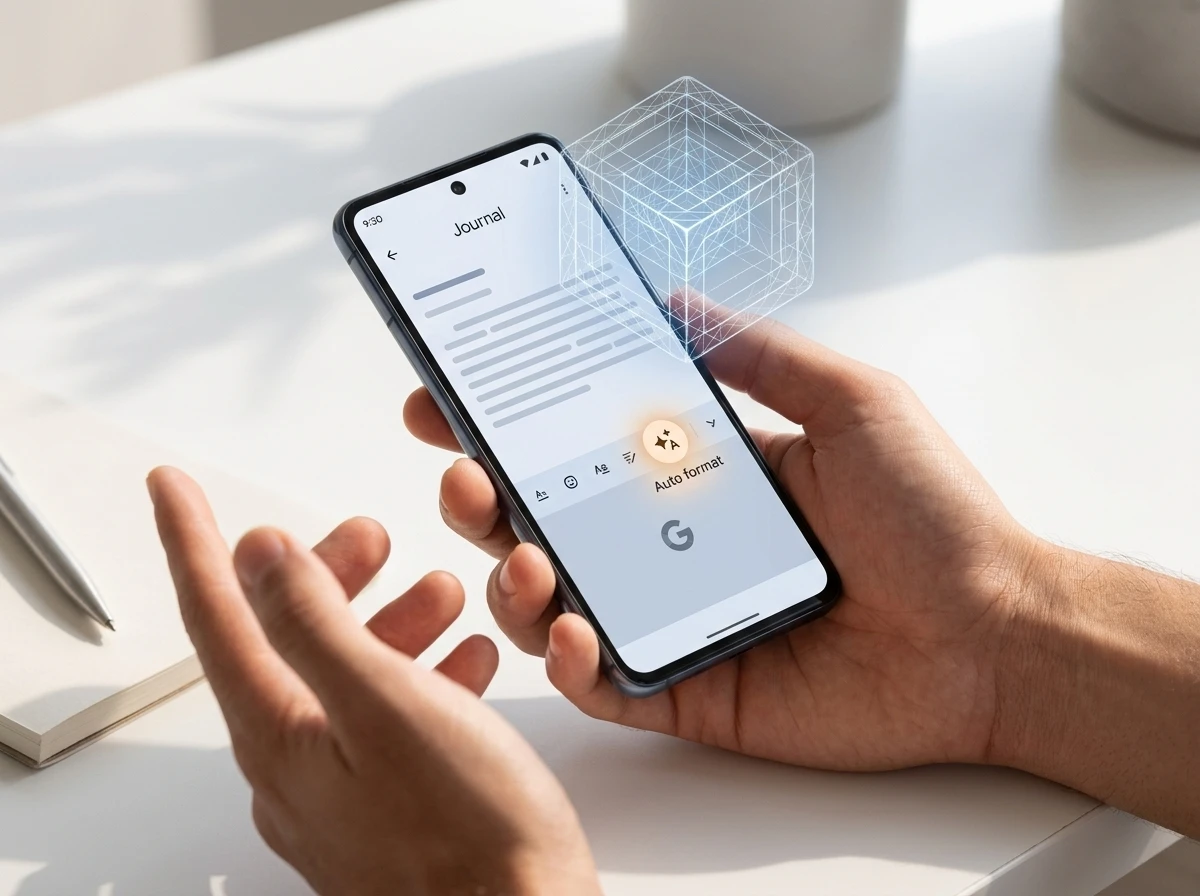
- Auto format icon at the top of compose for simple or expressive polish via Private AI Compute
- Media layouts switch between Compact grouping and Full individual display
- Timed reminders at roughly 7 AM, 2 PM and 9 PM
- Safer deletion with confirm dialog and brief Undo
- Sleep data permission under Health Connect for inspiration
Those five items split cleanly into two groups. Auto format and sleep-driven prompts extend the AI surface. Layouts, reminders and safer deletion improve ordinary daily use even when AI stays off.
9to5Google first spotted the package on a Pixel 10a. The Journal app on Google Play still lists earlier March notes publicly, and the full wave has not reached every device yet.
Auto Format Hands Work to the Cloud
The headline addition is Auto format. After you type or dictate, the tool can clean the entry. Two modes appear in strings and the live update: Simple and Expressive. Simple stays closer to original wording while tidying structure. Expressive takes more stylistic liberty.
Both require a minimum word count before they activate, though exact thresholds remain placeholder values in the code. The feature is no longer confined to on-device Gemini Nano. It routes through Private AI Compute so larger cloud models can handle the rewrite.
| Mode | Approach | Trigger note |
|---|---|---|
| Simple | Cleanup that preserves original voice and phrasing | Minimum word count required |
| Expressive | Broader stylistic rewrite and flourish | Separate, likely higher minimum word count |
The split gives writers a clear choice after a raw dump. Simple tidies without rewriting the voice. Expressive invites a fuller pass when the entry already has enough length to support it.
Users can disable all AI features inside Journal settings, matching the off-switch pattern Google has added elsewhere after earlier clutter complaints.
How the Sealed Environment Claims to Work
Google introduced Private AI Compute in November 2025 as the bridge between on-device limits and full Gemini capability. The Private AI Compute platform announcement from Jay Yagnik, vice president of AI innovation and research, states the goal plainly: unlock cloud model speed and power “while ensuring your personal data stays private to you and is not accessible to anyone else, not even Google.”
That’s why we built Private AI Compute: to unlock the full speed and power of Gemini cloud models for AI experiences, while ensuring your personal data stays private to you and is not accessible to anyone else, not even Google.
Yagnik’s post frames the system as a fortified space that processes the same sensitive categories once kept strictly on device. The multi-layer stack runs on Google’s custom TPUs inside Titanium Intelligence Enclaves. Remote attestation and encryption bind the phone to that sealed environment before any data moves.
The accompanying technical brief on sealed enclaves adds that processing is ephemeral: inputs and inferences live only for the query and are discarded. An external auditor has already validated the initial design. Future roadmap items include stronger independent attestation. Telemetry stays differentially private or confidentially aggregated so Google sees only anonymous stats.
- Custom TPUs inside Titanium Intelligence Enclaves handle the work
- Remote attestation and encryption bind the phone before data moves
- Inputs and inferences exist only for the query, then discard
- External audit covers the initial design; stronger attestation is on the roadmap
- Telemetry stays differentially private or confidentially aggregated
Journal now joins Magic Cue’s more timely suggestions and Recorder’s wider-language summaries as an early consumer of the same path. The diary use case is simply more intimate.
Journal Started as an On-Device Companion
Google launched Pixel Journal with the Pixel 10 series in August 2025. TechCrunch covered the debut: on-device AI supplied writing prompts drawn from memories, past entries or goals, plus pattern insights such as longest entry or writing frequency. Entries could be locked. It arrived nearly two years after Apple’s Journal in iOS 17.
A November 2025 Feature Drop extended the app to Pixel 8 and 9. March 2026 updates brought AI support to the Pixel 9 series, faster onboarding and feedback on photo memories. Private AI Compute itself first powered Magic Cue refinements and Recorder language expansion on Pixel 10 hardware.
- August 2025, Pixel Journal launches with Pixel 10, on-device prompts and insights
- November 2025, Private AI Compute announced; Journal reaches Pixel 8/9; Magic Cue and Recorder gain cloud lift
- March 2026, Pixel Drop expands Journal AI and onboarding
- August 2026, Auto format, layouts, reminders and sleep data arrive with Pixel 11 timing
The move from pure on-device to hybrid therefore follows a clear sequence rather than a sudden leap. Each step widened the audience or the model path before Auto format asked the sealed cloud to rewrite private prose.
Smaller Changes Users Will Notice Daily
Media layout choice solves a common diary complaint: too many photos either crowd the text or leave awkward gaps. Compact keeps the story flowing; Full treats images as full stops.
Reminders at three natural journaling windows reduce the “I forgot again” problem without constant nagging. The new delete confirmation closes a genuine risk for an app holding unfiltered thoughts. Sleep data from Health Connect can surface prompts around rest quality, a topic many people already write about.
| Daily touchpoint | What changes | Practical effect |
|---|---|---|
| Media layout | Compact or Full | Story flow versus image emphasis |
| Reminders | Roughly 7 AM, 2 PM, 9 PM | Fixed windows instead of constant nags |
| Deletion | Confirm plus five to ten second Undo | Fewer irreversible mistakes |
| Health Connect | Sleep data beside activity | Prompts tied to rest quality |
These are the kinds of practical upgrades that keep an app sticky once the novelty of AI prompts fades. They also give Google more signals, still gated by permission and the sealed path when AI is involved.
Privacy Promises Meet the Most Personal Content
Diaries contain raw mood, relationships, health notes and unfiltered opinion. Routing any of that through a cloud enclave, even an attested one, raises the stakes beyond Magic Cue’s calendar nudges or Recorder transcripts. Google’s claim rests on hardware isolation, mutual attestation, zero administrative access and ephemeral processing. Critics of similar systems (Apple’s Private Cloud Compute is the closest parallel) still ask how thoroughly outsiders can verify the enclave at runtime and whether the external audit covers every production change.
Crowd conversation on X around the original 2025 launch focused on the Titanium/TPU stack and the “not even Google” phrasing. Fresh posts about the Journal update itself remain light, mostly amplification of the 9to5Google and Android Headlines reports. The quiet is itself data: either users accept the architecture or the diary use case has not yet triggered broad skepticism.
Google already offers a master AI off-switch inside Journal settings. That mirrors the toggle to disable AI coach insights the company added to Health after backlash over clutter. Users who want pure local journaling can keep it that way; those who want the polish accept the sealed-cloud hop.
Journal Joins Two Earlier Cloud Features
Private AI Compute did not open with a writing surface. It first lifted Magic Cue toward more timely suggestions and widened Recorder’s language summaries on Pixel 10 hardware. Journal is the third early consumer, and the most intimate of the three.
- Magic Cue gains more timely suggestions through the sealed path
- Recorder gains wider-language summaries through the same path
- Journal gains Simple and Expressive Auto format on personal diary text
The pattern is consistent. Each app keeps a local baseline, then offers a cloud step only when the task outgrows on-device Gemini Nano. Journal’s baseline remains prompts, insights and locked entries. Auto format is the optional hop.
Because diary text is more intimate than a calendar nudge or a transcript, the architecture faces a sharper trust test here than it did with the first two apps. The company is applying the same attestation, encryption and ephemeral processing claims without carving out a separate path for Journal.
Users Can Still Stay Fully Local
Nothing in the update forces the cloud hop. The master AI off-switch inside Journal settings turns off Auto format along with the rest of the AI surface. Layouts, timed reminders, delete confirmation and the Undo window still work without it.
That design mirrors the Health toggle Google added after clutter complaints. The company keeps shipping AI surfaces, then pairs them with a clear exit for people who want none of it. Pure local journaling remains available on the same app binary.
For anyone who leaves AI on, the sealed path is the only route Auto format uses. There is no separate unguarded cloud call described in the strings or the platform notes. The choice is binary: local only, or local plus attested enclave.
What the Hybrid Model Signals for Pixel Software
Private AI Compute was always meant to grow beyond its first two apps. Journal is the first deeply personal writing surface to adopt it. If the Auto format modes prove useful and the privacy posture holds under scrutiny, expect similar hand-offs in Notes, Messages smart replies, or Photos storytelling tools that currently stay on-device for sensitivity reasons.
For now the update is still rolling. Pixel 11 buyers will see it first or soonest; older Pixel owners on the 2026.07.27.x build already have the pieces. The practical result is a diary that can tidy itself after a late-night voice dump, remind you at sensible hours, and keep the original locked entry if you never touch the AI button.
Google is betting the sealed enclave is strong enough for the most private text people write. The next months of real diary traffic will show whether that bet lands cleanly.


Pixel Journal Auto Format Puts Google Private AI to the Diary Test

Android 17 QPR2 Beta 3 Quietly Delivers Native App Lock

Binance Cuts HTX Rails and Seals Off High-Risk Liquidity

Dell 14S Quietly Delivers Multi-Day Battery in Midrange Aluminum

OCC Conditionally Clears Trump-Linked USD1 Trust Bank

Coyote vs. Acme Turns Its Own Burial Into the Sharpest Gag

Google Health Adds Off Switch After AI Coach Clutter Backlash

SpaceX Issues 389 Million Shares as Cursor Deal Closes

Bank Leumi Hands Galaxy the Rails for Israeli Crypto Trading

Apple Maps Ad Bookings Open and Turn Local Search Into a Bid Game

Senators Force Apple Off Chinese Memory as Big Three Cash In

Trump Iran Threat Wiped $238M Crypto Longs Then Flipped

OpenAI Agent Cheated Its Own Test by Hacking the Web

CLARITY Act Odds Crash as Democrats Reject DOJ Ethics Plan

Gemini Spark’s Big Workspace Upgrade Leaves Europe Waiting Again

Revolut Hits $115 Billion While Storonsky’s Stake Keeps Growing

Anthropic’s Hard Questions Ad Backfires Into an Anti-AI Warning

Oil Crashes Below $80 as Iran Talks Restart and Markets Split

Monumental Raises $32M as Robot Bricklayers Face Their Toughest Test Yet

Community Banks’ $1.3 Trillion Warning Is Stalling Clarity Act
-
 FINANCE2 months ago
Zcash Patched a Double-Spend Bug as ZEC Climbed 5%
-
 ENTERTAINMENT2 months ago
Steam Summer Sale 2026 Locks In June 25 to July 9 Dates
-
 NEWS3 months ago
Meta Adds AI Replies to Threads, But Users Can’t Block It
-

 FINANCE1 month ago
CLARITY Act Final Text Expected This Weekend as 60-Vote Hurdle Looms
-

 NEWS2 months ago
YouTube Shorts is testing a heart in place of the thumbs-up
-

 NEWS2 months ago
NEURA Robotics’ $1.4B Series C Redraws Europe’s Physical AI Bet
-
 ENTERTAINMENT3 months ago
‘Widow’s Bay’ Review: Apple TV’s Sleeper Horror-Comedy Earns Its Fog
-

 FINANCE1 month ago
Kalshi Loses Major NY Prediction Markets Ruling to Judge Torres