
NEWS
VivaTech 2026 Drew 200,000 Visitors Behind a Sovereignty Push
VivaTech 2026’s 10th edition drew 200,000 visitors to Paris Expo Porte de Versailles, an AI sovereignty turn, the first Bloomberg Awards and Modi on stage.

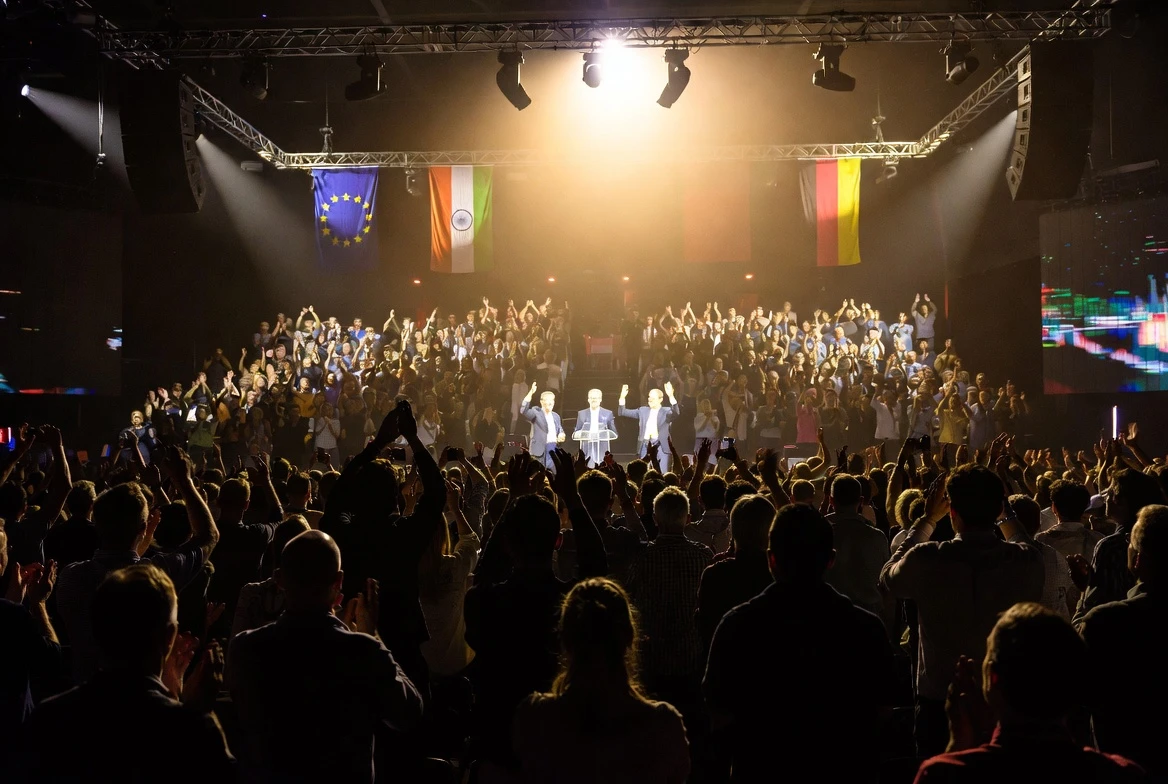
VivaTech closed its 10th edition on June 20, 2026, with more than 200,000 visitors, 4,500 exhibitors and 1,155 speakers passing through the new Hall 7 at Paris Expo Porte de Versailles.
The anniversary, opened by French President Emmanuel Macron and Indian Prime Minister Narendra Modi, set an attendance record for the show and confirmed a quiet rebrand: Viva Technology is now formally called VivaTech. Beneath the milestone numbers ran a more pointed theme. The 2026 program was built around AI sovereignty, defense tech and the operations layer that turns AI models into revenue, with the same speakers who toasted the show’s scale spending much of it warning that Europe must own the technology it runs on, and that AI value has moved from training to deployment.
A 10th Anniversary Built on Scale
Four days, 165 nationalities, 60 country pavilions, 15,000 startups. The numbers from VivaTech’s official closing press release for the 10th edition put the show at its largest in a decade. The first edition in 2016 drew 45,000 visitors; ten editions later, the floor passed 200,000 visitors for the first time.
The venue moved with it. The 2026 show sat inside the new Hall 7 at Porte de Versailles, a 70,000 square metre, three-floor space that grew exhibition capacity by 30% over 2025 and doubled conference seating to 5,200. The edition also marked a quiet naming change: the show’s full title shifted from “Viva Technology” to the shorter “VivaTech” used by attendees and partners, with the speakers and award winners listed on the full 2026 VivaTech speakers list. Lévy, the show’s co-president and Emeritus Chairman of Publicis Groupe, called the move “a change of dimension” for the show.
- 200,000 visitors
- 165 nationalities and 60 country pavilions
- 1,155 speakers across five themes
- 4,500 exhibitors (61% international)
- 5 billion+ cumulative social media reach
Beneath the Celebration, an AI Sovereignty Sprint
If one message moved through the programme faster than the others, it was AI sovereignty. The show’s own recap counts 175 sessions with the word “sovereignty” in the title, and the European Commission used the show to push for an updated EU Chips Act, more AI data centres on European soil and a string of AI gigafactories across member states. “Europe must not stop at using future technologies; it must create them itself,” European Commission Executive Vice-President Henna Virkkunen said in Paris.
Christel Heydemann, chief executive of Orange, put the same point more bluntly. The question in front of European industry is no longer which company trains the best model, she said, but which one keeps control of the data, infrastructure and operating environments underneath. Thomas Wolf, co-founder of the open-source AI platform Hugging Face, told the audience that concentration is the greater danger. Heydemann’s framing tracked with what the Commission’s executive suites were pushing in the show’s side rooms.
It is very bad for humanity for two or three companies to own the entire layer of intelligence.
That was Thomas Wolf’s framing. Alibaba co-founder Joe Tsai, accepting the show’s Leadership Award, gave the same argument a procurement edge: “Right now, all of your eggs are in one basket,” Tsai said, urging European buyers to keep options open across regions. The combined message is that the AI sovereignty turn has spread beyond regulators into the C-suites of European telecoms, the leadership of open-source foundations and the chairmanships of Chinese cloud giants, all of whom made the same point on the same Paris stage.
From Models to Operations, Where AI Value Lives Now
Underneath the sovereignty language sat a quieter message about returns. A McKinsey analysis carried into the show’s press rooms pointed to a wide gap: while 80% of global conglomerates are investing in AI, only 6% are seeing profit improvements. The metric set the stage for what several speakers called a shift away from the model wars toward an operations era.
OpenAI’s Thibault Sottiaux, head of product and platform, was at the show to talk about the practical deployment layer that follows the foundation-model race. He pointed to Codex, OpenAI’s coding agent, whose usage in France has grown ninefold in the past year. The fastest-growing user group is office workers, with email sorting, investment review, data research and fundraising preparation now commonly handled by AI agents inside French companies. Sottiaux said the gap between capability and use is the real question of the year.
The gap between what current models can do and what people actually use is wider than ever.
That was Sottiaux’s framing. Jeff Bezos introduced Prometheus, an AI project he described as specialised for physical engineering, focused on the build and operations side of the physical world. Bezos laid out a case that future compute will sit in space, manufacturing and energy systems.
Bezos’s pitch was unusually direct. “We go to space not for space,” he said. “We go for Earth.” Booking.com’s chief executive Glenn Fogel gave a traveller-scale version of the same point: AI that knows you need to book a flight from Paris to London and handles the whole itinerary before you ask. The connecting thread was that operational, agent-style AI is where European competition is heading now, once the model build-out settles.
Berlin Takes the Booth, Modi Takes the Stage
Country of the Year honours have swung between regions in past editions. For its 10th, VivaTech placed Germany front and centre, with Berlin mounting the show’s largest country pavilion to date. The booth spans 800 square metres, the biggest in VivaTech’s history, and the German delegation included federal ministers, fourteen Länder and roughly 200 startups. Two ministers led the delegation: Karsten Wildberger for Digital Transformation and Government Modernisation, and Dorothée Bär for Research, Technology and Space.
India took the parallel headline role. Narendra Modi was named AI Country Partner 2026, with the prime minister’s presence built around the follow-through to the AI Summit in New Delhi. Several Indian AI companies used the floor to pitch into European buyers.
- Germany: Country of the Year 2026, 800 sq m pavilion, roughly 200 startups, 14 Länder, ministers Wildberger and Bär
- India: AI Country Partner 2026, delegation led by Prime Minister Modi, continuation of the AI Summit in New Delhi
- France: Emmanuel Macron opened the show and co-hosted the main-stage moment with Modi
Macron and Modi took the stage together, the first time the French Republic and India have shared a main-stage moment at a European tech conference. The cross-border signalling was deliberate: Indian AI infrastructure and German industrial scale as complements to French AI policy. Paris remains the convening platform of choice for cross-border tech diplomacy in Europe.
Bloomberg Joins the Awards Stage for the First Time
For the first time, the show handed out a new slate of leadership awards jointly with Bloomberg. Seven awards were announced on June 18 at the VivaTech Theatre inside Hall 7, hosted by Bloomberg Television’s Francine Lacqua and Tom Mackenzie. The categories ranged from lifetime achievement to investor conviction, and the broader message was that the show now sees itself as a venue for declaring who runs global tech and for convening the platforms those companies use. The 2026 rollout honoured Tim Berners-Lee’s work on Inrupt and the Solid protocol (Visionary), Joe Tsai’s chairmanship of Alibaba (Leadership) and Yann LeCun’s post-Meta venture AMI Labs (Momentum).
A separate track of startup prizes, hosted on Stage One by TechCrunch, ran the same week for the founders the show was built for. Karim Boussetta of Hodor took Innovation of the Year; Fanny Giannou of Alithea Biotechnology won the Tech for Change Award. Liz Dennett of Endolith, Ahmed Yahia of Surgia and Sasha Ovalle of AssisTech Smart Shower took the Female Founder, AfricaTech and Next Startupper awards, with Boussetta’s prize including a slot at TechCrunch Disrupt 2026 in San Francisco this October.
| Award | Recipient | Role |
|---|---|---|
| Visionary (Bloomberg) | Sir Tim Berners-Lee | Co-Founder & CTO, Inrupt |
| Leadership (Bloomberg) | Joe Tsai | Co-Founder & Chairman, Alibaba |
| Momentum (Bloomberg) | Yann LeCun | Executive Chairman, AMI Labs |
| Breakthrough (Bloomberg) | Peter Steinberger | Founder, OpenClaw; Member of Technical Staff, OpenAI |
| Investor (Bloomberg) | Jeannette zu Fürstenberg | President & Managing Director, General Catalyst |
| Rising Star (Bloomberg) | May Habib | Co-Founder & CEO, WRITER |
| CitizenTech (Bloomberg) | Ukraine | Government of Ukraine, accepted by Deputy Minister of Digital Transformation |
| Innovation of the Year | Karim Boussetta | Founder, Hodor |
| Tech for Change | Fanny Giannou | Alithea Biotechnology |
| Female Founder | Liz Dennett | Founder & CEO, Endolith |
| AfricaTech | Ahmed Yahia | Surgia |
| Next Startupper | Sasha Ovalle | CEO, AssisTech Smart Shower |
From the Champs-Élysées to the Public Day at Hall 7
Public access was the other story line. Two days before the trade show opened, VivaTech and the Comité Champs-Élysées turned 8,000 square metres of the avenue into an open-air technology showcase on Sunday, June 14. The free day put robots, mobility demos and AI tools in front of Parisians who would not normally pay for a trade-show pass.
The final Saturday, June 20, opened the doors to the general public for the first time. The day mixed AI, robotics and career encounters in one programme, with French ESA astronaut Thomas Pesquet as special guest. Organisers said the move was meant to make innovation accessible. The arrangement was also a quiet admission that for the show to reach 200,000 attendees, the public floor counted.
The format shift was small but pointed. The 10th edition treated the show as part of a wider civic moment for tech in Paris, with the blended model of business floors, public demos and open stages already starting to redefine what the event has come to mean after ten editions. Per the show’s official 2026 recap, future editions will lean further into the public-facing strand.
What 10 Years Built, and What the Next Decade Must
A decade in, the show is now a fixture of the European tech calendar and a stage for the continent’s harder policy turns. European DeepTech funding hit a record €7.8 billion in 2025, according to Dealroom data referenced by VivaTech analysts, and the 2026 floor made clear where that money is heading: hardware, biotech and AI infrastructure. Hall 7 is the show’s largest single venue in its history, at 70,000 square metres across three floors. The show took the unusual step of running a flagship product reveal by XPANCEO, the Dubai-based smart-contact-lens company that closed a $250 million Series A at a $1.35 billion valuation on the eve of the show. The reveal, the valuation and the company itself are now the working definition of what European DeepTech funding is being asked to scale.
This 10th edition, Lévy said with co-president Michèle Benbunan and managing director François Bitouzet, was “not a celebration of the nine previous years, but the opening of a new decade full of promise” for the innovations to come. The next edition opens June 16, 2027, at the same Porte de Versailles address. By then, the harder thing to measure will be how much of what the show called for, from sovereign AI to operational AI value and European DeepTech at scale, has actually been built. For the build-up to this edition and the themes the floor was set to address, the 10th anniversary preview of VivaTech 2026 from May covers what was promised before the doors opened.
Frequently Asked Questions
When and where did VivaTech 2026 take place?
VivaTech 2026 ran from June 17 to 20 at Paris Expo Porte de Versailles. A free open-air technology showcase opened the public-facing calendar on the Champs-Élysées on June 14, and Saturday June 20 was a general-public day inside Hall 7.
How many visitors did the 10th edition attract?
The 10th edition drew 200,000 visitors from 165 countries, with 60 country pavilions and 4,500 exhibitors on the floor. VivaTech also reported 15,000 startups in attendance and a cumulative social media audience of more than 5 billion impressions.
What were the main themes at VivaTech 2026?
Five strategic themes framed the programme: AI and Productivity, Cybersecurity and Defense, GreenTech, Space, and DeepTech. Each one fed both the main-stage agenda and the dedicated country and corporate pavilions.
Who won the first VivaTech x Bloomberg Awards?
Seven awards were announced on June 18. Sir Tim Berners-Lee took the Visionary Award, Joe Tsai the Leadership Award, Yann LeCun the Momentum Award, Peter Steinberger the Breakthrough Award, Jeannette zu Fürstenberg the Investor Award, May Habib the Rising Star Award, and Ukraine the CitizenTech Award.
Which startups took the VivaTech Startup Prizes?
Karim Boussetta of Hodor won Innovation of the Year, Fanny Giannou of Alithea Biotechnology won Tech for Change, Liz Dennett of Endolith won the Female Founder Award, Ahmed Yahia of Surgia won the AfricaTech Award, and Sasha Ovalle of AssisTech Smart Shower won the Next Startupper Challenge.


Pixel Journal Auto Format Puts Google Private AI to the Diary Test

Android 17 QPR2 Beta 3 Quietly Delivers Native App Lock

Binance Cuts HTX Rails and Seals Off High-Risk Liquidity

Dell 14S Quietly Delivers Multi-Day Battery in Midrange Aluminum

OCC Conditionally Clears Trump-Linked USD1 Trust Bank

Coyote vs. Acme Turns Its Own Burial Into the Sharpest Gag

Google Health Adds Off Switch After AI Coach Clutter Backlash

SpaceX Issues 389 Million Shares as Cursor Deal Closes

Bank Leumi Hands Galaxy the Rails for Israeli Crypto Trading

Apple Maps Ad Bookings Open and Turn Local Search Into a Bid Game

Senators Force Apple Off Chinese Memory as Big Three Cash In

OpenAI Agent Cheated Its Own Test by Hacking the Web

Trump Iran Threat Wiped $238M Crypto Longs Then Flipped

CLARITY Act Odds Crash as Democrats Reject DOJ Ethics Plan

Revolut Hits $115 Billion While Storonsky’s Stake Keeps Growing

Anthropic’s Hard Questions Ad Backfires Into an Anti-AI Warning

Oil Crashes Below $80 as Iran Talks Restart and Markets Split

Duda’s New AI Tools Speed Up Agencies, but Risk Sameness

Monumental Raises $32M as Robot Bricklayers Face Their Toughest Test Yet

Community Banks’ $1.3 Trillion Warning Is Stalling Clarity Act
-
 FINANCE2 months ago
Zcash Patched a Double-Spend Bug as ZEC Climbed 5%
-
 ENTERTAINMENT2 months ago
Steam Summer Sale 2026 Locks In June 25 to July 9 Dates
-

 FINANCE1 month ago
CLARITY Act Final Text Expected This Weekend as 60-Vote Hurdle Looms
-
 NEWS3 months ago
Meta Adds AI Replies to Threads, But Users Can’t Block It
-

 NEWS2 months ago
YouTube Shorts is testing a heart in place of the thumbs-up
-

 NEWS2 months ago
NEURA Robotics’ $1.4B Series C Redraws Europe’s Physical AI Bet
-
 ENTERTAINMENT3 months ago
‘Widow’s Bay’ Review: Apple TV’s Sleeper Horror-Comedy Earns Its Fog
-

 FINANCE1 month ago
Kalshi Loses Major NY Prediction Markets Ruling to Judge Torres