
NEWS
Berlin Startup Xavveo Targets the Radar Gap Killing Air Defences

Conventional air-defence radar was built to catch jets and cruise missiles tens of kilometres out, and it carries a near-field gap that cheap drones now exploit by slipping in low and close. Berlin deeptech startup Xavveo says its fibre-optic photonic sensing closes that gap, detecting Class 1 drones and first-person-view platforms inside a 5 to 10 kilometre band where legacy systems lose resolution or go blind. That is the pitch driving its move into defence.
The catch sits in the company’s own timeline. Xavveo is barely two years old, has raised a single seed round, and is still in talks with defence and aerospace buyers while selling a perception architecture that nobody else builds from off-the-shelf parts.
Why Conventional Radar Loses Small Drones up Close
Legacy perimeter and air-defence radar was engineered for a different threat. It scans for large, fast objects approaching from distance, operating at low frequencies with refresh rates that update roughly once per second. Against a fighter jet, that is plenty. Against a quadcopter weaving between buildings two kilometres away, it is close to useless.
The blind spot is partly geometry and partly physics. Radar designed for long-range coverage tends to leave a hole near the antenna, the very zone where a small drone suddenly appears. Low-frequency systems also struggle to resolve an object as small as a hobby drone, and in urban settings they routinely confuse drones with buildings, birds, or ground clutter.
Engineers have known about the resolution-versus-coverage trade-off for years, and academic groups have tested exotic fixes, including peer-reviewed work on fibre-optic drone detection using distributed acoustic sensing. The unsolved part has been doing it cheaply, at scale, and fast enough to track a target moving in real time.
The Drone Tempo Forcing a Rethink
The reason this gap matters now is volume. The war in Ukraine has turned the cheap drone into a mass-produced weapon, and the numbers have climbed past anything air-defence planners modelled a decade ago.
Russia launched more than 54,000 Geran-type drones and decoys at Ukraine across 2025, by the count of the Institute for Science and International Security, averaging around 4,500 a month and rising into early 2026. Single nights have brought waves of 100, 200, and on occasion several hundred drones at once. Russian forces have also pushed launches to extremely low altitudes, exactly the profile conventional radar handles worst.
- 54,000+ Geran-type drones and decoys fired at Ukraine in 2025, by ISIS estimates.
- 4,500 launched per month on average, a figure being surpassed in early 2026.
- 100,000 Ukrainian interceptor drones produced in 2025, accounting for around 70% of Shaheds downed in January 2026.
That saturation has forced Western governments to treat counter-drone work as a long-term procurement line rather than an emergency patch. Detection is the first link in that chain, and it is the link Xavveo is targeting. You cannot intercept what you cannot see in time.
How Xavveo’s Tree of Fibre Sensors Works
Founded in Berlin in 2023, Xavveo did not set out to build a radar company. It set out to fix perception, the problem of letting a machine sense its surroundings accurately, which CEO Dr Sven Otte calls one of the biggest unsolved challenges in autonomous systems. The architecture it landed on borrows more from fibre optics than from traditional radar engineering.
The Tree Structure
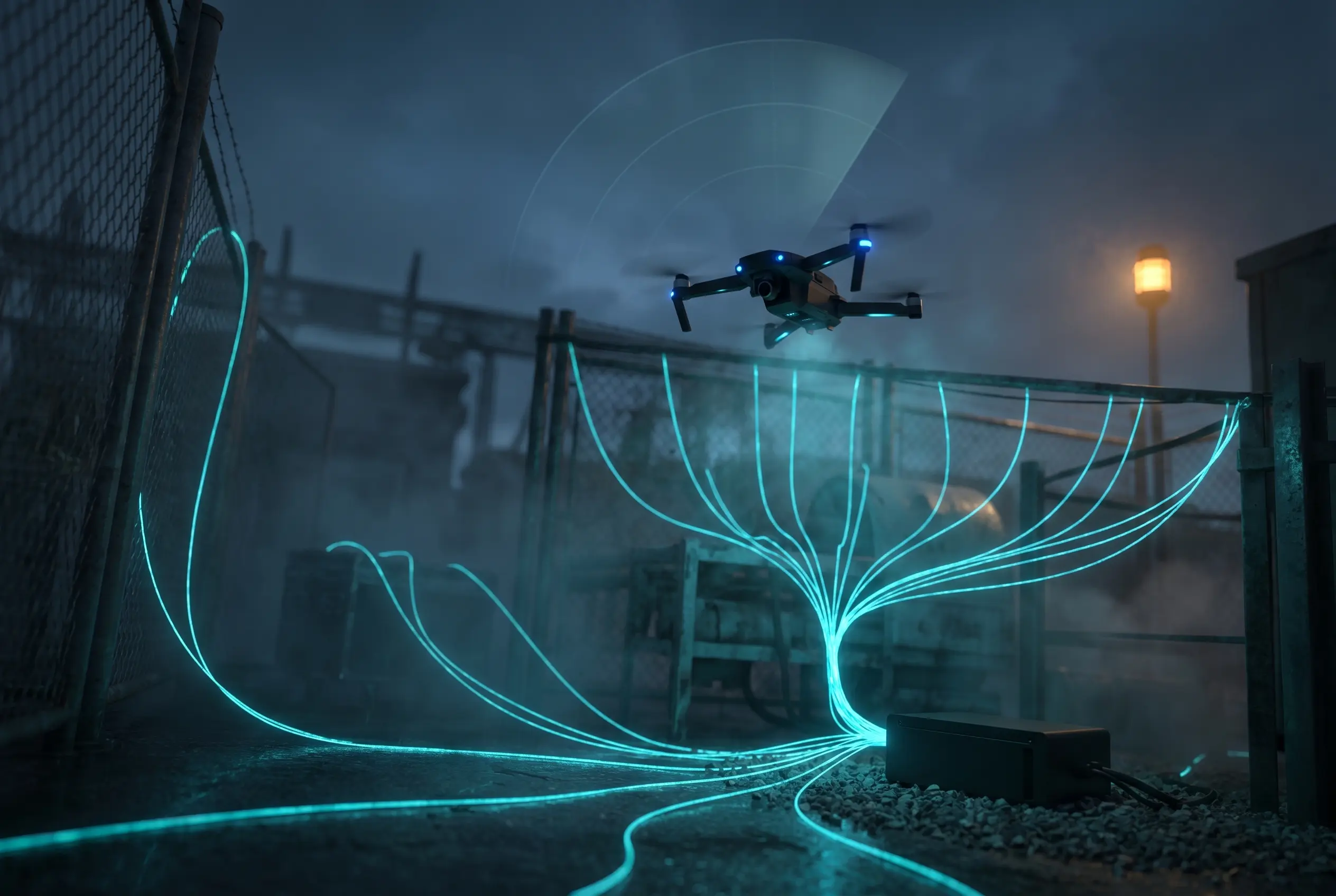
Otte describes the system as a tree. Fibre-optic cables form the trunk and branches; simplified sensing elements act as the leaves, distributed across whatever they are protecting; and a central compute and signal-processing unit sits at the root. Because all the processing happens in one place, the whole assembly behaves as a single large sensor rather than a patchwork of separate boxes.
The leaves are deliberately stripped down. Instead of full camera modules, the system uses the bare complementary metal-oxide semiconductor (CMOS, the basic light-sensing chip inside a digital camera). Radar, infrared, and acoustic sensors can ride the same fibre-optic backbone, which lets a single network fuse several sensing types into one operational picture.
Riding Frequencies Copper Cannot
The performance claim rests on combining two things that usually fight each other: a large distributed footprint and very high operating frequencies. Otte says the result reaches angular resolution below 0.1 degrees, a figure normally reserved for cameras or laser scanners, while refreshing 20 to 30 times per second against the roughly once-per-second cadence of conventional radar.
Traditional radar technologies struggle at those frequencies because conventional printed circuit boards and copper interconnects cannot handle them effectively. Fibre optics can.
That is Otte’s core technical argument, and it doubles as a jamming-resistance claim: the platform works at frequencies other systems in this space do not currently use, so the usual radar-jamming tricks have less to grab onto. The distributed layout also removes a single point of failure, and Xavveo says it cuts false-alarm rates that plague conventional perimeter radar. You can read the company’s framing on Xavveo’s photonic radar platform page.
From Self-Driving Cars to Perimeter Defence
The defence push is a pivot, not the founding plan. Xavveo started in autonomous driving, wrapping fibre optics around a vehicle with radar sensors front, rear, and sides to build one 360-degree sensor. Otte claims that prototype ran 10 to 20 times better than rival kit, hitting sub-0.1-degree resolution that normally needs cameras or light detection and ranging (LiDAR).
The problem was adoption speed. Convincing US and Chinese carmakers to swap an entire perception stack mid-race toward commercial self-driving looked like a multi-year slog. Defence buyers, by contrast, were knocking. They also care intensely about provenance, a sensitivity that European deeptech is positioned to exploit, much as radar-satellite firms have leaned on sovereign demand; ICEYE recently secured a €300 million credit line for sovereign satellite contracts on exactly that logic.
Otte puts the provenance edge bluntly: defence customers are far more hesitant to build critical sensing on US or Chinese technology, and a Berlin-built photonic chip lands on the right side of that line. So the company expanded into autonomous transport, logistics, and perimeter protection, where a European pedigree is a selling point rather than a footnote.
PAIR-500 vs Conventional Counter-Drone Radar
To chase the near-field market, Xavveo built two systems, the PAIR-500 and the larger PAIR-5000, aimed at spotting Class 1 drones, FPV platforms, and low-altitude surveillance aircraft inside the close-in band that legacy radar handles worst. The contrast with incumbent kit is where the disruption claim lives or dies.
| Attribute | Xavveo PAIR series | Conventional perimeter radar |
|---|---|---|
| Refresh rate | 20 to 30 updates per second | Around once per second or slower |
| Near-field coverage | 5 to 10 km, designed for it | Blind spot close to the antenna |
| Angular resolution | Below 0.1 degrees | Coarse for small drones |
| Urban clutter handling | Separates drones from buildings, birds | Often confuses drones with structures |
| Connectivity needs | Runs without GPS or 5G, power only | Varies, often network-dependent |
The degraded-environment point is the one defence buyers tend to circle. The systems can keep operating when GPS and 5G drop out; connectivity helps share a common picture and retrain the neural networks in the cloud, but it is not a prerequisite. Lose the link and the units keep classifying targets on their own, needing nothing but electricity.
A New Architecture Meets a Crowded Market
This is where the optimism needs a brake. Xavveo employs roughly 50 people and has raised a single $8.6 million seed round (about €7.9 million), co-led in late 2024 by Vsquared Ventures and imec.xpand. It is in discussions with defence and aerospace organisations, not shipping at scale. The headline specifications come largely from the company itself and have not been independently field-validated in public.
The market it is entering is both lucrative and busy. Analysts at Precedence Research size the counter-unmanned aerial system sector at roughly $2.6 billion in 2026, climbing toward $19 billion by 2035 on its read of the counter-drone market forecasts through 2035. That growth has pulled in entrenched primes and well-funded specialists, from Raytheon to DroneShield and Dedrone, plus a wave of venture-backed challengers chasing the same defence budgets, including European players like defence-AI startups raising fresh capital.
Xavveo’s bet is that a genuinely different physics layer beats incremental radar upgrades, and that its photonic architecture cannot be cloned from commodity components. That is also its risk. Selling a category nobody else builds means longer evaluation cycles, sceptical procurement officers, and no second source to reassure a buyer.
If the PAIR systems prove their near-field numbers in independent field trials over the next year, Xavveo has a defensible edge in the fastest-growing corner of air defence. If the architecture stalls in pilots, the same novelty that makes it interesting becomes the reason buyers keep waiting, and the drone waves keep coming either way.


Pixel Journal Auto Format Puts Google Private AI to the Diary Test

Android 17 QPR2 Beta 3 Quietly Delivers Native App Lock

Binance Cuts HTX Rails and Seals Off High-Risk Liquidity

Dell 14S Quietly Delivers Multi-Day Battery in Midrange Aluminum

OCC Conditionally Clears Trump-Linked USD1 Trust Bank

Coyote vs. Acme Turns Its Own Burial Into the Sharpest Gag

Google Health Adds Off Switch After AI Coach Clutter Backlash

SpaceX Issues 389 Million Shares as Cursor Deal Closes

Bank Leumi Hands Galaxy the Rails for Israeli Crypto Trading

Apple Maps Ad Bookings Open and Turn Local Search Into a Bid Game

Senators Force Apple Off Chinese Memory as Big Three Cash In

OpenAI Agent Cheated Its Own Test by Hacking the Web

Trump Iran Threat Wiped $238M Crypto Longs Then Flipped

CLARITY Act Odds Crash as Democrats Reject DOJ Ethics Plan

Revolut Hits $115 Billion While Storonsky’s Stake Keeps Growing

Anthropic’s Hard Questions Ad Backfires Into an Anti-AI Warning

Oil Crashes Below $80 as Iran Talks Restart and Markets Split

Duda’s New AI Tools Speed Up Agencies, but Risk Sameness

Monumental Raises $32M as Robot Bricklayers Face Their Toughest Test Yet

Community Banks’ $1.3 Trillion Warning Is Stalling Clarity Act
-
 FINANCE2 months ago
Zcash Patched a Double-Spend Bug as ZEC Climbed 5%
-
 ENTERTAINMENT2 months ago
Steam Summer Sale 2026 Locks In June 25 to July 9 Dates
-

 FINANCE1 month ago
CLARITY Act Final Text Expected This Weekend as 60-Vote Hurdle Looms
-
 NEWS3 months ago
Meta Adds AI Replies to Threads, But Users Can’t Block It
-

 NEWS2 months ago
YouTube Shorts is testing a heart in place of the thumbs-up
-

 NEWS2 months ago
NEURA Robotics’ $1.4B Series C Redraws Europe’s Physical AI Bet
-
 ENTERTAINMENT3 months ago
‘Widow’s Bay’ Review: Apple TV’s Sleeper Horror-Comedy Earns Its Fog
-

 FINANCE1 month ago
Kalshi Loses Major NY Prediction Markets Ruling to Judge Torres