
NEWS
Investors Bet £4.3m That Caudal’s Tidal Fin Beats Wind Costs
Caudal Energy’s £4.3 million seed funds a Strangford Lough trial of an oscillating tidal fin that backers say can match offshore wind costs.

£4.3 million is now sitting behind a tidal machine that does not spin. Caudal Energy, an Oxford spinout founded in 2024 as Porpoise Power, closed that seed round on 27 May 2026 to fund full-scale tests of an oscillating fin at Strangford Lough in Northern Ireland, with a first commercial unit aimed at 2028.
Oxford Science Enterprises and Empirical Ventures co-led the round, which lifts total capital to £5.5 million after a £1.2 million pre-seed in 2024. The cheque is a dated wager: Technology Readiness Level 5 today, TRL 8 if the 2028 plan holds, and a claimed path to costs in line with offshore wind from sites that ordinary tidal turbines skip.
A £4.3 Million Wager on Mid-Flow Tides
The money is modest beside an offshore wind farm, and large beside most recent UK tidal cheques written by institutions rather than subsidy auctions. Returning backers Zero Carbon Capital and Creator Fund joined, as did Kibo Capital and Oxford Innovation Finance. ESG filings around the close put the pounds at about $5.6 million.
John Kennedy, chief executive and a former managing director at Wayfair, said the company was founded to challenge the assumption that tidal power has to stay complex, costly and niche. Hilary Struthers, chief commercial officer and a former Shell executive, and Professor Adrian Thomas, Caudal’s chief scientific officer and professor of biomechanics at the University of Oxford, sit with him. Martin Hall, a marine systems engineer, is named among the founders. Glen Pascoe, vice president of engineering, brings 20 years in Formula 1.
On 7 September 2026, Oxford Innovation Finance was still posting its piece of the round, through the Oxford Innovation EIS Growth Fund and OION Angels, and said the seed would take the hardware from TRL 5 toward TRL 7 ahead of that 2028 commercial date.
🐳 We are pleased to announce our investment in Caudal Energy, formerly Porpoise Power, through both the Oxford Innovation EIS Growth Fund and OION Angels.
Read the full announcement: https://t.co/2esa1MzbK6#OxfordInnovationFinance #EIS #OION #Investment #ClimateTech #NetZero pic.twitter.com/CAby1TsTr4
— Oxford Innovation Finance (@OION_TVIN_OEI) September 7, 2026
Andy Straiton, investment lead at Oxford Science Enterprises, said Caudal had been designed around the economics of large-scale deployment, not only technical performance, and that simpler install, lower operating complexity and a wider set of sites could make tidal cost-competitive with solar and wind. That is the bet. It has not been collected.
The Fin Works in 3-Knot Water
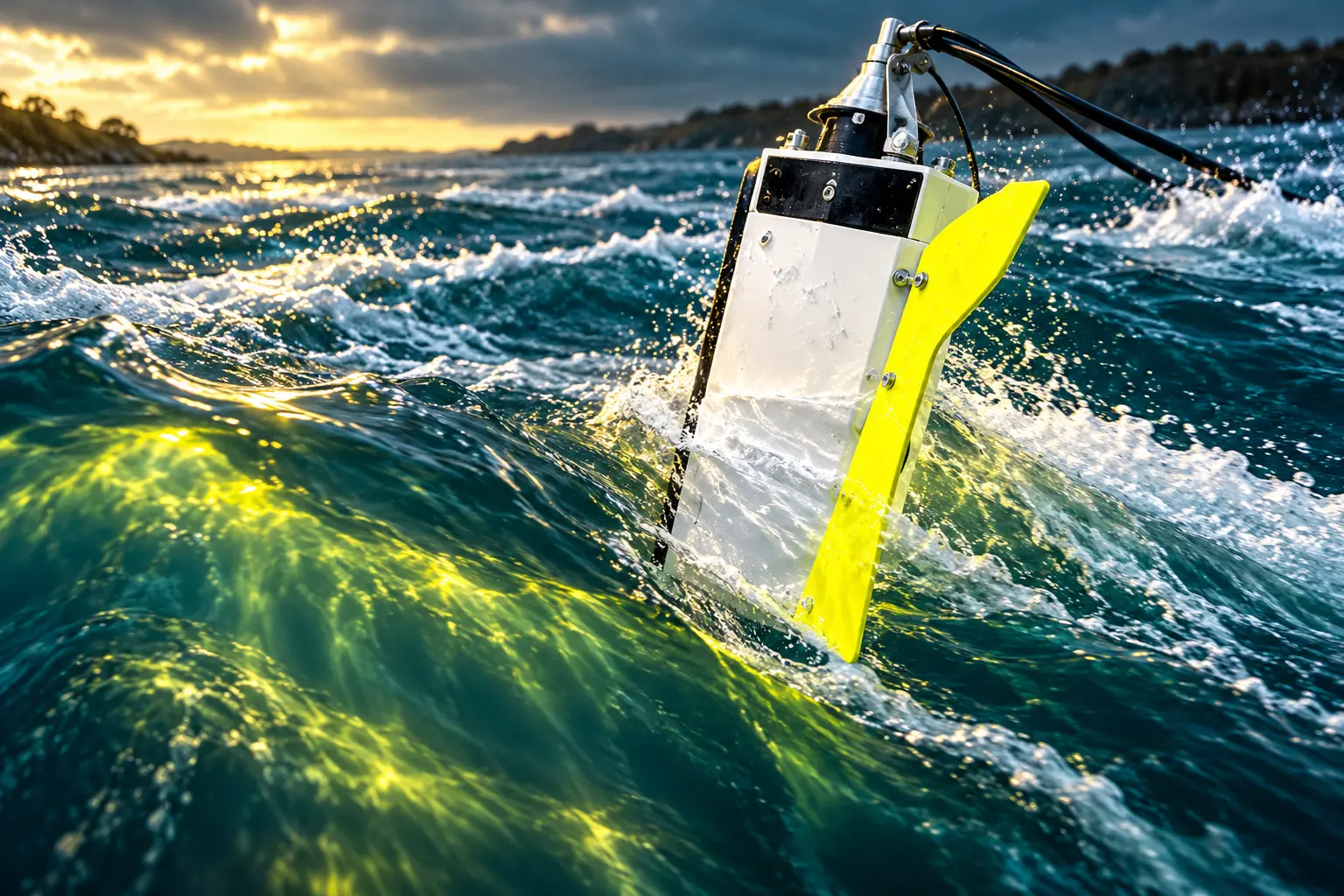
Conventional tidal turbines, the company says, need peak flows above 5 knots to pay. That confines them to a short list of extreme channels. Caudal’s oscillating foil is specified for peak flows above 3 knots, the mid-flow band that covers far more coastline. The foil converts current through hydrodynamic lift and motion rather than a rotor, a method the company traces to the caudal fins of marine mammals and to Thomas’s Oxford work.
Water, Caudal notes, is over 800 times denser than air, and tides can be forecast years ahead. The commercial argument is that a predictable plant can sit beside wind and solar without a warehouse of batteries. The engineering argument is that the plant has to be cheap enough to place in ordinary water, not only in the Pentland Firth.
HOW THE CAUDAL GENERATOR IS MEANT TO STAY CHEAP
- Surface pontoon: Units are modular and surface-mounted, rather than piled into the seabed like a classic tidal turbine.
- Ordinary boats: The company says install can use standard workboats and docks, and standard parts and factory processes.
- Dry electrics: Electrical kit stays out of the water, and the fins can be lifted for service.
- Mid-flow sites: Operation from 3 knots is meant to put arrays closer to load, including private wires and coastal industry.
On its site, Caudal says that shift would unlock 10 times as many sites, taking potential UK resource from 11GW to 60GW. The 11 GW floor matches the independent literature in broad terms. The 60 GW ceiling is the company’s own. It also lists three early customer types: data-centre developers pairing the output with batteries, grid-constrained sites that want a short private line, and off-grid coastal operators who need a baseload under wind and solar.
Strangford Lough Already Hosted This Experiment
Full-scale testing is planned for Strangford Lough, the same narrows that held SeaGen, the first large commercial tidal stream machine. Marine Current Turbines installed that 1.2 MW plant, two 0.6 MW rotors on a crossbeam, in April 2008. It connected to the grid in July 2008, hit full power that December, and was sold with the company to Siemens in 2012, then to Atlantis Resources, later SIMEC Atlantis Energy, in 2015.
SeaGen cost about £12 million. It exported 11.6 GWh before decommissioning finished in July 2019, 11 years after first grid power. The lough is a marine conservation zone, a special protection area and a special area of conservation. Seals and porpoises were the original worry; monitoring later found no drop in numbers tied to the rotors. The machine still came out.
Monks at Nendrum on Mahee Island had already trapped the tide here. The National Trust records sea walls that fed a mill dated to AD 619, the oldest-known tidal mill in Europe. The resource is not the question. The bill is.
FROM SEAGEN TO CAUDAL AT THE SAME LOUGH
- April 2008: SeaGen is installed in Strangford Narrows as a 1.2 MW twin-rotor turbine.
- July 2008: The plant connects to the grid; full 1.2 MW follows in December 2008.
- July 2019: After 11.6 GWh exported, the last of the structure is removed.
- 2024: Porpoise Power closes a £1.2 million pre-seed led by Zero Carbon Capital and later becomes Caudal Energy.
- February 2025: Winter sea trials off Wales, described by a fluid-dynamics specialist helping the team, put a prototype in real current before the seed.
- 27 May 2026: The £4.3 million seed is aimed at a full-scale Strangford pilot and a 2028 commercial unit.
About 10 MW of tidal stream still runs in UK waters, with MeyGen’s 6 MW array in the Pentland Firth the largest block. More than 120 MW sits on support contracts for deployment by 2029. That is not Caudal. Its hardware is still at TRL 5, validated in a relevant setting, not yet a commercial array.
Why Earlier Oscillating Foils Stopped
Oscillating hydrofoils are not a new class. The European Marine Energy Centre already lists them beside horizontal-axis turbines, vertical-axis machines, venturi devices, Archimedes screws and tidal kites. A 150 kW Stingray was tested in Shetland in 2003. Pulse Tidal put a 100 kW unit in the Humber in 2009. BioPower Systems’ shark-inspired bioSTREAM never left the prototype file. Most of those names are now marked inactive.
The Engineering Business reinstalled its 150 kW oscillating hydroplane in Tell Sound between July and September 2003. Testers got energy out across tides, but actuation used more power than planned, control of the cycle stayed the weak point, and minor faults stopped a 14-tide run. Cost modelling at the time pointed to 6.7 pence per kilowatt-hour once 100 MW had been installed. That 100 MW was never built.
Pulse Tidal’s 100 kW Pulse-Stream sat at Immingham Dock and fed a nearby chemicals plant. The firm won European money for a 1.2 MW follow-on at Lynmouth and held a Crown Estate lease. It was liquidated in 2014. PRIMRE’s device list still shows Pulse-Stream, bioSTREAM, Kinetic Keel and Tidal Flyer as inactive; EEL Energy’s river and tidal foils are the rare entries still marked active.
OSCILLATING FOILS AND THE STRANGFORD TURBINE
| Device | In the water | Rating | Where it ended |
|---|---|---|---|
| Stingray | 2003, Shetland | 150 kW | Test programme; 100 MW never built |
| Pulse-Stream | 2009, Humber | 100 kW | Pulse Tidal liquidated in 2014 |
| SeaGen | 2008, Strangford | 1.2 MW | Removed in 2019 after 11.6 GWh |
| Caudal Generator | Full-scale tests planned, Strangford | Not disclosed | TRL 5; commercial target 2028 |
Nick Hawker, the First Light Fusion founder who spent time with the Porpoise Power team, put the distinction in a single line: “The hydrodynamics are super elegant, but that is not what makes the difference.” He had been on a Welsh shore in mid-February with the prototype. What sold him was that the thing looked straightforward to build, install and maintain. That is also the claim Stingray and Pulse Tidal could not turn into a factory.
Offshore Wind’s Price Is the Real Benchmark
Johnathan Matlock, general partner at Empirical Ventures, is the backer who said the quiet part. Grid operators, he argued, now put a price on output you can mark in a diary, and the plants that win are the ones that do it without storage sitting on the bill.
Grid operators are increasingly pricing predictability into the system, and the renewables that benefit are the ones that can deliver deterministic output without storage costs. Caudal is one of the only tidal platforms we have assessed with a credible path to LCOE parity with offshore wind, and the team has done the detailed engineering work to back up the modular deployment claim at scale. This is what made it investible for us.
Johnathan Matlock, General Partner, Empirical Ventures
A 2021 review in the Proceedings of the Royal Society A, led by Daniel Coles at the University of Plymouth, backed a UK and Channel Islands practical resource of 34 TWh a year, about 11.5 GW of plant, or 11 per cent of UK electricity demand as it then stood. The same paper put tidal stream’s levelised cost around £240 per megawatt-hour, with a path below £150/MWh if 124 MW were installed and a 17 per cent learning rate held. Zero Carbon Capital, writing at the seed close, repeated the parity-with-offshore-wind line and added that the architecture should be cheaper and faster to field than nuclear.
Those figures still sit well above working offshore wind. They also sit on hardware that has not yet run at Strangford. Caudal has not published a number for its own levelised cost. The 2028 commercial date is the first point at which that gap can be measured rather than modelled.
The Seed Round Pays for Sea Trials and a Pontoon
Zero Carbon Capital, which led the 2024 pre-seed and came back, said the team had already iterated hardware, collected test data and rebuilt its digital model, and that this work is what moved the device to TRL 5. The fund also said Caudal had hired former Formula 1 engineers, a hire that matches Pascoe’s post. Hawker’s Welsh February trip is the public scrap of evidence that a prototype had already met real current before this round.
WHAT THE £4.3 MILLION IS FOR
- The Strangford pilot: Zero Carbon Capital said the round funds full-scale testing of their pilot unit at a Northern Ireland tidal site.
- A multi-unit pontoon: The same note says the cash pays for design of a pontoon that carries several units, the step from a single foil to a repeatable block.
- A CfD and private wires: The company is to chase a Contract for Difference and private-line clients, the two revenue paths that make a 2028 unit bankable.
- Engineering depth: Caudal said it will expand modelling and engineering, push demonstration work, and talk to utility, industrial and distributed buyers.
Oxford Innovation Finance’s September note frames the same spend as a move from TRL 5 to TRL 7. That is not a clash with the company’s TRL 8 target. The seed is meant to get a full-scale machine through sea trials. TRL 8 is the 2028 commercial plant, if it is built.
The 2028 Date the Money Has to Earn
Two years is a short marine calendar. Consents at a protected lough, weather windows, and the jump from a lifted fin on a pontoon to a repeatable block all sit on that path. Caudal says it is already in talks with strategic partners. It has not named them, and it has not reported that the Strangford pilot is in the water.
The company is still a small Oxford team with a surface-mounted foil, a lough that has already seen a 1.2 MW turbine come and go, and a cost claim that earlier oscillating machines never cashed. Empirical Ventures bought the engineering pack and the mid-flow map. Strangford is where that pack has to run, on a timetable that now ends in 2028.
Disclaimer: This article is news reporting and analysis of a completed seed round and of public claims about a tidal generator that has not yet had a full-scale commercial trial. It is for information only and is not investment advice, a solicitation to buy or sell securities, or a recommendation of Caudal Energy, Oxford Science Enterprises, Empirical Ventures or any other named fund. Readers who are considering an investment in early-stage energy hardware, EIS products or unlisted shares should consult a suitably authorised financial adviser and read the relevant fund documents before acting. Figures, technology-readiness labels, site plans and 2028 dates reflect company, investor and research sources as published and may change as tests, consents and contracts move.

UPI MDR Delay Hands Traders the Calendar After Paytm Falls

Google Messages Builds Nine In-Chat Games After Samsung’s Exit

Anthropic’s $100 Million Academy Trains the Firms That Bill Both Sides

Toyota’s Electric C-HR Leaves the Cheap Twin to Subaru

Markets Bet the Fed Skips October After Hawkish Minutes

The Orchard Bug Forced Zcash to Open an Empty Pool

The $5.99 Game That Won Steam’s 2026 Summer Sale

Don Lee Joins Hemsworth as Extraction 3 Starts Shooting

YouTube Shorts Retires Dislikes and Swaps Likes for Hearts

NEURA Robotics Is Spending Its $1.4B on a Machine Stack
-
 NEWS5 months ago
The Orchard Bug Forced Zcash to Open an Empty Pool
-
 GAMING5 months ago
The $5.99 Game That Won Steam’s 2026 Summer Sale
-
 ENTERTAINMENT7 months ago
Don Lee Joins Hemsworth as Extraction 3 Starts Shooting
-
 NEWS5 months ago
YouTube Shorts Retires Dislikes and Swaps Likes for Hearts
-
 NEWS4 months ago
NEURA Robotics Is Spending Its $1.4B on a Machine Stack
-

 NEWS5 months ago
Atlantic City Turned WWE’s Return Into a Civic Night
-

 AUTO6 months ago
Kawasaki Bets the New Z1100 Against Its Own Supercharger
-
 BUSINESS5 months ago
Norway’s Export Bank Backs Nscale’s $790 Million Narvik Loan