
ENTERTAINMENT
The Mandalorian and Grogu Builds Lucas’s Lost Chessboard
The Mandalorian and Grogu puts 1977 holochess beasts on a giant Dejarik board Lucas scrapped after Futureworld.

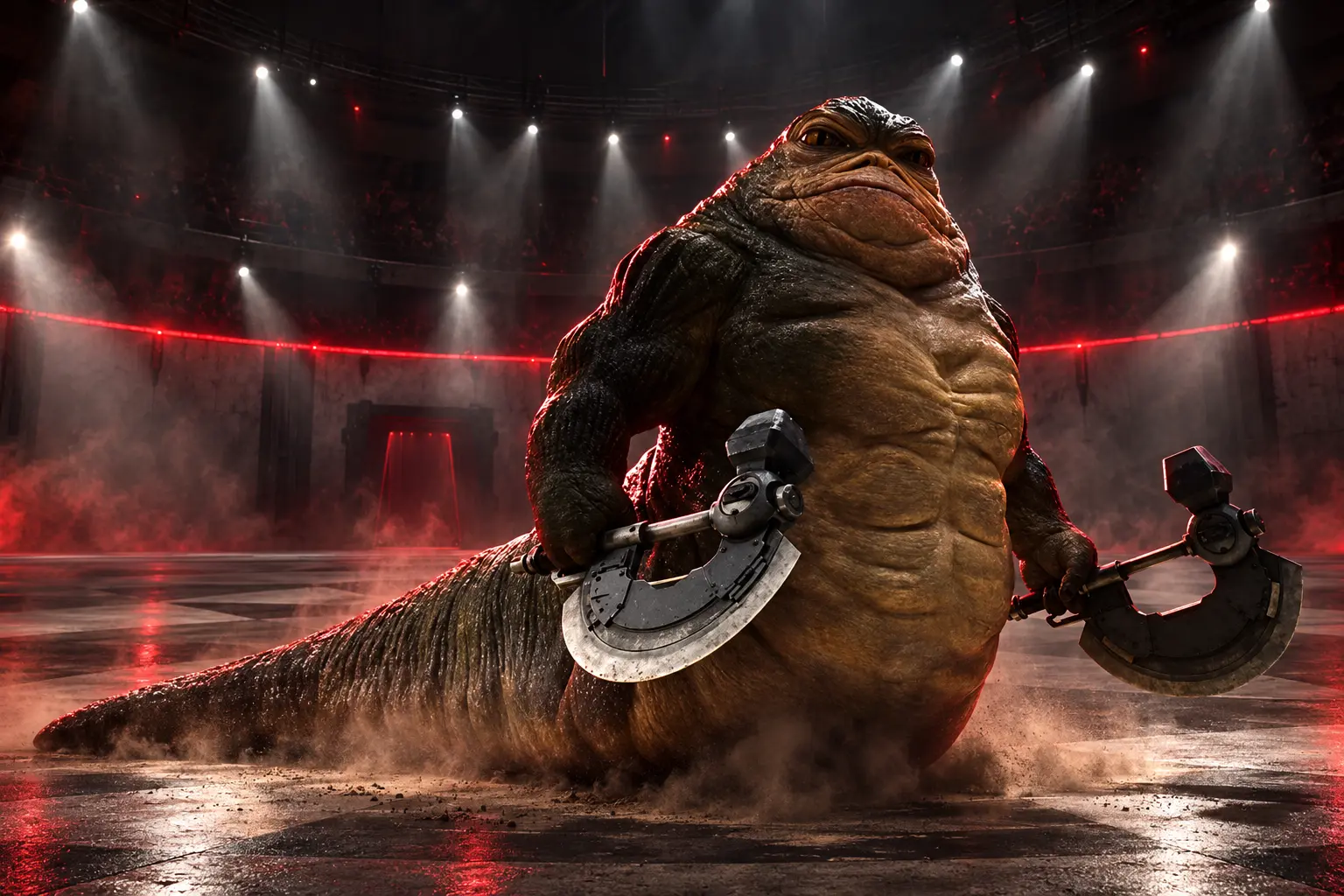
Jon Favreau’s The Mandalorian and Grogu puts the eight Dejarik holochess creatures from 1977 on a full-size arena floor, 49 years after George Lucas dropped that giant-board plan. Industrial Light & Magic built them as living animals, not tabletop holograms, for the May 22, 2026 theatrical film that began streaming on Disney+ on September 2.
The pit is on Shakari, where Din Djarin and Grogu go to pull Rotta the Hutt out of a fixed gladiator contract. The floor is the old Falcon board, scaled up until a body slam can shake the stands.
A Circular Pit With a Chessboard Floor
On the Millennium Falcon in A New Hope, Chewbacca and R2-D2 play a game of glowing monsters for less than 30 seconds. In Favreau’s film those same silhouettes occupy a gladiatorial arena whose floor is patterned like the circular board, a detail production animation supervisor Hal Hickel’s team treated as architecture rather than set dressing.
Pedro Pascal’s Din Djarin is already in the pit when crime boss Lord Janu Coin dumps the menagerie on him. Rotta, grown from the Hutt child in The Clone Wars into a cage fighter voiced by Jeremy Allen White, is supposed to die in that match. Grogu is held in the luxury box. The fight is the plot, not a pause in it.
ILM animation supervisor Rick O’Connor kept action running in the background so a cutaway still showed beasts circling, slamming, and crowding the rails. About 45 percent of the movie was shot natively for IMAX, and the pit is one of the sequences that uses that extra frame. Replay it on a laptop and the board still reads. In a theater the pieces have weight.
Lucas Shelved a Giant Chessboard After Futureworld
The gag was never supposed to be a tabletop. Lucas wanted costumed performers on a giant chessboard, composited as holograms. Futureworld (1976) got there first, and the plan died. Phil Tippett and Jon Berg, who had been sculpting leftover cantina ideas, were asked to animate tiny stop-motion puppets instead. Lucas wanted them about six inches tall. Sound designer Ben Burtt voiced the creatures himself.
The official history of Dejarik on StarWars.com tracks how those rush sculptures became canon furniture. The game still had no on-screen name in 1977. West End Games called it dejarik in a 1995 roleplaying supplement, and the label stuck. Decipher’s card game later named the eight pieces and gave them homeworlds, weapons, and tempers.
THE DEJARIK BOARD ACROSS STAR WARS
- 1976: Futureworld uses a similar giant-board effect, and Lucas drops the live-performer plan.
- 1977: Tippett and Berg shoot the Falcon holochess scene in stop-motion with eight of their sculptures.
- 2015: Tippett Studio rebuilds decaying puppets so the game can flicker back on in The Force Awakens.
- 2018: The same shop restores two cut sculptures, nicknamed Bulb and Scrimp, for Lando’s table in Solo.
- 2026: Favreau stages living versions of the classic eight in a Shakari arena whose floor copies the board.
Tippett already had a Mantellian Savrip figure when Lucas asked for a full set, Hickel said, and then had to invent seven more in the same weird style with no time for notes. The holograms that followed were a simple, of-the-moment version of that rush job. Favreau’s film asks what those toys were selling.
What a Happy Meal Gladiator Looks Like at Full Size
Hickel has been blunt about the director’s brief. The Falcon figures were the cheap souvenir. Somewhere in the galaxy the real animal was fighting for money.
It was Jon’s idea that the holochess figures that you saw in the original Star Wars were just meant to be the Happy Meal toy version of an actual battling creature somewhere in the galaxy.
Hal Hickel, production animation supervisor, Industrial Light & Magic
Production designer Doug Chiang and the Lucasfilm art department pushed the old silhouettes toward animals you could believe were ten feet tall. Lead CG modeler Masa Narita and a team of five built them in three dimensions, adding scales, wrinkles, and hide that the holograms never needed. Hickel’s reference pile was earthly on purpose: rhinos, alligators, snakes, gorillas, pro wrestlers. The Kintan Strider and Savrip had to move like heavy bipeds. The K’lor’slug got a scamper-and-spring rhythm. Molator, a bony exoskeleton, ended up with an orangutan-like sideways run because that gait fit the proportions.
They also cheated. The Houjix, originally as large as the others, was shrunk into a comic biter, still dangerous, closer to an electric eel or a vicious small dog than a tank. Some pieces wear belts and carry hammers or staffs. Hickel’s crew had to decide which ones had language and which ones were just animals in a ring. ILM later published a long account of bringing the Dejarik creatures to life, and the shop’s own account posted the same brief.
To bring the action-packed Dejarik battle to life in The Mandalorian and Grogu, ILM started with researching the classic hologram creatures who've been depicted using stop-motion animation going all the way back to Star Wars: A New Hope. "Now we had to say, ‘Alright look, here’s… pic.twitter.com/sovb2PyyLs
— Industrial Light & Magic (@ILMVFX) July 23, 2026
Almost the entire arena was a gray stage. One picture-ready wall and Janu Coin’s luxury box were real. Stunt coordinator JJ Dashnaw and Lateef Crowder, in the Din Djarin helmet, worked from previs Hickel calls rough animation of the gags. Each beast had a color-coded stunt performer with a picture pinned to the chest so the camera could see where a K’lor’slug or a Molator was supposed to stand. Richard Cetrone stood in for Rotta beside a full-size Hutt head from Legacy Effects, used for light and framing. Hickel said the first cut looked strange. Then the animators put the animals back in.
Television never gave them this calendar. A Mandalorian season turned around in less than a year. The feature had several years, and ILM, Image Engine, Hybride, and Important Looking Pirates delivered about 2,200 visual effects shots. Lead animator Dave Logan said O’Connor liked handing people three connected shots so motion could carry. Senior animator Meg Grube started asking where the eye should go, not only whether a shot “read.” The job was to make a hologram smell like breath.
HOW THE EIGHT PIECES CHANGED ON SHAKARI
| Creature | 1977 table version | 2026 pit version |
|---|---|---|
| Mantellian Savrip | Clothed reptilian hologram, the body-slam piece | Heavy biped in vest and belt, still the slam |
| Kintan Strider | Long-armed club fighter from Kintan | Stone-hammer gladiator, gorilla and wrestler motion |
| K’lor’slug | Poisonous swamp hunter | Scamper-and-spring animal that wraps Rotta |
| Houjix | Large four-legged blue beast | Shrunken comic biter with an eel zap |
| Ghhhk | Green four-legged insectoid | Full-size bug with little earthly reference |
| Molator (Grimtaash) | Bony Alderaanian guardian figure | Exoskeleton with a primate sideways run |
| Monnok | Semi-sentient with staff or spear | Armed opponent, not a dumb animal |
| Ng’ok | Bad-tempered clawed warbeast | Kept in the living menagerie of the match |
Hickel wanted viewers to imagine the smell of the breath and the feel of the hide. That is a different assignment from making a chess piece glow.
Tippett Spent Ten Months on a Different Fight
A lot of early chatter treated the Dejarik pit as a stop-motion showcase. The stop-motion showcase is next door. Tippett Studio animated two hulking Hutt-guard droids in a fight that runs close to two minutes, with live performers in the same space. Production visual effects supervisor John Knoll said that work took the Tippett crew, he thinks, ten months to animate, the better part of a year, a schedule a Disney+ season could not have carried.
TWO FIGHTS, TWO TOOLKITS
- Dejarik pit: ILM computer animation of living holochess animals on a board-shaped arena, with color-coded stunt stand-ins on a mostly gray stage.
- Droid fight: Tippett Studio stop-motion of two armored machines, one with a club and one with a gun, interacting with Pascal and Grogu for close to two minutes.
- Why it mattered: Favreau wanted every generation of Star Wars effects on the same movie, from motion-control miniatures to new capture tools, and he used the longer feature calendar to fund both.
Hickel, who came up in stop-motion, spent heavy time beating the droid sequence into shape. Tippett’s first boards were rough enough that he called them cave paintings. The shop built Maya assets, 3D-printed parts onto real armatures, and then had to solve what Hickel calls action math: if Mando closes in, the other droid should just shoot him. They took the disintegrator rifle away for most of the fight because he needs it later against Embo, left him a pistol that would bounce off armor, and leaned on a vibro knife. Hickel even animated one shot himself.
Knoll’s larger brief was not nostalgia. Rubber masks, animatronics, LED volume, photogrammetry, full CG, and Gaussian Splatting all sat in the same kit. A 1976 ILM Y-wing known as the Red Jammer, borrowed from the Lucas Museum of Narrative Art, appears in two shots. The Dejarik animals are the CG half of that argument. The droids are the handmade half. Mixing them up flattens both.
The Savrip Still Body-Slams the Strider
Everyone on the crew knew which 1977 beat had to return. Near the climax, the Mantellian Savrip lifts the Kintan Strider and throws him down, roaring. Hickel said that slam was the callback they were not allowed to miss. A TV spot had already shown the move, so a slice of the audience walked in waiting for it.
Other finishes arrived from monster-movie memory. When the K’lor’slug wraps Rotta, the Hutt punches it off and slams it down in a rhythm Hickel traced to King Kong fighting the serpent in 1933. It is not a shot-for-shot copy. Favreau saw the cut and named Kong immediately. That is the sequence’s method in miniature: steal the toy’s silhouette, then stage it like a 1930s creature feature that happens to be chess.
The radial floor does the rest of the joke. Once you notice the rings, every lunge is a piece leaving its square. People who liked the movie and people who did not still point at this stretch. The louder complaint about the rest of the runtime does not land here. This is the scene that behaves like a Star Wars set piece from before streaming, built with a streaming show’s creature memory.
Janu Coin Opens the Cages Anyway
The match exists because Janu Coin wants Rotta dead before a contract expires. New Republic Colonel Ward, played by Sigourney Weaver, has sent Din after an Imperial warlord. The Hutt Twins will trade that warlord’s location for Rotta’s return. On Shakari the young Hutt is famous, in debt, and sure his next bout buys freedom. Din tries to buy him out. Coin refuses. Rotta calls security. Din wakes up unarmed in the pit.
He beats Rotta and will not kill him, which should void the contract. Coin answers by flooding the arena with the living board. Din and Rotta have to fight as a pair. Rotta then wrecks the security system, the surviving animals spill into the city, and the extraction becomes a chase. Zeb Orrelios helps bag the Hutt. Rotta’s news is worse than the pit: the Twins want him gone so they can take the cartel, and Janu Coin is the warlord Din was hired to find.
Knoll called Rotta a conceptual problem more than a technical one. Hutts on screen have been sluggish blobs. This one is young, fast, English-speaking, and built like a fighter. The motion that finally worked was an elephant seal’s galumph and a barrel roll. Rotta is a little over a meter across, so one roll covers about 3.14 meters in a blink. Hickel, talking through building a galactic bestiary, noted that Rotta has the second-most lines in the film after Din and has to be someone the audience will protect. A buff Hutt only works if the animals around him feel like a real card deck come to life.
When the fence fails, Din gets Grogu and Rotta out. He does not turn into the pit’s public safety officer. The bloodsport is Coin’s product. The board was always a fight. The movie just stops pretending the pieces are two inches tall.
Walt Disney Studios opened the PG-13 film, which runs 2 hours 12 minutes, in 4,300 North American theaters on May 22, 2026, after some overseas markets on May 20. Box Office Mojo’s tally is a $81.7 million domestic opening, $177.7 million domestic, and $345.5 million worldwide on a $165 million production budget. On September 2 the movie reached Disney+, where the pit is a chapter you can open without buying another ticket.
Frequently Asked Questions
What is Dejarik in Star Wars?
Dejarik is the in-universe name for the holographic creature game first seen on the Millennium Falcon, later applied to that 1977 scene after West End Games used the word in the 1995 supplement Galladinium’s Fantastic Technology. Official material has never published a complete rulebook; one named tactic is the Kintan Strider death gambit, and the eight pieces are a mix of real animals and myth, each with its own attack style on a round board.
Who created the original holochess creatures?
Stop-motion animators Phil Tippett and Jon Berg sculpted and shot the puppets after their cantina maquettes caught Lucas’s eye, while Grant McCune built the table itself and Ben Burtt supplied the creature voices. Lucas asked for figures about six inches tall and was on set for the shoot; four of the original puppets later sat on a plaque in his office until the rubber failed and Tippett Studio had to rebuild them for later films.
Is the Dejarik arena fight in The Mandalorian and Grogu stop-motion?
No. The Shakari Dejarik animals are ILM computer characters performed against live stunt stand-ins, while Tippett Studio’s stop-motion in this film is a separate two-droid fight that runs close to two minutes. Tippett’s shop had already returned to classic holochess stop-motion for The Force Awakens and Solo, and had done a shorter stop-motion beat with a trash crab on Skeleton Crew, so the technique is in the movie, just not inside the chess pit.
Which Dejarik creatures appear in the Shakari arena?
The living match uses the classic eight: Ghhhk from the Bith homeworld, Grimtaash the Molator from Alderaanian myth, Houjix from Kinyen, the Kintan Strider, the K’lor’slug from Noe’ha’on, the Mantellian Savrip, the Socorran Monnok, and the Ng’ok warbeast. Two extra 1977 sculptures that never fit on the Falcon table, Bulb and Scrimp, stay out of this pit; they had already been scanned back into Solo.
Why did George Lucas change the 1977 chess scene?
He had planned little people in costumes on a giant board, then saw Futureworld (1976) do a similar gag and shifted to Tippett and Berg’s stop-motion sculptures. They actually made ten figures; Lucas preferred eight because the table looked less cluttered, and Solo later joked that Chewbacca had damaged the projector, which is why the Falcon set no longer shows a full ten-piece game.
The Mandalorian and Grogu is on Disney+, and the Dejarik pit is the chapter that still plays like the board George Lucas could not afford to build at human scale in 1977.

UPI MDR Delay Hands Traders the Calendar After Paytm Falls

Google Messages Builds Nine In-Chat Games After Samsung’s Exit

Anthropic’s $100 Million Academy Trains the Firms That Bill Both Sides

Toyota’s Electric C-HR Leaves the Cheap Twin to Subaru

Markets Bet the Fed Skips October After Hawkish Minutes

The Orchard Bug Forced Zcash to Open an Empty Pool

The $5.99 Game That Won Steam’s 2026 Summer Sale

Don Lee Joins Hemsworth as Extraction 3 Starts Shooting

YouTube Shorts Retires Dislikes and Swaps Likes for Hearts

NEURA Robotics Is Spending Its $1.4B on a Machine Stack
-
 NEWS5 months ago
The Orchard Bug Forced Zcash to Open an Empty Pool
-
 GAMING5 months ago
The $5.99 Game That Won Steam’s 2026 Summer Sale
-
 ENTERTAINMENT7 months ago
Don Lee Joins Hemsworth as Extraction 3 Starts Shooting
-
 NEWS5 months ago
YouTube Shorts Retires Dislikes and Swaps Likes for Hearts
-
 NEWS4 months ago
NEURA Robotics Is Spending Its $1.4B on a Machine Stack
-
 NEWS5 months ago
Atlantic City Turned WWE’s Return Into a Civic Night
-
 AUTO6 months ago
Kawasaki Bets the New Z1100 Against Its Own Supercharger
-
 BUSINESS5 months ago
Norway’s Export Bank Backs Nscale’s $790 Million Narvik Loan