
BUSINESS
Mykor Raises £4M to Push Mycelium Wall Panels Into UK Builds

Mykor closed a £4 million round on May 27, with London-based Clean Growth Fund leading and a syndicate that pulls in the British Business Bank’s South West Investment Fund via The FSE Group, Green Angel Ventures, and Innovate UK’s investor partnership programme. The Bristol biotech, founded in 2021 by chief executive Olivia Page and chief operating officer Valentina Dipietro, builds prefabricated wall panels from engineered mycelium and farm-and-factory waste streams.
It has booked roughly £337 million in offtake agreements with UK and European contractors before this scale-up cheque even cleared. That order-book-first sequence is what makes the round more interesting than the headline figure suggests.
The £4 Million Cap Table and What It Buys
The round brings Mykor’s total raised to about £7.5 million, split across roughly £5.5 million in equity and £2 million in grants. Earlier public funding includes a £231,521 Innovate UK award and a smaller biomanufacturing feasibility grant from UK research councils. Earlier seed backers, Rumbo Ventures, Sustainable Ventures, Core Angels, Moonstone, and Pera Innovation, joined Green Angel Ventures in the 2024 seed round and then watched the company sign two large contractor agreements over the following 12 months.
Clean Growth Fund’s £101m climate venture mandate typically writes cheques between £500,000 and £5 million at seed and Series A. Mykor sits in the upper half of that range, alongside other Fund I bets including low-carbon heat-network operator Rendesco and electric-refrigeration unit maker Sunswap. Fund I’s 19 portfolio companies are projected by the manager to cut more than 55 million tonnes of CO₂e (carbon dioxide equivalent, the standard climate accounting unit) by 2030.
The £4 million is earmarked for three jobs: pushing volumes through co-manufacturing partners already running lines in Belgium, Portugal, and the UK, hiring beyond the 17 full-time roles the company carries today, and expanding the product set from interior partitions into external structural panels and a loose-fill cavity insulation product called MykoBead. None of the capital, notably, is going into greenfield factory construction.
Why Polystyrene’s Six-Decade Grip Started Slipping
Expanded polystyrene (EPS, the white foam board used inside most prefabricated wall panels) has been the default insulating core for UK structural insulated panels (SIPs, the prefab sandwich panels used in low-rise commercial and residential construction) since the 1960s. It is cheap, lightweight, hits thermal targets, and runs through automated factory lines without much fuss. Until the past five years, none of those advantages carried a meaningful penalty.
That changed when construction’s carbon math started showing up in tender documents. The built environment generates roughly 37% of global energy-related CO₂ emissions per UN Environment Programme tracking of buildings and construction, with about 28% from operational energy use and the remainder from embodied carbon locked into materials.
Cement, brick, and steel carry the largest individual footprints. EPS sits inside the plastics-and-chemicals bucket that contractors are now being asked to substitute, especially on projects with green-building certification or carbon-budget caps written into the contract.
UK developers handling tenders above 1,000 square metres are also tracking the proposed Part Z amendment for whole-life carbon in UK building regulations, the industry-led push to make embodied-carbon reporting mandatory rather than voluntary. The proposal targets compliance for projects above the 1,000 m² threshold or above 10 dwellings, capturing the bulk of UK commercial fit-out work in one stroke.
The Platform Bet, Not the Factory Bet
Mykor positions itself as a process and intellectual-property platform rather than a vertically integrated manufacturer. The mycelium strains, the green-chemistry binding additives, and the closed-loop automation that grows them into panels are licensable into existing prefab factories, which is a different bet from the one Ecovative made in upstate New York. Ecovative spent years building dedicated growing facilities before pivoting toward adapting existing mushroom farms. Mykor skips the first leg of that journey and goes straight to retrofitted partner lines.
The advantage shows up in the offtake book: two contractor agreements worth a combined £337 million were signed across 2024 and 2025, with co-manufacturing partners in three countries spinning up output without Mykor underwriting the capex itself. The disadvantage is that margin per panel is thinner than a vertically integrated producer would book, and quality control across a federated factory network is materially harder than at one site.
We’ve built Mykor around the idea that decarbonising construction cannot come at the expense of cost, performance or practicality. The challenge has never just been inventing a biomaterial, it’s been manufacturing these systems at an industrial scale and integrating them into real construction supply chains.
Olivia Page, chief executive and co-founder, in the company’s funding announcement on May 27.
What MykoSIP Has to Prove on Site
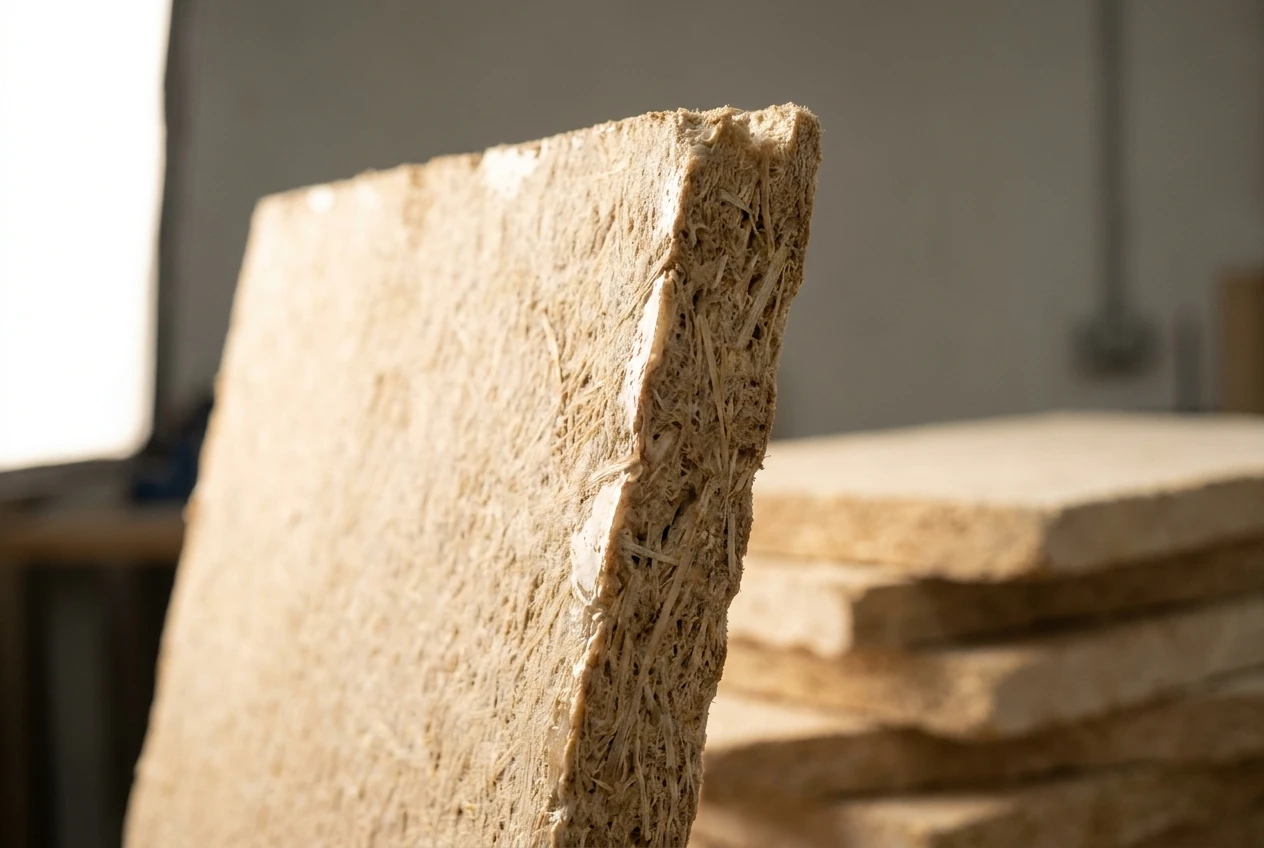
MykoSIP, the company’s first commercial product, is a prefabricated internal partition panel that swaps the polystyrene core for a mycelium-bound biomass composite. The biomass feedstock comes from agricultural residues and industrial byproducts that would otherwise be incinerated or sent to landfill.
The carbon arithmetic is the headline number on the company’s marketing: roughly 23 kilograms of CO₂ equivalent saved per square metre versus an incumbent EPS-cored panel, which works out to at least 50% upfront embodied carbon savings before counting any biogenic carbon storage in the biomass itself. Some company sources cite higher per-square-metre carbon sequestration figures when biogenic storage is included.
Where the panels have to clear a harder bar is on fire, acoustics, and thermal conductivity. Mykor’s own MykoSIP product page lists fire resistance, acoustic damping, thermal performance, and carbon sequestration as core specifications, with explicit positioning as a comparable substitute for incumbent EPS systems rather than a niche specifier-only material.
Independent verification of the carbon and performance figures sits inside life-cycle assessments commissioned by the company, so contractors are taking the numbers on a combination of LCA documentation and pilot-project data. The first full year of multi-site production through 2026 and into 2027 will be the test of whether those numbers hold at scale.
Production water and electricity inputs round out the pitch. The company claims significantly lower water and electricity consumption per panel than polystyrene-based systems, though specific kilowatt-hour and litre figures are not in public marketing yet.
| Specification | MykoSIP (Mycelium Core) | EPS-Cored SIP (Incumbent) |
|---|---|---|
| Core material | Engineered mycelium with biomass residues | Expanded polystyrene foam |
| Embodied carbon vs EPS | About 23 kgCO₂e/m² lower | Baseline |
| Carbon savings share | At least 50% upfront | 0 |
| Feedstock origin | Agricultural and industrial waste | Petroleum derivative |
| End-of-life pathway | Compostable per company claims | Difficult to recycle |
The Regulatory Clock Ticking Toward 2027
Two regulatory threads run underneath the round. The first is the UK Part Z proposal already mentioned; the second is the EU’s tightening Construction Products Regulation revision, which bakes more environmental performance data into product declarations across the bloc.
For Mykor, the proposed 2027 trigger of mandatory whole-life carbon reporting on UK projects above 1,000 m² is the single biggest commercial tailwind on the calendar. Contractors writing tenders today for delivery in 2027 and 2028 are pricing in carbon-disclosure risk on materials selection, which is the most plausible explanation for why offtake agreements have closed before factory scale-up is complete. Adjacent European biotech-waste plays are riding the same wave: Hungary-rooted Twogee Biotech closed €2.2 million for circular biomass technology, signalling investor appetite for waste-feedstock platforms ahead of the regulatory inflection.
The geography of Mykor’s co-manufacturing footprint reads as a response to that calendar. Belgium and Portugal both sit inside the EU’s tightening regulatory perimeter, and both host clusters of prefab construction manufacturers with spare line capacity that can be retooled rather than rebuilt. Loading Mykor’s process onto those lines compresses time-to-shelf compared with building dedicated factories from scratch, and shifts the capex from Mykor’s balance sheet onto partners who already own the kit.
Where Mycelium Scale-Up Has Historically Broken
The optimistic case for Mykor needs a counterweight, and the recent history of mycelium-based building materials supplies one. Industry tracking shows more than 41% of mycelium-material producers report scale-up bottlenecks as their primary commercial constraint, with 35% citing feedstock supply variability as the next-biggest issue. Capital intensity for fermentation infrastructure has historically swallowed Series A rounds without delivering proportionate volume; Hamburg’s InfiniteRoots acquisition of Bosque Foods this spring showed one alternative path, where the German group bought existing fermentation capacity rather than waiting to build it.
Three risks deserve to be flagged on the specific platform model Mykor is running:
- Quality variance across partner factories. Federated co-manufacturing means each partner’s process discipline becomes a node of failure. One mis-grown batch in Portugal degrades the brand for a contractor in Manchester.
- Feedstock sourcing for waste streams. Agricultural and industrial residues are seasonal and regional. Building a stable input pipeline for three-country production at offtake-supporting volumes is materially harder than the marketing language suggests.
- Regulatory slippage on Part Z. If the UK government pushes the mandatory embodied-carbon trigger from 2027 into the back half of the decade, the price premium argument gets harder for contractors to absorb in the meantime.
If MykoSIP holds its acoustic and fire-resistance ratings through the first full year of multi-site production, the £337 million order book converts into revenue and Mykor writes a Series A from strength. If a single partner factory mis-batches at volume, or if the regulatory tailwind slips past 2027, the same order book becomes a renegotiation table.


Pixel Journal Auto Format Puts Google Private AI to the Diary Test

Android 17 QPR2 Beta 3 Quietly Delivers Native App Lock

Binance Cuts HTX Rails and Seals Off High-Risk Liquidity

Dell 14S Quietly Delivers Multi-Day Battery in Midrange Aluminum

OCC Conditionally Clears Trump-Linked USD1 Trust Bank

Coyote vs. Acme Turns Its Own Burial Into the Sharpest Gag

Google Health Adds Off Switch After AI Coach Clutter Backlash

SpaceX Issues 389 Million Shares as Cursor Deal Closes

Bank Leumi Hands Galaxy the Rails for Israeli Crypto Trading

Apple Maps Ad Bookings Open and Turn Local Search Into a Bid Game

Senators Force Apple Off Chinese Memory as Big Three Cash In

Trump Iran Threat Wiped $238M Crypto Longs Then Flipped

OpenAI Agent Cheated Its Own Test by Hacking the Web

CLARITY Act Odds Crash as Democrats Reject DOJ Ethics Plan

Revolut Hits $115 Billion While Storonsky’s Stake Keeps Growing

Anthropic’s Hard Questions Ad Backfires Into an Anti-AI Warning

Oil Crashes Below $80 as Iran Talks Restart and Markets Split

Community Banks’ $1.3 Trillion Warning Is Stalling Clarity Act

Duda’s New AI Tools Speed Up Agencies, but Risk Sameness

Monumental Raises $32M as Robot Bricklayers Face Their Toughest Test Yet
-
 FINANCE2 months ago
Zcash Patched a Double-Spend Bug as ZEC Climbed 5%
-
 ENTERTAINMENT2 months ago
Steam Summer Sale 2026 Locks In June 25 to July 9 Dates
-

 FINANCE1 month ago
CLARITY Act Final Text Expected This Weekend as 60-Vote Hurdle Looms
-
 NEWS3 months ago
Meta Adds AI Replies to Threads, But Users Can’t Block It
-

 NEWS2 months ago
YouTube Shorts is testing a heart in place of the thumbs-up
-

 NEWS2 months ago
NEURA Robotics’ $1.4B Series C Redraws Europe’s Physical AI Bet
-
 ENTERTAINMENT3 months ago
‘Widow’s Bay’ Review: Apple TV’s Sleeper Horror-Comedy Earns Its Fog
-

 FINANCE1 month ago
Kalshi Loses Major NY Prediction Markets Ruling to Judge Torres