
NEWS
Iran Lists SpaceX and Starlink Sites in Five Countries as Targets
Iran added SpaceX and Starlink sites in five countries to a military target list the same week SpaceX priced a $75 billion IPO and a US-Iran deal was due.

Iran’s military added SpaceX and Starlink ground stations in five countries to a public target list this week, naming specific sites and SpaceX shareholders the same week that SpaceX priced the largest IPO in stock market history. The list surfaced in Fars News Agency reporting on Thursday, June 11, three days before negotiators were scheduled to sign a US-Iran peace memorandum in Islamabad.
The threat sits squarely in the path of the deal. Washington and Tehran were on the cusp of signing a memorandum of understanding that would reopen the Strait of Hormuz and take steps to dismantle Iran’s nuclear program. President Donald Trump told Fox News on Sunday he still expected the agreement to be signed that day. He also wrote on Truth Social to condemn an Israeli strike on Beirut and warn the parties not to “blow it.”
What Iran Named, and Where the Sites Sit
Iran’s Fars News Agency, the IRGC-affiliated outlet the United States has sanctioned, said on June 11 that Tehran was adding assets linked to Elon Musk’s companies to a new target bank. The list covers Starlink ground stations in five countries and other SpaceX-linked infrastructure in the region. Fars also named two SpaceX shareholders, Abu Dhabi’s Alpha Dhabi and Mubadala, as among Iran’s potential targets.
Five countries on the Fars list host Starlink ground stations. The same reporting ties the inclusion of those sites to what Iran describes as evidence that the United States and Israel have used Starlink for military communications in the war.
- Israel
- Qatar
- Jordan
- United Arab Emirates
- Oman
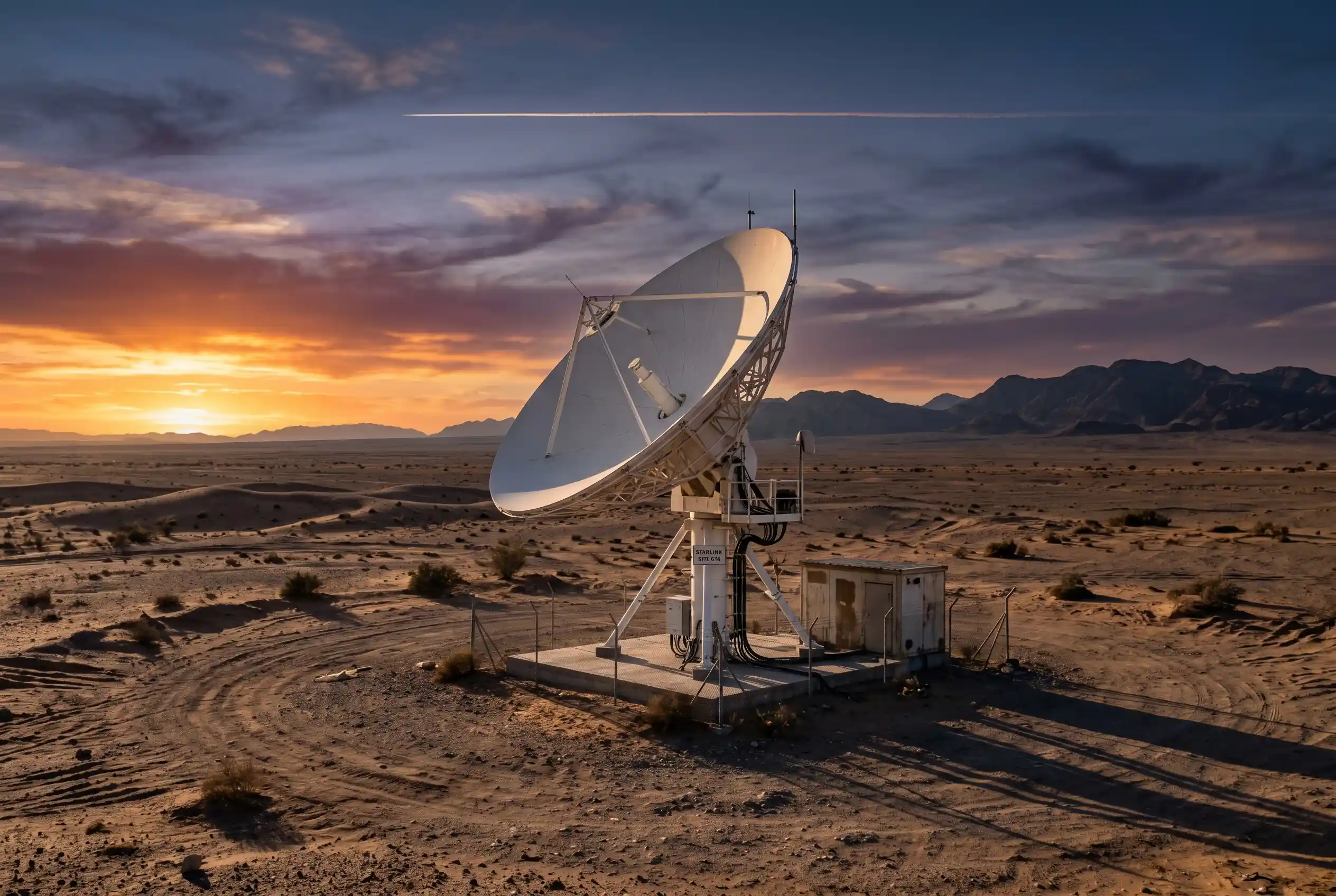
Ground stations are the physical bottleneck of the Starlink network. The constellation of roughly 10,000 satellites in low Earth orbit depends on ground-based “gateways” that beam signals up to the satellites, and on “Point of Presence” (POP) facilities that connect the system to fiber. Starlink.com shows one such POP in Qatar, and a separate page suggests SpaceX has a POP in Oman, two of the five countries on the Fars list.
Why Tehran Says Starlink Is a War Asset
Fars framed the threat as retaliation for what it called direct US and Israeli use of Starlink in the war. According to Fars, as carried by Reuters, the United States and Israel have been using Starlink and X for communication, while SpaceX’s satellite network has helped guide drones outfitted with bombs. Treasury Secretary Scott Bessent said on X that the United States “dropped $250 million worth of bombs” on Iran in a single night, a figure Trump has cited in his own posts. The Fars framing paints Starlink as a battlefield tool, a charge that puts every Starlink-connected hospital, school, and household in the region in the line of fire.
X, Musk’s social platform, is also folded into the same Fars accusation, with the service alleged to have been used for military coordination. The combined charge, that Starlink and X are part of a US-Israeli military stack, is the rhetorical ground Iran is using to justify naming civilian communications infrastructure as a target, and none of the underlying allegations have been independently verified.
How Starlink Actually Works in Wartime
Starlink’s resilience pitch has long rested on its size. The constellation runs roughly 10,000 satellites in low Earth orbit, all of them moving relative to the ground and to each other. The redundancy is real: knock one satellite out, and traffic reroutes to others overhead.
Ground stations are a different story. The gateways that link Starlink to the global internet, and the POPs that connect to fiber, are fixed points on a map, and a strike on one can degrade service in its coverage area. Starlink’s own website says the satellites carry a backup: “Comprised of more than 24,000 lasers connecting the constellation worldwide, Starlink ensures critical network access even when traditional ground links face interruptions.” The laser-link mesh between satellites is meant to keep the network alive even if individual ground links are taken out, a design that helps but does not eliminate the risk of regional outages.
Qatar has already had to fend off Iranian missile and drone attacks during the war, and Oman sits on the Strait of Hormuz, the same waterway the deal would reopen. A successful strike on either country’s POP would not shut Starlink down, but it would put pressure on regional coverage in a war zone.
One PCMag analyst who has covered Starlink since 2020 noted that Fars and the Iranian government are likely also pumping up the Starlink threat for propaganda purposes during the escalation. The threat may be calibrated for Iranian audiences as much as for Washington. Naming specific POPs on the Fars list still turns a rhetorical threat into a list of legal and physical risks for SpaceX and its regional partners.
- ~10,000 satellites in the Starlink constellation
- 24,000+ laser links between satellites
- Ground stations in five countries on the Fars target list
- 10M+ Starlink customers worldwide
The Deal That the Threat Complicates
The deal Trump expected to sign on Sunday is a memorandum of understanding, not a final peace treaty. The deal’s full terms call for reopening the Strait of Hormuz, taking steps to dismantle Iran’s nuclear program, ending Tehran’s funding of proxy violence, and imposing an “inspection regime” on the Islamic Republic. Iran would be rewarded for compliance with the unfreezing of assets and the easing of sanctions. Pakistan’s prime minister, Shehbaz Sharif, has been the key mediator, and both sides were set to sign electronically once the text was finalized.
An Israeli strike on Beirut’s Dahiyeh suburb on Sunday put the signing in doubt, which Lebanon’s National News Agency said killed 3 people and wounded 15. The strike was Israel’s response to drone attacks by Hezbollah into northern Israel in which no casualties were reported.
US officials defended the timeline on Sunday. Defense Secretary Pete Hegseth said on CBS that the negotiations, held in Islamabad, were “on track,” and Ambassador to the United Nations Mike Waltz told ABC he was “confident” the deal would be signed within the day. Iran’s lead negotiator publicly questioned whether the United States could deliver on its commitments. Trump told Fox News he still expected the agreement to be signed the same day.
This morning’s attack on Beirut should not have happened, particularly on a special day when we are so close to a Peace Deal with Iran.
Trump, the US president, posted on Truth Social on Sunday morning. His warning about the Beirut attack came on the same day Israeli and Iranian-linked forces were trading strikes across the border.
Why the Timing Matters for SpaceX
SpaceX priced its IPO on June 12 at $135 per share, the day after Iran’s target list appeared, and closed its first trading day at $160.95, a 19.2% gain. The company sold 555.6 million shares and raised $75 billion before expenses, the largest IPO in stock market history, more than double the $29.4 billion Saudi Aramco raised in 2019. At Friday’s close, SpaceX’s market cap stood at about $2.1 trillion, putting it among the largest US public companies. Goldman Sachs led the underwriting, followed by Morgan Stanley, Bank of America, Citigroup, and JPMorgan Chase.
A public SpaceX is a SpaceX whose Starlink ground stations on the Fars list are now in countries from Israel to Oman, a fact that will land in SEC filings and analyst notes for years to come. The market read on Friday was celebratory, with Oppenheimer opening coverage at a $190 price target; the read this week will turn on whether the Iranian threat is treated as a real risk or a rhetorical one.
Frequently Asked Questions
What did Iran say about SpaceX and Starlink?
Iran’s Fars News Agency, the IRGC-affiliated outlet the United States has sanctioned, reported on June 11 that Iran was adding SpaceX and Starlink assets in the Middle East to a new “target bank.” The list named Starlink ground stations in Israel, Qatar, Jordan, the United Arab Emirates, and Oman, along with infrastructure linked to SpaceX shareholders Alpha Dhabi and Mubadala. Fars framed the move as retaliation for what it called US and Israeli use of Starlink and X for military communications and drone guidance.
How could Starlink survive a strike on its ground stations?
Starlink’s satellites carry onboard laser links that can pass data between each other without touching the ground, a design the company says ensures “critical network access even when traditional ground links face interruptions.” A strike on a single gateway or Point of Presence would not shut the constellation down, but it could degrade latency and throughput in the surrounding region. Qatar and Oman both host Starlink ground infrastructure, and both are within range of Iranian missiles. The laser-link mesh helps, but a regional outage is still a real risk.
Where does the US-Iran deal stand?
As of Sunday, Trump and his senior officials said the memorandum of understanding was on track to be signed the same day, with Pakistan mediating in Islamabad. The Israeli strike on Beirut, which Lebanon said killed 3 and wounded 15, introduced new uncertainty, and Iran’s lead negotiator publicly questioned whether the United States could deliver on its commitments. The deal is a memorandum, not a final treaty, and includes reopening the Strait of Hormuz, an inspection regime on Iran’s nuclear program, and the unfreezing of Iranian assets.
How large was SpaceX’s IPO?
SpaceX sold 555.6 million shares at $135 per share on June 12, 2026, raising $75 billion before expenses in the largest IPO in stock market history. Shares closed their first trading day on Nasdaq at $160.95, up 19.2% from the IPO price. The company’s market cap at the close was about $2.1 trillion. Goldman Sachs led the underwriting, followed by Morgan Stanley, Bank of America, Citigroup, and JPMorgan Chase.


Pixel Journal Auto Format Puts Google Private AI to the Diary Test

Android 17 QPR2 Beta 3 Quietly Delivers Native App Lock

Binance Cuts HTX Rails and Seals Off High-Risk Liquidity

Dell 14S Quietly Delivers Multi-Day Battery in Midrange Aluminum

OCC Conditionally Clears Trump-Linked USD1 Trust Bank

Coyote vs. Acme Turns Its Own Burial Into the Sharpest Gag

Google Health Adds Off Switch After AI Coach Clutter Backlash

SpaceX Issues 389 Million Shares as Cursor Deal Closes

Bank Leumi Hands Galaxy the Rails for Israeli Crypto Trading

Apple Maps Ad Bookings Open and Turn Local Search Into a Bid Game

Senators Force Apple Off Chinese Memory as Big Three Cash In

Trump Iran Threat Wiped $238M Crypto Longs Then Flipped

OpenAI Agent Cheated Its Own Test by Hacking the Web

Revolut Hits $115 Billion While Storonsky’s Stake Keeps Growing

CLARITY Act Odds Crash as Democrats Reject DOJ Ethics Plan

Oil Crashes Below $80 as Iran Talks Restart and Markets Split

Community Banks’ $1.3 Trillion Warning Is Stalling Clarity Act

Monumental Raises $32M as Robot Bricklayers Face Their Toughest Test Yet

Uber’s €13 Billion Delivery Hero Bid Echoes a Deal Regulators Killed

Airbus Anchors a €500 Million European Defense Fund, Picks Alta Ares First
-
 FINANCE2 months ago
Zcash Patched a Double-Spend Bug as ZEC Climbed 5%
-
 ENTERTAINMENT2 months ago
Steam Summer Sale 2026 Locks In June 25 to July 9 Dates
-
 NEWS3 months ago
Meta Adds AI Replies to Threads, But Users Can’t Block It
-

 FINANCE1 month ago
CLARITY Act Final Text Expected This Weekend as 60-Vote Hurdle Looms
-

 NEWS2 months ago
YouTube Shorts is testing a heart in place of the thumbs-up
-

 NEWS2 months ago
NEURA Robotics’ $1.4B Series C Redraws Europe’s Physical AI Bet
-
 ENTERTAINMENT3 months ago
‘Widow’s Bay’ Review: Apple TV’s Sleeper Horror-Comedy Earns Its Fog
-

 FINANCE1 month ago
Kalshi Loses Major NY Prediction Markets Ruling to Judge Torres