
FINANCE
Coinbase CEO Brian Armstrong Is ‘As Bullish as Ever’ on Bitcoin
Coinbase CEO Brian Armstrong says he’s ‘as bullish as ever’ on Bitcoin, calling it the new digital gold and expecting a ‘much higher’ price by 2030.

Coinbase CEO Brian Armstrong has reopened his bullish case for Bitcoin with a post on social media, declaring himself “as bullish as ever” and “still long” on the asset even as it trades well below last year’s peak. His post, timestamped June 15, 2026, came days after Bitcoin reclaimed $65,000, and it lays out the same bet he has held through the latest correction: the market is overreading the noise and underreading the long arc.
Armstrong Reopens His Bitcoin Bull Case
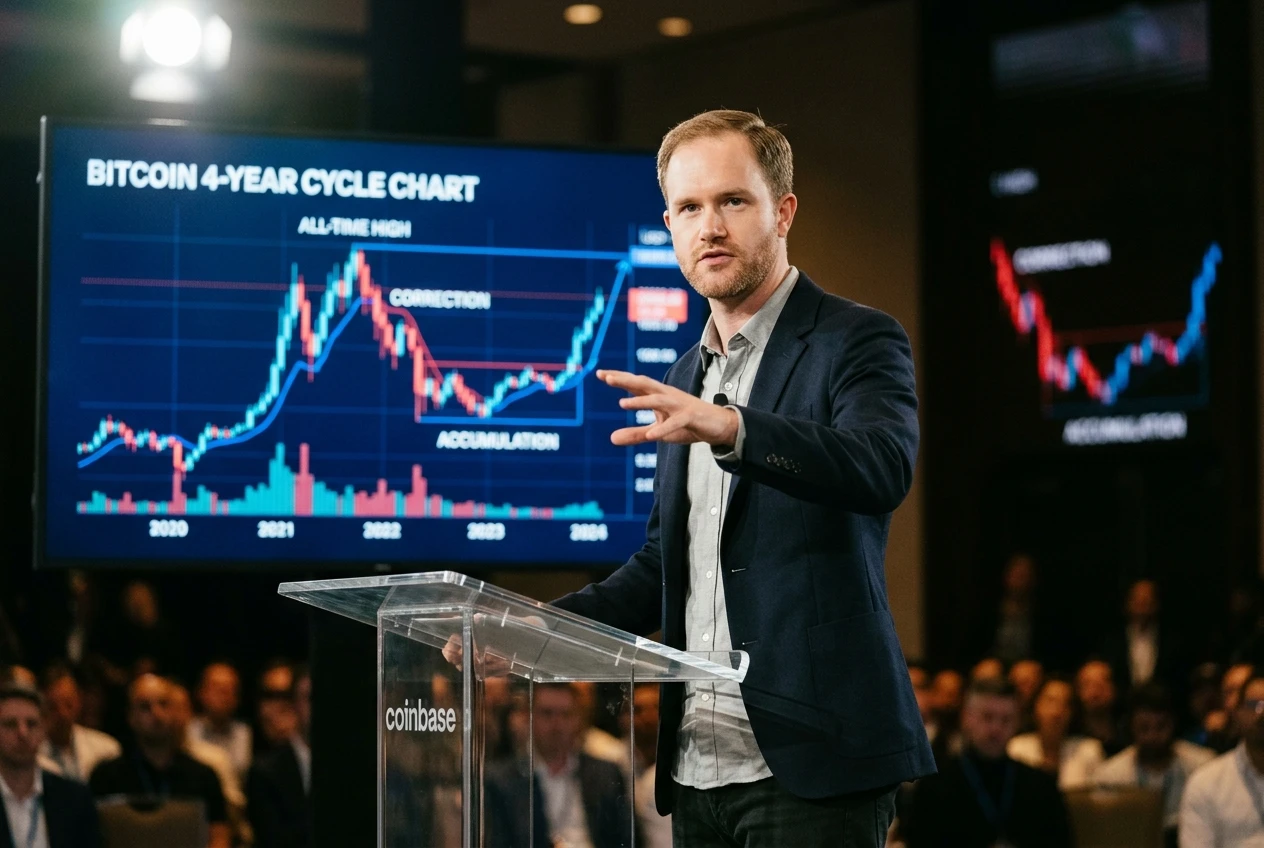
The post itself is short. In it, Armstrong wrote: “I’m as bullish as ever on Bitcoin, and still long (as always). It’s never as good or bad as it seems.” He paired the text with a chart of Bitcoin’s four-year market cycles, the recurring boom-and-bust pattern traders watch around halving events, and a video clip from his recent appearance on the Moonshots with Peter Diamandis podcast. The post had drawn more than 3.77 million views, 4,031 likes, 361 retweets and 339 replies within hours of going up, according to the engagement counts shown on the post page itself.
In the embedded video, Armstrong framed Bitcoin as a long-horizon asset that markets routinely misread in both directions. He put the bull case in three sentences, and the post lifts the most quoted one into a single line: Bitcoin is the new digital gold, and it will be a key part of the economy going forward. The full clip is attached to Armstrong’s June 15 post and the four-year cycle chart.
I think Bitcoin is the new digital gold. I think it’s gonna be a key part of our economy going forward into the future. So, I am as bullish as ever.
The quote is drawn from Armstrong’s video clip embedded in the post. The same post includes the four-year cycle chart he is leaning on, with comments underneath from long-term holders restating their own version of the bet.
The Numbers Investors Are Missing
The immediate context is that Bitcoin has clawed back above $65,000 after weeks of geopolitical and macro pressure. A market snapshot reported alongside Armstrong’s post had BTC changing hands at $65,786.70, up 2.30% in the prior 24 hours, according to Benzinga Pro data cited in the full write-up of Armstrong’s 2030 call. A separate price check on the Friday before, dated June 12, had Bitcoin trading around $63,900.
The longer arithmetic is the one Armstrong is pointing at. Bitcoin has lost nearly half its value since reaching a record high above $123,000 in July 2025, according to the full June 12 review of the Bitcoin drawdown. A buyer who picked the July 2025 top and held through the June 2026 low near $60,000 is staring at a near-50% mark-to-market loss, the kind of drawdown Armstrong’s framework treats as the signal, not the exit.
His argument hinges on one specific ratio: the share of holders still in profit. In the video, Armstrong said the four-year cycle chart shows the percentage of people who have made money versus not, and used that pattern to claim the latest washout has compressed the supply of profitable sellers. The more of the float sitting underwater, his logic goes, the less supply the market has to absorb on the way back up.
For comparison, CryptoQuant put Bitcoin’s realized price at $53,600, about 13% above spot, with the firm’s view that a confirmed bottom still needs demand to return, as covered in Bitcoin’s $53,600 realized price floor explained. That is the on-chain anchor the chart is pointing at.
Why the Long-Term Holders Keep Accumulating
Armstrong is not the only high-profile name leaning on the same data. SkyBridge Capital founder Anthony Scaramucci has said he remains a “long-term believer” in Bitcoin and expects the cryptocurrency to adhere to its typical four-year cycle, according to the same recap. Coinbase itself has been a buyer through the slide: in a separate post, Armstrong disclosed that the exchange increased its Bitcoin holdings by 2,509 BTC in the second quarter, with the message that “Coinbase is long bitcoin” and the firm is “keep buying more.”
- Coinbase added 2,509 BTC to its corporate treasury in Q2 2026, per Armstrong’s own disclosure.
- SkyBridge Capital’s Anthony Scaramucci has publicly described himself as a “long-term believer” in Bitcoin.
- Strategy and other long-term holders remain “unshaken” by the drawdown, in the words of Coinbase’s head of strategy, John D’Agostino.
The pattern, in Armstrong’s read, is that the cohort with the longest time horizon is the cohort doing the most buying, while short-term traders chase the tape. On the other side of that trade, the cohort that bought the July 2025 high and is now sitting on a near-50% loss is the cohort most likely to sell into any recovery.
The Geopolitical Trigger
The catalyst for the latest leg up was not on-chain data. It was a peace deal. On Sunday, June 14, Pakistani Prime Minister Shehbaz Sharif, whose country acted as intermediary, announced that the United States and Iran had reached an agreement, with the official signing set for Friday, June 19, in Switzerland, according to Forbes reporting. President Donald Trump confirmed the deal in a Truth Social post the same evening, calling it “complete” and authorizing the “toll-free opening” of the Strait of Hormuz.
- Pakistani PM Shehbaz Sharif announced the agreement on Sunday, June 14, citing his country’s role as mediator.
- President Trump confirmed the deal in a Truth Social post the same evening, calling it “complete.”
- Trump authorized the “toll-free opening” of the Strait of Hormuz in the same post.
- Iran’s Supreme National Security Council said the memorandum of understanding text is finalized, with official signing set for June 19 in Switzerland.
The geopolitical easing has been the single biggest macro variable for oil, equities, and risk assets over the past month. The Strait of Hormuz reopening alone removes a tail risk that had been priced into energy markets and, by extension, into the cost-of-living inputs that pull at the Fed’s reaction function. For the wider context of how US-Iran tensions have moved Bitcoin, Bitcoin’s drop after US strikes on Iran traces the prior leg down, and the $1.86 billion crypto liquidation cascade details the leveraged washout that followed. After sitting in the $60,000 to $63,000 range for most of June, BTC pushed back above $65,000 once the deal language hardened.
The Skeptic’s Frame
The case against the rally is straightforward, and it is the case that Armstrong’s own chart is meant to rebut. Morningstar’s Daniel Sotiroff, in the CNBC review of the drawdown, summed up the skeptic’s read in a single line: “I think a lot of this is crypto being crypto.” Bitcoin does not generate earnings, interest, or rent. Its price is set by what the next buyer will pay, and the next buyer’s appetite can vanish as quickly as it arrived.
Sotiroff’s critique of the “digital gold” thesis is that Bitcoin’s volatility makes it a difficult store of value, and that investors who want an inflation hedge already have Treasury Inflation-Protected Securities. Robert Johnson, a finance professor at Creighton University quoted in the same piece, went further: “You cannot invest in Bitcoin, you can only speculate.” Investors who bought the July 2025 high above $123,000 are living with that distinction in real time, and the stretch of red months on the chart starting in October 2025 is the evidence they point to.
The bull counter is that the same volatility that produces the drawdowns has produced every prior cycle’s recovery, and that the only investors who have captured those recoveries are the ones with a plan that survives them. Matt Chancey, a CFP at Tax Alpha Companies, framed the divide in the same piece this way: “What a selloff actually does is reveal which investors had a plan and which were riding momentum.” Armstrong is publicly aligning himself with the first group. The disagreement is over whether that plan is the right one for the next four years, not over whether it exists.
What Armstrong Has Said Before
The June 15 post is the latest iteration of a long-running posture, not a new one. Earlier in June, in a separate post, Armstrong argued that Bitcoin is “going to do great and is as important as ever,” a line flagged in the same Benzinga recap. He has, in his own framing, been saying the same thing through every drawdown in the cycle, and the Moonshots clip leans on the same four-year-cycle chart he has used across multiple recent posts, including the one where he disclosed the Q2 BTC purchase.
The pattern matters because the conviction has not changed. The question the post is implicitly answering is whether the Coinbase chief is shifting his view in real time, or whether he is restating it. The language of the latest post, “as always,” is meant to foreclose the first reading. So is the 2030 anchor. The forecast attached to the bet is long-horizon: “By 2030, we’re going to have a much higher price,” Armstrong said in the video. The exact multiple is not specified, and he is the first to acknowledge he is offering a direction, not a number. That, too, is part of the public case: a call on the role of Bitcoin in the financial system over the next four years, with the near-term tape the noise to be ignored.
What the Next Move Could Look Like
Two dates will test the thesis. The first is Friday, June 19, the official signing of the US-Iran agreement in Switzerland. The market has priced the deal language in, and the rotation that lifted Bitcoin back above $65,000 sits on top of that assumption. A reversal in the deal language is the trigger that would unwind it.
The second date is longer-dated and more uncertain. Armstrong’s 2030 call is a call on Bitcoin’s share of the global financial system, not on a price point. The holders who treat that call as a number to wait for will be waiting in vain; the trade, in his framing, is the cumulative weight of every cycle’s drawdown against the long-arc trajectory. Coinbase’s own filings, including the Q2 disclosure Armstrong posted, are a quieter expression of the same conviction from a treasury that has to mark to market every quarter. “My instinct is we probably have bottomed at this point, maybe at $60,000,” Armstrong said. Nobody, including him, can say for sure. The post is the public expression of that bet, made when even his own framework calls the bottom uncertain.
Frequently Asked Questions
What did Brian Armstrong say about Bitcoin on June 15, 2026?
Armstrong posted on social media that he is “as bullish as ever on Bitcoin, and still long (as always),” and called Bitcoin “the new digital gold” in an attached video clip from the Moonshots with Peter Diamandis podcast. The post also includes a four-year-cycle chart Armstrong has used to argue the market is closer to a bottom than a top.
What is Brian Armstrong’s Bitcoin price prediction for 2030?
Armstrong said he expects the price of Bitcoin to be “much higher” by 2030, without naming a specific target, according to a June 2026 recap of his post. The forecast is a directional call on Bitcoin’s share of the global financial system, not a price point.
Why did Bitcoin rally above $65,000 in mid-June 2026?
Bitcoin pushed back above $65,000 after President Donald Trump confirmed the US-Iran peace deal is “complete” and authorized the “toll-free opening” of the Strait of Hormuz, with the official signing set for June 19 in Switzerland, per Forbes reporting and live updates from CGTN. The geopolitical easing removed a tail risk that had been priced into energy and risk assets for weeks.
Has Coinbase been buying Bitcoin through the 2026 drawdown?
Coinbase CEO Brian Armstrong disclosed on social media that the exchange’s Bitcoin holdings increased by 2,509 BTC in the second quarter of 2026, with the message that “Coinbase is long bitcoin” and the firm is “keep buying more.” Coinbase’s stock, by contrast, closed 0.41% lower at $159.78 on the Friday before the post, in the latest reminder that the treasury and the equity tell different stories.


Pixel Journal Auto Format Puts Google Private AI to the Diary Test

Android 17 QPR2 Beta 3 Quietly Delivers Native App Lock

Binance Cuts HTX Rails and Seals Off High-Risk Liquidity

Dell 14S Quietly Delivers Multi-Day Battery in Midrange Aluminum

OCC Conditionally Clears Trump-Linked USD1 Trust Bank

Coyote vs. Acme Turns Its Own Burial Into the Sharpest Gag

Google Health Adds Off Switch After AI Coach Clutter Backlash

SpaceX Issues 389 Million Shares as Cursor Deal Closes

Bank Leumi Hands Galaxy the Rails for Israeli Crypto Trading

Apple Maps Ad Bookings Open and Turn Local Search Into a Bid Game

Senators Force Apple Off Chinese Memory as Big Three Cash In

Trump Iran Threat Wiped $238M Crypto Longs Then Flipped

OpenAI Agent Cheated Its Own Test by Hacking the Web

CLARITY Act Odds Crash as Democrats Reject DOJ Ethics Plan

Revolut Hits $115 Billion While Storonsky’s Stake Keeps Growing

Anthropic’s Hard Questions Ad Backfires Into an Anti-AI Warning

Oil Crashes Below $80 as Iran Talks Restart and Markets Split

Community Banks’ $1.3 Trillion Warning Is Stalling Clarity Act

Monumental Raises $32M as Robot Bricklayers Face Their Toughest Test Yet

Uber’s €13 Billion Delivery Hero Bid Echoes a Deal Regulators Killed
-
 FINANCE2 months ago
Zcash Patched a Double-Spend Bug as ZEC Climbed 5%
-
 ENTERTAINMENT2 months ago
Steam Summer Sale 2026 Locks In June 25 to July 9 Dates
-
 NEWS3 months ago
Meta Adds AI Replies to Threads, But Users Can’t Block It
-

 FINANCE1 month ago
CLARITY Act Final Text Expected This Weekend as 60-Vote Hurdle Looms
-

 NEWS2 months ago
YouTube Shorts is testing a heart in place of the thumbs-up
-

 NEWS2 months ago
NEURA Robotics’ $1.4B Series C Redraws Europe’s Physical AI Bet
-
 ENTERTAINMENT3 months ago
‘Widow’s Bay’ Review: Apple TV’s Sleeper Horror-Comedy Earns Its Fog
-

 FINANCE1 month ago
Kalshi Loses Major NY Prediction Markets Ruling to Judge Torres