
NEWS
Clicks Communicator Enters Q4 With Reservations Still Open
Clicks Communicator still has not opened Q4 order setup for $199 deposits, even after Android 17 demos and a 4,450 mAh battery bump.

The Clicks Communicator still has no order-setup window for the people who put $199 down, even after a June working demo and a 4,450 mAh battery bump. Clicks Technology showed dummy units at CES in January 2026, promised working prototypes in Q2, and put manufacturing and shipping in Q4 2026. Late in the third quarter, the public FAQ still tells reservation holders to wait until the first production run.
Android 17 is no longer a future skin. The hard remaining work is lab approvals, color and layout picks, and turning deposits into configured phones.
Android 17 Landed in June Without the Phone
Google put Android 17 on supported Pixel phones on June 16, 2026, and other makers have been following through the year. Testers can already load Android 17 QPR 2 test builds on current Pixel hardware. That calendar is why the May software note aged so fast: a Q4 phone can ship on 17 without asking buyers to sit on last year’s build.
Clicks first talked about Android 16 at the January unveil, with major upgrades promised through Android 20 and security patches through 2031. In late May it told reservation holders the first boot image would be Android 17 instead. That is now the least risky part of the plan, because the platform has been public for 87 days.
A June 29 first-look video then showed a unit that powered on, placed calls, and ran apps. The September 7 home-screen clip still carries a different label: pre-production hardware and beta software. Hitting a working sample is not the same as freezing the image that goes in the box.
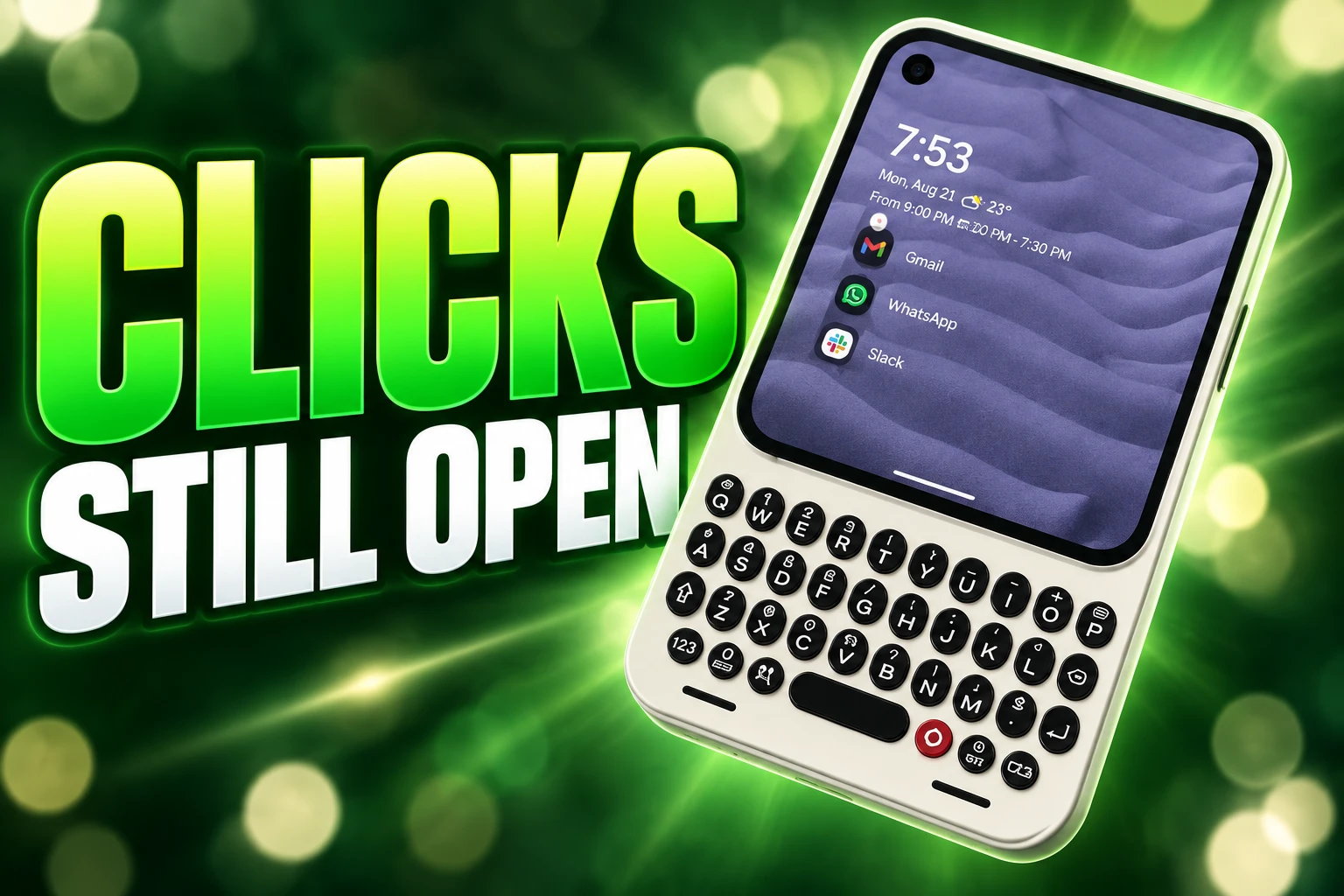
The Battery Jump Stopped at 4,450 mAh
The original pack was 4,000 mAh, already using silicon-carbon chemistry rather than a plain lithium-ion cell. In an April 27 note to the community, Clicks said resourceful engineering had pushed the battery past 4,000 mAh, and called that unglamorous work a step toward June working units. The figure that later stuck on the product page is 4,450 mAh, a 450 mAh gain.
Clicks still will not publish a runtime. The company says it is too early to project battery life, and that the 4.03-inch AMOLED and a 4-nanometer chip are supposed to do as much of the endurance job as the extra cell. Compared with flagship packs that now run much larger, 4,450 mAh looks small until the chassis is in the hand: 130.5 x 78.63 x 12 mm and 170g, with a keyboard occupying the lower half.
Charging is USB-C plus Qi2 on the magnetic backs. There is no public wattage. Anyone buying this as a second phone will care more about whether a workday of messages fits than about beating a 6.8-inch slab on a spec sheet.
Q3 Promised Color Picks That Buyers Still Cannot Make
The April 27 road map is still the only dated production calendar Clicks has put on paper. It named two public commitments, working prototypes in Q2 and shipping later in the year, and said both were on track. June’s powered-on demo kept the first half of that sentence honest. The second half now sits on Q3 lab work and a configuration round that the live FAQ has not opened.
THE CALENDAR CLICKS PUT ON PAPER IN APRIL
- January 2, 2026: Clicks unveils Communicator and opens reservations, with dummy hardware at CES.
- February 27, 2026: Extra keyboard layouts and the MediaTek MT8883 platform are confirmed.
- April 27, 2026: Battery rises past 4,000 mAh; Q2 prototypes, Q3 testing, and Q4 shipping are locked as the public plan.
- Late May 2026: Reservation holders get Android 17 as the first boot image and the 4,450 mAh pack.
- June 16, 2026: Android 17 reaches Pixel phones, taking the OS risk out of a Q4 launch.
- June 29, 2026: A working Communicator appears on video, with hardware and software both running.
- July 30, 2026: The Communicator Ring bumper is shown, on sale when reservations convert in the fall.
- September 7, 2026: A Niagara home-screen preview still flags pre-production hardware and beta software.
April put color, layout, and back-cover choices in Q3, alongside certifications and beta testing. The live product FAQ still says holders will be invited closer to the first production run. Those two sentences can both be true only if the invite is still in draft this late in the quarter.
A 4.03-Inch Slab With BlackBerry Hands on the Keys
Communicator is a compact Android phone with a physical keyboard under a 4.03-inch Full HD AMOLED, sold as a companion you can leave a flagship at home for, or as a main phone if the app list is short enough. Storage is 256GB, with microSD up to 2TB. The cameras are a 50MP rear with OIS and a 24MP front. A 3.5mm jack sits on the top. The tray under the pop-off back takes nanoSIM and microSD, and the phone also supports eSIM.
The chip is the MediaTek MT8883, described by Clicks as a long-life 4 nm platform in the 4-nanometer Dimensity 8300 family. MediaTek’s 8300-class parts use four Cortex-A715 cores and four Cortex-A510 cores, Wi-Fi 6E, and Bluetooth 5.4. Clicks picked the MT8883 for Android updates through Android 20, not for winning benchmark charts.
COMMUNICATOR HARDWARE AS PUBLISHED
| Part | Spec |
|---|---|
| Display | 4.03-inch Full HD AMOLED |
| Battery | 4,450 mAh silicon-carbon, Qi2 plus USB-C |
| Chip | MediaTek MT8883, 4 nm, Dimensity 8300 family |
| Storage | 256GB plus microSD up to 2TB |
| Cameras | 50MP rear with OIS, 24MP front |
| Body | 130.5 x 78.63 x 12 mm, 170g |
An August 24 design note is more revealing than the chip table. Clicks says the mid-frame is a carbon fibre composite that is transparent to radio, which is how it claims seven cellular antennas in the frame against five on many rivals, plus TD-LTE bands used across Asia. A vapour chamber sits in the chassis so the frame is not the only heat path into the hand. Three microphones sit on the top, in the chin, and on the back.
Joseph Hofer shaped the keys. He is the industrial designer who worked on the BlackBerry Bold 9900 and the Passport, then left phone work for a decade. Clicks brought him back as a design partner. He has described about 30 percent more key surface than earlier Clicks cases, with a raised inner corner the thumb can find without looking. The fingerprint reader lives under the spacebar. Layouts at configuration, when that email finally goes out, are QWERTY, AZERTY, QWERTZ, Korean, and Arabic. Body colors are Smoke, Clover, and Onyx, with swap-off backs.
Niagara Turns Messages Into the Home Screen
The keyboard is the bait. The software is the argument Clicks actually has to win on a 4.03-inch panel. The company is co-building the interface with Niagara Launcher, an Android home-screen project it has said has more than 12 million downloads. A September 7 clip walks through that home screen on a unit that is still in beta.
On camera, the presenter says the phone was built to respect your time and cut through noise. Favorite apps sit on the home screen with inline preplies. Start typing and search jumps to a contact, an app, or the web. Plug in headphones and the music player comes up. Double-tap the alphabet rail to lock. VIP traffic is supposed to light the Signal Light, then clear that light when you act on the message in place.
THE HARDWARE THAT TRIES TO REPLACE THE BANNER TRAY
- Signal Light: A lamp in the side Prompt Key uses color for who or what, and a breathing, pulsing, or recording pattern for how urgent it is, readable face up or face down.
- Prompt Key: Hold in a text field to dictate and release to send; outside a field it starts a voice note, with later hooks promised for note apps and agents.
- Message Hub: Mail and chat from apps such as Gmail, WhatsApp, Telegram, and Slack are meant to land in one feed so the keyboard can triage them.
- Kill switch: A physical control can mute radios and go dark when the light would otherwise keep tapping your attention.
- Touch-sensitive keys: The keyboard can scroll lists so a thumb does not have to leave the keys for the glass.
That stack is how Clicks wants a small screen to feel larger than it is. It is also why a September beta label still matters. Message Hub, Signal Light mapping, and keyboard shortcuts are the product. If those miss, a nice keyboard on stock Android is just a Unihertz-class experiment at a higher price, and shoppers already have Titan 2 Elite and Minimal Phone 2 in the same year.
$199 Deposits Convert on Clicks’ Clock
Reservations opened on January 2. A $199 deposit locks a place in line and counts toward the bill. Early birds who reserved in that first window were offered $399. The special launch price on the terms page is $499, or $529 if you pay in full with $30 shipping. An early-bird full pay is listed at $429. Clicks is not selling a finished phone at checkout. It is selling a place in a queue that will automatically convert into an order unless you cancel before the deadline in the conversion email.
At conversion, $199 holders are charged the rest. Full-pay holders are not, unless they add extras. Deposits and full reservations are refundable until that conversion. After it, normal return rules apply. The same terms warn that every reservation stays subject to factory readiness, parts, regulatory approvals, and quality checks, and that estimated dates are for planning, not a guarantee. Delaware law governs the contract. The limited warranty is one year from delivery.
On September 9, co-founder Kevin Michaluk posted that you can order four Communicators for the price of one iPhone Duo, pointing buyers at ClicksPhone.com. In the replies, people who put money down in March asked for a tracking number rather than another price joke. That split is the whole customer problem now. The object still photographs well. The queue wants a configure link.
Clicks is not a two-person Kickstarter. CEO and co-founder Adrian Li used the case business as the demand proof when the phone was announced.
Since launching Clicks Keyboard, we’ve shipped more than 100,000 units to customers in over 100 countries.
Adrian Li, CEO and co-founder of Clicks, January 2 announcement
Those cases, plus later Power Keyboard units, are why the company believes a built-in keyboard phone can sell. They are also why delays sting. Some Power Keyboard buyers spent 2026 waiting on batches, tariffs, and a China certification cancel. Communicator is a full Android handset, so carrier and safety labs are a harder gate than a case. The July 30 Ring bumper, a polycarbonate and TPU frame, only goes on sale when those reservations convert in the fall.
The Paint Shop Is Still Open
On September 8, Clicks posted that Communicator units were keeping staff connected halfway around the world, which is the first public hint that more than a demo bench set exists. On September 11 it posted from a paint factory, saying the team was obsessing over colors, materials, and finishes, with a prototype in the morning and a sample back by afternoon.
Team Clicks flew to the paint factory to obsess over things most people will never notice. Communicator's colors, materials, and finishes, refined in real time. Prototype in the morning, sample back by afternoon. Dreams really do come true 🤩 pic.twitter.com/doPpHg8Zyl
— Clicks (@clickskeyboard) September 11, 2026
Paint QC can be a production-readiness step. It can also be evidence that cosmetic SKUs are not frozen while Q4 is supposed to be for the manufacturing ramp. The company has not published a certification pass, a configure-by date, or a week in Q4 when boxes move. Co-founders Michael Fisher and Jeff Gadway have kept the drumbeat of clips going, which is more than most phone startups do, and still less than a ship notice.
WHAT WE KNOW
- Software target: Communicator is still planned to boot Android 17, with OS upgrades through Android 20 and security support through 2031.
- Battery: The published cell is 4,450 mAh silicon-carbon, 450 mAh above the CES figure, with no runtime claim.
- Hardware proof: A working unit was shown on June 29; September clips still say pre-production and beta.
- Money: $199 deposits remain refundable until Clicks emails that ordering is open and the reservation converts.
WHAT IS UNCONFIRMED
- Lab status: Clicks has not said whether Q3 certification is done, in progress, or slipping into Q4.
- Config mail: The April plan put Smoke, Clover, Onyx, and the five layouts in Q3; the live FAQ still points at the first production run.
- First ship week: Q4 remains the window, with no day attached, and timelines in the terms are explicitly not guarantees.
The May notes on Android 17 and the fatter cell did what they were supposed to do. They told the queue the company was still moving. Eight months after CES, the remaining work is duller: freeze paint, pass labs, send the configure mail, and charge the rest of the $199. Until that email lands, Communicator is a working prototype with a Q4 slot, not a phone you can unpack.

Triumph Bonneville 400 Puts Its Badge on a 349cc Tax Cut

Verstappen Takes First 2026 Pole at a Relocated Bahrain GP

Anthropic Warns a Pentagon Fight Can Hit Private Clients

FDA Closes Taylor Farms Lettuce Probe Without a Cause

Galaxy Z Fold 8 Ultra Gets a 5,298MB October Security Update

The Orchard Bug Forced Zcash to Open an Empty Pool

The $5.99 Game That Won Steam’s 2026 Summer Sale

Don Lee Joins Hemsworth as Extraction 3 Starts Shooting

YouTube Shorts Retires Dislikes and Swaps Likes for Hearts

NEURA Robotics Is Spending Its $1.4B on a Machine Stack
-
 NEWS4 months ago
The Orchard Bug Forced Zcash to Open an Empty Pool
-
 GAMING4 months ago
The $5.99 Game That Won Steam’s 2026 Summer Sale
-
 ENTERTAINMENT6 months ago
Don Lee Joins Hemsworth as Extraction 3 Starts Shooting
-
 NEWS4 months ago
YouTube Shorts Retires Dislikes and Swaps Likes for Hearts
-
 NEWS4 months ago
NEURA Robotics Is Spending Its $1.4B on a Machine Stack
-
 AUTO6 months ago
Kawasaki Bets the New Z1100 Against Its Own Supercharger
-

 BUSINESS5 months ago
Norway’s Export Bank Backs Nscale’s $790 Million Narvik Loan
-

 GAMING4 months ago
Game of Thrones Dragonfire Follows Boston’s Conquest Playbook