
BUSINESS
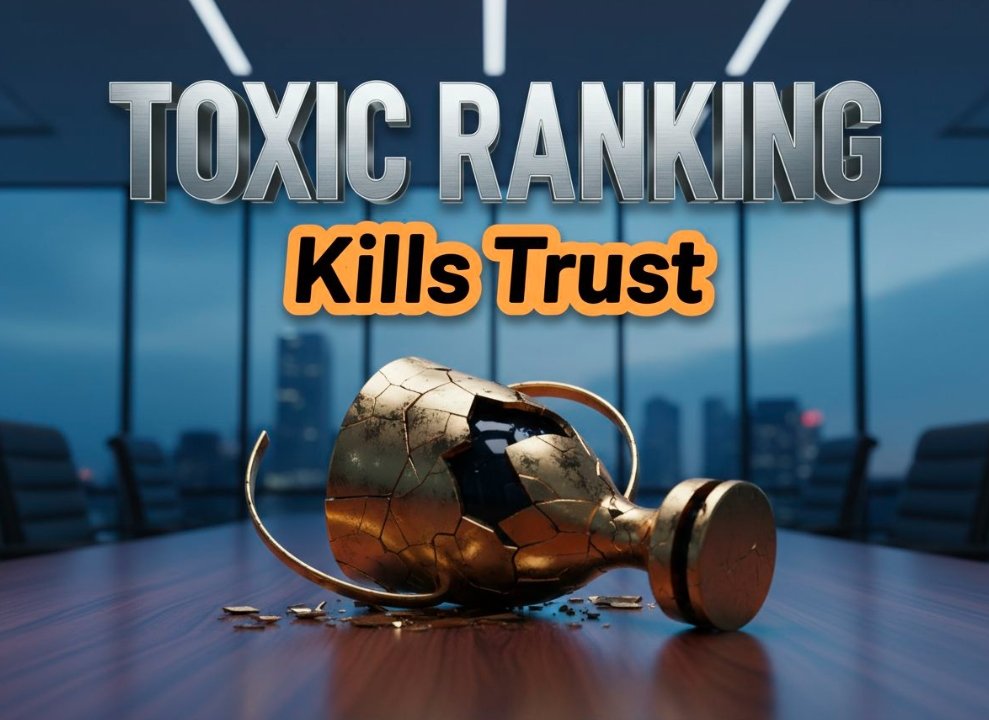
Why Ranking Staff Against Peers Kills Team Trust

Performance review season often brings a hidden danger to modern offices that leaders fail to see. While managers seek clarity by rating workers against their colleagues, new data suggests this method destroys collaboration. This outdated tactic creates rivals instead of teammates and sabotages long term growth for short term metrics.
Old Habits Return in High Pressure Workplaces
The corporate world is seeing a quiet return of comparative evaluations. This method was once famously known as “stack ranking” or the “rank and yank” system popular in the 1980s. It forces managers to place employees on a bell curve regardless of actual collective performance.
Many tech giants and financial firms moved away from this decade ago. They realized it created toxic cultures where internal sabotage became a survival strategy. However, the current economic climate has changed the playing field.
Tight budgets and remote work struggles are pushing executives back toward rigid grading systems. Leaders want to identify low performers quickly. They believe comparing team members against each other provides objective data for layoffs or promotion limits.
But experts warn that using relative ranking as a primary tool ignores the complexity of modern teamwork.
Work is rarely done in isolation anymore. A software engineer needs a product manager, and a sales rep needs marketing support. When you grade these people against each other, the incentive to help disappears.
corporate performance review tension graph
“When an employee knows their neighbor’s success creates their own failure, the team is effectively dead.”
The resurgence is subtle. It often hides behind terms like “calibration sessions” or “talent density reviews.” The mechanism remains the same. One person must lose for another to win.
Psychological Safety Takes a Massive Hit
The human brain reacts poorly to social threats. Neuroscience research indicates that being ranked lower than a peer triggers the same pain centers as physical injury. This is a biological reality that managers cannot ignore.
When an employee feels they are in a contest for survival, their focus shifts. They stop thinking about the customer or the product. They start thinking about optics and self-preservation.
Fear serves as the enemy of creativity and honest communication.
Employees in these environments stop asking for help. Admitting a struggle looks like weakness to a manager who is keeping score. They also stop offering help to others. Helping a colleague might improve that colleague’s ranking at the expense of their own.
A culture of silence begins to form. Mistakes get hidden rather than fixed. Innovation stalls because no one wants to take a risk on a project that might fail. The safest path is to do exactly what is asked and nothing more.
The Cost of Competition
| Impact Area | Collaborative Culture | Comparative Culture |
|---|---|---|
| Information Flow | Open and shared freely | Hoarded for leverage |
| Risk Taking | Encouraged for growth | Avoided to protect status |
| Team Dynamic | “We win together” | “I must beat you” |
| Focus | Solving customer problems | Pleasing the manager |
This table shows the stark difference in daily operations. The comparative model fundamentally breaks the trust required for agile business. Speed is lost because every decision goes through a filter of personal politics.
Innovation Dies When Competition Rules
Great products usually come from cross-functional cooperation. It requires a marketing expert to listen to an engineer and a designer to compromise with a data analyst. This friction creates sparks that lead to new ideas.
Comparative feedback pours water on these sparks.
Consider a scenario where a team needs to launch a risky new feature. In a psychological safety model, the team rallies to solve problems as they arise. In a ranking model, individuals will distance themselves from the risky parts.
They do not want to be associated with a potential flop during review season.
High performers will eventually leave organizations that force them to compete with their allies.
Top talent usually values growth and purpose over petty office politics. If they spend 30 percent of their energy defending their territory, they burnout. They will move to competitors that allow them to focus entirely on the work itself.
This leads to a “talent drain” that is hard to measure on a spreadsheet. The company loses its best collaborators. It retains only the most aggressive individualists. Over time, the culture becomes cutthroat and dysfunctional.
Smarter Ways to Measure Real Success
The solution is not to stop evaluating performance. Companies must have high standards to survive. The shift must be from “relative” evaluation to “absolute” evaluation.
Measure employees against their goals, not their neighbors.
If an entire team hits their targets, the entire team should be rewarded. There is no logical reason to artificially deflate the score of a solid worker just to fit a curve.
Effective leaders focus on individual growth trajectories.
The conversation shifts from “You are number 4 on the team” to “Here is how you met your goals.” This separates the person’s value from their peers. It allows for a culture where everyone can technically succeed if they do the work.
Actionable Steps for Managers
- Set Clear Standards: Define what “excellent” looks like before the year starts so the target does not move.
- Encourage Peer Recognition: Ask team members who helped them succeed. This rewards the helpers, not just the stars.
- Decouple Development from Pay: Have separate conversations about skill growth and salary to lower the temperature.
- Track Team Metrics: Make a significant portion of the review based on the collective output of the group.
This approach builds a “growth mindset” across the organization. It treats performance as an infinite resource that can be expanded. It rejects the idea that talent is a fixed pie that must be divided.
When people feel their rating depends on their own output, they work harder. When they feel it depends on someone else failing, they give up. The choice for leadership is clear.
Companies that master this balance will win the future. They will move faster because their internal friction is lower. They will keep their best people longer. And they will solve problems their competitors are too busy fighting over.
The era of the “lone wolf” employee is over. The era of the high-performing ecosystem is here. Reviews must reflect that reality.
We can still spot outliers and underperformers without turning the workplace into an arena. It takes more effort from management to grade based on nuance. But the return on investment is a loyal, fearless workforce.
The decision to drop comparative rankings is a decision to prioritize the company’s long-term health. It builds a foundation where trust can thrive. Without trust, there is no speed, no quality, and no future.
Leaders must ask themselves a simple question. Do they want a team of fighters or a fighting team? The answer determines the success of the entire enterprise.


Pixel Journal Auto Format Puts Google Private AI to the Diary Test

Android 17 QPR2 Beta 3 Quietly Delivers Native App Lock

Binance Cuts HTX Rails and Seals Off High-Risk Liquidity

Dell 14S Quietly Delivers Multi-Day Battery in Midrange Aluminum

OCC Conditionally Clears Trump-Linked USD1 Trust Bank

Coyote vs. Acme Turns Its Own Burial Into the Sharpest Gag

Google Health Adds Off Switch After AI Coach Clutter Backlash

SpaceX Issues 389 Million Shares as Cursor Deal Closes

Bank Leumi Hands Galaxy the Rails for Israeli Crypto Trading

Apple Maps Ad Bookings Open and Turn Local Search Into a Bid Game

Senators Force Apple Off Chinese Memory as Big Three Cash In

Trump Iran Threat Wiped $238M Crypto Longs Then Flipped

OpenAI Agent Cheated Its Own Test by Hacking the Web

CLARITY Act Odds Crash as Democrats Reject DOJ Ethics Plan

Revolut Hits $115 Billion While Storonsky’s Stake Keeps Growing

Oil Crashes Below $80 as Iran Talks Restart and Markets Split

Community Banks’ $1.3 Trillion Warning Is Stalling Clarity Act

Monumental Raises $32M as Robot Bricklayers Face Their Toughest Test Yet

Uber’s €13 Billion Delivery Hero Bid Echoes a Deal Regulators Killed

Airbus Anchors a €500 Million European Defense Fund, Picks Alta Ares First
-
 FINANCE2 months ago
Zcash Patched a Double-Spend Bug as ZEC Climbed 5%
-
 ENTERTAINMENT2 months ago
Steam Summer Sale 2026 Locks In June 25 to July 9 Dates
-
 NEWS3 months ago
Meta Adds AI Replies to Threads, But Users Can’t Block It
-

 FINANCE1 month ago
CLARITY Act Final Text Expected This Weekend as 60-Vote Hurdle Looms
-

 NEWS2 months ago
YouTube Shorts is testing a heart in place of the thumbs-up
-

 NEWS2 months ago
NEURA Robotics’ $1.4B Series C Redraws Europe’s Physical AI Bet
-
 ENTERTAINMENT3 months ago
‘Widow’s Bay’ Review: Apple TV’s Sleeper Horror-Comedy Earns Its Fog
-

 FINANCE1 month ago
Kalshi Loses Major NY Prediction Markets Ruling to Judge Torres