
BUSINESS
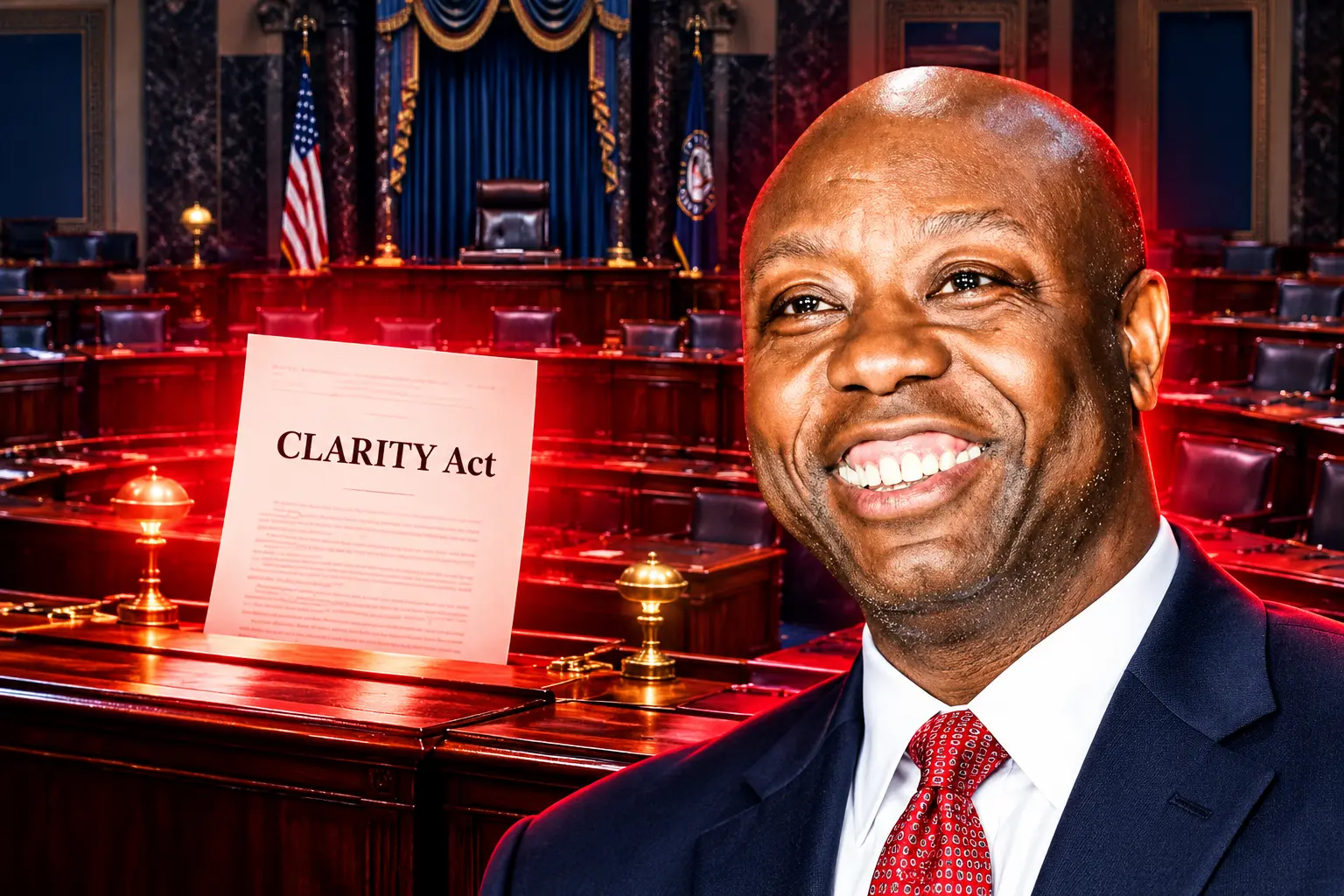
Tim Scott’s $30 Trillion Clarity Bet Faces a Senate Test
Scott’s $30 trillion Clarity Act claim now faces a September 15 Senate vote that only decides whether debate can start.

Senate Banking Chair Tim Scott said in June that the Clarity Act would pass before August and lift crypto to $30 trillion. The Senate will instead hold a September 15 cloture vote on a 630-page rewrite, a test of whether debate can start, not whether the bill becomes law.
Scott, a South Carolina Republican, tied that tenfold jump to one job: writing federal rules so digital-asset firms stay in the United States. The date he named is gone. The number is still the pitch.
Scott Put a Date on a $30 Trillion Call
On June 11, 2026, Scott went on Fox Business and treated the bill as a near-term fact. He put the industry at about $3 trillion and said he thought it was going to $30 trillion in the next several years. Clip accounts circulated his closer the same week: “It’s coming, period.”
Job one is making sure that consumers are protected. Job two is making it less expensive to do business in America and easier to do it 24/7. Blockchain and digital assets allow us to get there faster.
Tim Scott, Senate Banking Committee chairman, on Mornings with Maria, June 11, 2026
He also said digital assets are part of the future of finance and that even JPMorgan was getting involved in stablecoins. White House crypto advisor Patrick Witt had talked up a July 4 signing. Scott’s own line was leadership or dust: “We can either lead in America or watch the dust from a distance.”
That first $30 trillion market call landed after his committee had already voted. The House had passed H.R. 3633, the Digital Asset Market Clarity Act of 2025, on July 17, 2025, by 294-134, with Rep. French Hill of Arkansas as sponsor. Senate Banking advanced its version 15-9 on May 14, 2026, with Democrats Ruben Gallego of Arizona and Angela Alsobrooks of Maryland joining all 13 committee Republicans. On June 1 the bill reached the Senate Legislative Calendar. Eligible is not the same as scheduled.
THE PATH TO THE FLOOR
- May 29, 2025: Hill introduces H.R. 3633 in the House.
- July 17, 2025: House passes the bill 294-134.
- May 14, 2026: Senate Banking advances it 15-9.
- June 11, 2026: Scott forecasts $30 trillion and an August passage.
- July 4, 2026: The informal signing target passes with no floor vote.
- August 8, 2026: Majority Leader John Thune files cloture on the motion to proceed, then the chamber leaves for recess.
- September 10, 2026: Sen. Cynthia Lummis of Wyoming releases a 630-page revision.
- September 15, 2026: Cloture on the motion to proceed is set for 2:15 p.m. Eastern.
July 4 came and went. So did the August recess Scott had used as a deadline. The bet did not die. It got smaller, and it moved to a Tuesday clock.
Tuesday’s Vote Only Opens the Floor
September 15 is not final passage. It is a 60-vote test on whether the Senate will begin formal debate on H.R. 3633. If cloture succeeds, amendments come next, then a later passage vote, then a conference with the House, then a signature. If it fails, the bill sits again while midterm politics eat the calendar.
Congress.gov records a cloture motion filed on August 8, the Saturday before the summer break. That filing is why the chamber has a date at all. Thune, a South Dakota Republican, had already told reporters he did not expect to finish the bill before recess and wanted at least to get it started.
Lummis spent the break rewriting. On September 10 she put out new text and said Republicans had written in more than 114 Democratic-requested provisions. The draft adds CFTC registration for trading protocols that fail a decentralization test, limits those DeFi rules to spot and cash digital-commodity trades after tribal objections about prediction markets, and clarifies credit-union powers. She listed BlackRock, Fidelity, Franklin Templeton, Goldman Sachs, Charles Schwab, and SoFi among financial firms backing the bill, plus several police groups.
Unlike rulemaking, legislation gives this industry a lasting solution that shields it from the whiplash of changes in the White House. Since the CFTC and SEC will write rules on digital assets with or without the Clarity Act, I believe a lasting, bipartisan compromise is the best route for America’s future. It’s time for a vote; America’s financial leadership depends on it.
Cynthia Lummis, Senate Banking Digital Assets Subcommittee chair, September 10, 2026
She called the product bipartisan. No Democratic senator publicly signed onto that draft the day it dropped. A procedural yes vote would only open debate and amendments. It would not mint a $30 trillion market on Tuesday afternoon, which is how a lot of trading chatter is still treating the calendar.
The Senate Still Needs 60 Votes
Republicans hold 53 seats. Cloture takes 60. If every Republican votes yes, the bill still needs 7 Democrats. Galaxy Research’s Alex Thorn, head of firmwide research, wrote in July that Sens. Josh Hawley of Missouri and Rand Paul of Kentucky had been counted as likely no votes, which would drop the GOP floor to 51 and raise the Democratic ask to 9.
SENATE ARITHMETIC FOR CLOTURE
| Item | Count |
|---|---|
| Votes to invoke cloture | 60 |
| Republican seats | 53 |
| Democrats needed if the GOP holds | 7 |
| Democrats needed if two GOP senators defect | 9 |
| Democratic yes votes at the May 14 markup | 2 (Gallego, Alsobrooks) |
Those two committee votes never equaled a floor bloc. Gallego and Alsobrooks both conditioned further support on more talks. In July, seven Democrats who had been negotiating (Mark Warner, Angela Alsobrooks, Cory Booker, Catherine Cortez Masto, Ruben Gallego, John Hickenlooper, and Raphael Warnock) said the then-current text “falls short” on ethics, consumer protection, illicit finance, conflicts of interest, and market integrity, while saying they would keep talking. Sen. Kirsten Gillibrand of New York was not in that group.
Stand With Crypto, a Coinbase-backed advocacy group, said its supporters contacted members of Congress nearly 50,000 times in August. Community bankers spent the same recess pressing senators at home over stablecoin rewards. Both campaigns are still aimed at a chamber that has not shown 60 votes in public.
Ethics Language Is the Remaining Fight
The rewrite leaves the ethics chapter largely where July left it. Covered senior officials and their spouses would be barred from issuing or sponsoring digital assets for consideration while in office. Enforcement sits with the Justice Department. The restriction sunsets at noon on January 20, 2029.
That is the fight Democrats have refused to treat as a side issue, because it runs through President Donald Trump’s own crypto businesses. Senate Banking Ranking Member Elizabeth Warren of Massachusetts said the July package would not stop him from collecting more than $1.4 billion in 2025 crypto income again, and that DOJ-only enforcement plus a 2029 cutoff left the next administration unable to act. Her minority staff called the language riddled with loopholes.
Donald Trump raked in more than $1.4 billion from cryptocurrency ventures, and this bill does nothing to prevent him from vacuuming up his next $1.4 billion in crypto profits.
Elizabeth Warren, Senate Banking ranking member, July 22, 2026
Trump accepted the July ethics add-on. A separate draft associated with Sen. Thom Tillis, a North Carolina Republican, and Democratic negotiators sought tighter terms. The September 10 text did not adopt the core of that alternative. Software developers, for their part, still want a hard line between publishing code and being treated as money transmitters, which is why the bill’s developer-protection sections keep getting raised alongside ethics rather than instead of it.
Scott’s original sales pitch was consumer protection and cheaper 24/7 payments. The holdup is who in government can issue a token, who can police that, and when the rule expires.
What the Clarity Act Would Change
Strip the 630 pages down and the bill still does one core job: it tries to say which digital assets are commodities for the Commodity Futures Trading Commission and which stay with the Securities and Exchange Commission. Bitcoin-style spot markets would sit at the CFTC. Tokens that behave like securities would stay at the SEC. That line is what Scott means by clarity.
WHAT THE SEPTEMBER DRAFT ADDS
- Controlled protocols: A “non-decentralized finance trading protocol” under a person or group that can change its rules would have to register with the CFTC and face Bank Secrecy Act duties.
- Spot-only DeFi: Those protocol rules apply to spot and cash digital-commodity trades, a limit Lummis tied to tribal concerns about prediction markets.
- Credit unions: The text spells out when credit unions may handle digital-asset activity.
- Stablecoin rewards: Earlier Banking language bars interest paid only for holding a payment stablecoin, while still allowing some activity-based rewards, a split community banks have not accepted.
- Developer shield: Non-controlling developers and infrastructure providers would not be treated as money transmitters solely for publishing software or offering non-custodial tools.
The July combined draft, 616 pages, had already folded Agriculture Committee work from January 29, 2026, into Banking’s product, plus an ethics division and changes to the GENIUS Act, the stablecoin law already on the books. Customer-asset segregation, qualified custody, and anti-scam tools sit in that pile too. None of it moves until 60 senators agree to debate it.
The $30 Trillion Figure Meets a Smaller Market
Scott’s June baseline of $3 trillion was already a round number. CoinPaprika put total crypto market value at $2.74 trillion on September 11, 2026. A tenfold jump from his $3 trillion is $30 trillion. From the September print, the same target is a much larger multiple, and it is not a forecast anyone can mark to market against one bill.
He said the gain would come over the next several years if firms did not take the work offshore. That is a political size, built for a hearing and a clip, not a model of token prices. Banks, asset managers, and the SEC have not waited for it. Asset managers have kept listing products under existing SEC processes, including a 15-coin active crypto ETF approval for T. Rowe Price, while the Senate still argues over market structure.
Galaxy’s Thorn cut 2026 passage odds to 30% on July 24, after having them at 75% in late May and 60% in June. He was writing about the calendar as much as the text: if the Senate left town in August without a law, the midterm year would do the rest. Cloture got filed. A law did not. September is the window he already treated as a worse bet.
Lummis is right about one mechanical point. The CFTC and the SEC can keep writing rules if Congress does not. Scott’s $30 trillion claim assumed Congress would, and that institutions would size positions as if the argument over what a token is had ended. Tuesday does not end that argument.
Dollar Stablecoins Moved Without Waiting
Scott’s more grounded case was never the headline multiple. It was the dollar. He said stablecoins have to be backed by dollars or Treasuries, penny for penny, and that this helps keep the dollar as the world’s reserve currency. CryptoTicker put dollar-pegged stablecoins at $283.9 billion on September 11. That stock exists under today’s rules, including GENIUS Act implementation at Treasury, not under a Clarity signature.
Treasury Secretary Scott Bessent made the national-security version of Scott’s leadership line on September 9, two days before Lummis dropped the new text. He asked senators to stay at the table, vote for the motion to proceed, and keep legislating.
In July, I called on the Senate to advance the Clarity Act — a bill to establish a comprehensive regulatory framework for digital assets and upgrade our ability to prevent bad actors from exploiting these critical technologies.
When the Senate returns from August recess, I…
— Treasury Secretary Scott Bessent (@SecScottBessent) September 9, 2026
Bessent warned that failing to advance the bill would tell allies and adversaries that the United States will not lead on digital assets and will forgo tools against their misuse. That is the same fork Scott named in June, minus the $30 trillion. November is already crowding the schedule, which is why the motion to proceed is being sold as the last realistic window in 2026.
Scott bet on an August law and a tenfold market. He is getting a September debate vote on a 630-page bill that still cannot show 60 names. The Clarity Act can still pass later. The dated wager he made in June cannot.
Disclaimer: This article is news reporting and analysis of pending U.S. legislation and public statements about digital-asset markets. It is for information only and is not investment advice, trading advice, legal advice, or a recommendation to buy or sell any cryptocurrency, token, stablecoin, or security. Readers should consult a licensed financial adviser, attorney, or tax professional before making investment or compliance decisions. Figures, bill text, vote counts, and legislative status reflect the cited official statements, filings, and market trackers as of the dates named in this article and can change as the Senate acts.

UPI MDR Delay Hands Traders the Calendar After Paytm Falls

Google Messages Builds Nine In-Chat Games After Samsung’s Exit

Anthropic’s $100 Million Academy Trains the Firms That Bill Both Sides

Toyota’s Electric C-HR Leaves the Cheap Twin to Subaru

Markets Bet the Fed Skips October After Hawkish Minutes

The Orchard Bug Forced Zcash to Open an Empty Pool

The $5.99 Game That Won Steam’s 2026 Summer Sale

Don Lee Joins Hemsworth as Extraction 3 Starts Shooting

YouTube Shorts Retires Dislikes and Swaps Likes for Hearts

NEURA Robotics Is Spending Its $1.4B on a Machine Stack
-
 NEWS5 months ago
The Orchard Bug Forced Zcash to Open an Empty Pool
-
 GAMING5 months ago
The $5.99 Game That Won Steam’s 2026 Summer Sale
-
 ENTERTAINMENT6 months ago
Don Lee Joins Hemsworth as Extraction 3 Starts Shooting
-
 NEWS4 months ago
YouTube Shorts Retires Dislikes and Swaps Likes for Hearts
-
 NEWS4 months ago
NEURA Robotics Is Spending Its $1.4B on a Machine Stack
-

 NEWS5 months ago
Atlantic City Turned WWE’s Return Into a Civic Night
-

 AUTO6 months ago
Kawasaki Bets the New Z1100 Against Its Own Supercharger
-

 BUSINESS5 months ago
Norway’s Export Bank Backs Nscale’s $790 Million Narvik Loan